


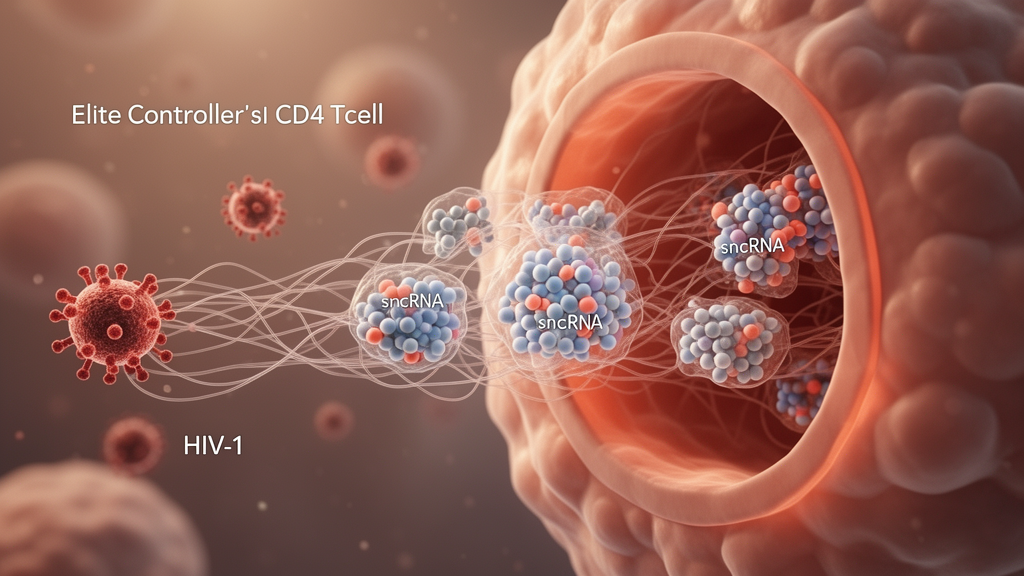
People with HIV who maintain very low viral loads without antiretroviral therapy have a distinctive small non-coding RNA profile in their CD4+ T cells, according to a comparative transcriptomic and cell-based study. In the cohort of 33 participants, elite controllers showed reduced expression of miR-99b-5p and miR-125a-5p compared with both treated and untreated non-controllers. Inhibiting these microRNAs in an immortalized human T-cell model reduced HIV-1 production by roughly 14–22%, depending on the inhibitor and inoculation dose, providing experimental support for a post-transcriptional component of natural viral restriction.
The study enrolled people with HIV at the HIV Unit of the Hospital Clínic de Barcelona and separated them into four clinical groups. Ten elite controllers maintained viral loads below 50 copies per milliliter for at least one year without antiretroviral therapy. Six viremic controllers maintained levels below 4,000 copies per milliliter for at least one year without treatment, while eight untreated non-controllers had loads above 5,000 copies per milliliter for more than one year.
A further nine non-controllers receiving antiretroviral therapy had loads below 50 copies per milliliter for more than one year. All participants had CD4+ T-cell counts above 450 cells/mm3, and elite and viremic controllers had been followed for more than five years at sampling. Median CD4+ T-cell counts were broadly similar across the groups, ranging from 594 cells/mm3 in treated non-controllers to 706 cells/mm3 in elite controllers, while median viral load differed substantially as defined by the study.
The cohort was composed mainly of men who acquired HIV through sexual intercourse, and six elite controllers and five viremic controllers later began antiretroviral therapy between one and nine years after sampling. Researchers found no difference in the frequency of the protective HLA-B57 and HLA-B27 alleles across the groups, and no participant had active hepatitis C virus coinfection at the time of sampling. These features limit the extent to which the molecular results can be separated from other biological and clinical differences within the small cohort.
Elite controllers had a broad, distinctive small-RNA landscape, including overexpression of specific lysine-associated tRNA isoacceptors and five PIWI-interacting RNAs. The tRNA-Lys-CTT-3-1 isoacceptor was strongly enriched in elite controllers relative to treated non-controllers, with a log2 fold change of 3.01, and relative to untreated non-controllers, with a log2 fold change of 4.32. Other lysine-, glycine-, threonine- and arginine-associated tRNAs showed trends toward overexpression, while several other isoacceptors were repressed.
The five PIWI-interacting RNAs elevated in elite controllers relative to treated non-controllers had nearly identical sequences and originated from six genomic loci associated with tRNA-Lys repeats. They were also expressed more highly than in untreated non-controllers, although by a smaller average amount. One PIWI-interacting RNA, piR-hsa-2138, was repressed in elite controllers relative to both viremic and untreated non-controllers.
Fewer changes were detected among small nuclear and small nucleolar RNAs: among elite controllers and untreated non-controllers, RN7SK and two annotated RNAs were overexpressed, two were repressed, and the H/ACA-box snoRNA SNORA6 was elevated. Because sequence reads with extensive similarity can be assigned to more than one small-RNA class, the piRNA signals linked to tRNA-Lys loci require particular caution. The clearest shared microRNA signal involved miR-99b-5p and miR-125a-5p, both of which were significantly downregulated in elite controllers relative to treated and untreated non-controllers.
MiR-125b-2-5p was also reduced relative to the treated non-controller group. No differentially expressed miRNAs were detected between the treated and untreated non-controller groups; this null comparison does not establish that antiretroviral treatment has no effect on the miRNA profile, but it shows that the principal group differences in this cohort were associated with controller status. No miRNAs were differentially expressed between viremic controllers and either elite controllers or treated non-controllers.
MiR-99b-5p, miR-221-5p and miR-501-3p were, however, lower in viremic controllers than in untreated non-controllers. The investigators noted that the small number of participants, particularly viremic controllers, could have limited group comparisons. Total-RNA sequencing showed that the microRNA signature coincided with broader changes in protein-coding gene expression.
Gene-set enrichment analyses identified common patterns in elite controllers compared with both non-controller groups, including p53 signaling, inflammatory responses, cell activation, apoptosis, cell death, responses to hypoxia and ultraviolet radiation, and oxidative-stress pathways such as NRF2 signaling. Metabolic terms involving carbohydrate metabolism and cholesterol homeostasis were also enriched. Differential-expression analysis found 106 genes differing between elite and treated non-controllers and 104 between elite and untreated non-controllers, with 26 genes deregulated in both comparisons.
Enriched transcription-factor sets included SP1, JUN-family members, SP3, CREB1 and CEBPB. These observations identify associations between cellular transcriptional states and elite control rather than proving that any one enriched pathway causes viral suppression. In the elite-controller versus treated-non-controller network, 41 differentially expressed genes were linked to miR-99b-5p and miR-125a-5p.
They included FLNA, DPM2, CDKN1A, BBC3, DUSP1 and SOD2, and pathway analysis linked the targets to p53 signaling, sterol-related processes, matrix metalloproteinase activation and metabolism of oxidative enzymes. In the comparison with untreated non-controllers, seven differentially expressed miRNAs collectively accounted for 86 linked differentially expressed genes, including miR-99b-5p and miR-125a-5p. Associated pathways included hypoxia signaling, p53-mediated apoptosis, Fc-gamma-receptor-dependent phagocytosis, OAS antiviral response and BH3-only proteins that inactivate anti-apoptotic BCL-2 family members.
Functional experiments used CEM-NKR-CCR5 cells, an immortalized human T-cell line susceptible to HIV-1. Synthetic inhibitors reduced expression of miR-99b-5p and miR-125a-5p by more than 90% when used separately or together. DPM2 and MAFB showed statistically significant increases in expression after inhibition, while other candidate targets generally changed by about 1.1- to 1.2-fold.
The cells were then exposed to two doses of the replication-competent NL4.3-Ren HIV-1 clone, and viral production was measured through luciferase activity 48 hours later and normalized to cell viability. At the lower dose, miR-99b-5p inhibition reduced replication by 18.2% with a 95% confidence interval of 3.6–30.5%, while miR-125a-5p inhibition produced an 18.4% reduction with a 6.4–28.9% interval. Combined inhibition yielded a 22.0% reduction, with an 11.7–31.1% interval.
At the higher inoculation dose, miR-99b-5p inhibition reduced replication by 17.0% with a 95% confidence interval of 5.5–27.0%. The reduction attributed to miR-125a-5p inhibition was 14.1%, with a 5.5–30.1% interval, but was not statistically significant at that dose. Combining both inhibitors produced a 20.7% reduction, with a 15.5–26.9% interval.
The abstract summarized the single and combined inhibitor effects across the experiments as 17.6%, 16.3% and 21.4%, respectively. These cell experiments support a modest antiviral effect of inhibiting the two microRNAs under the tested conditions, but they do not establish clinical efficacy in people or show that either microRNA alone produces the elite-controller phenotype. Several limitations constrain generalization from the findings.
Besides the small, predominantly male, single-center cohort, the analysis identified one untreated participant as a multivariate outlier and excluded that participant from all small-RNA analyses; another participant was excluded from the piRNA and tRNA analyses. The immortalized CEM-NKR-CCR5 model may not reproduce apoptosis, cell-cycle and other regulatory relationships observed in primary CD4+ T cells, and attempts to measure several relevant targets were unsuccessful. Primary CD4+ T cells or in vivo models would be needed to test the biological relevance of the proposed regulatory network more faithfully.
Within those limits, the study identifies a measurable post-transcriptional layer associated with natural HIV control and highlights miR-99b-5p and miR-125a-5p as candidates for further mechanistic investigation rather than established therapeutic targets.
Subject of Research: Small non-coding RNA signatures associated with natural control of HIV-1 in elite controllers
Article Title: sncRNA signatures underlying HIV-1 restriction in elite controllers
Article References: Ayala-Suárez, R., De la Torre Tarazona, E., Bermejo, M., Bargalló, M. E., Maleno, M. J., Coiras, M., Leal, L., García, F., Plana, M., García-Pérez, J., Alcamí, J., & Díez-Fuertes, F. (2026). sncRNA signatures underlying HIV-1 restriction in elite controllers. Frontiers in Cellular and Infection Microbiology, 16, Article 1926123. https://doi.org/10.3389/fcimb.2026.1926123
Image Credits: AI Generated
DOI: 10.3389/fcimb.2026.1926123
Keywords: HIV-1, elite controllers, small non-coding RNAs, microRNAs, CD4+ T cells, viral restriction, miR-99b-5p, miR-125a-5p, gene regulation, antiretroviral therapy, transcriptomics, sncRNA
Cite Scienmag News
Kristina Jarvis. (October 20, 2026). sncRNA signatures underlying HIV-1 restriction in elite controllers. Scienmag. https://scienmag.com/sncrna-signatures-underlying-hiv-1-restriction-in-elite-controllers/
Kristina Jarvis. "sncRNA signatures underlying HIV-1 restriction in elite controllers." Scienmag, 20 October 2026, https://scienmag.com/sncrna-signatures-underlying-hiv-1-restriction-in-elite-controllers/. Accessed 20 October 2026.
Kristina Jarvis. "sncRNA signatures underlying HIV-1 restriction in elite controllers." Scienmag. October 20, 2026. https://scienmag.com/sncrna-signatures-underlying-hiv-1-restriction-in-elite-controllers/


