


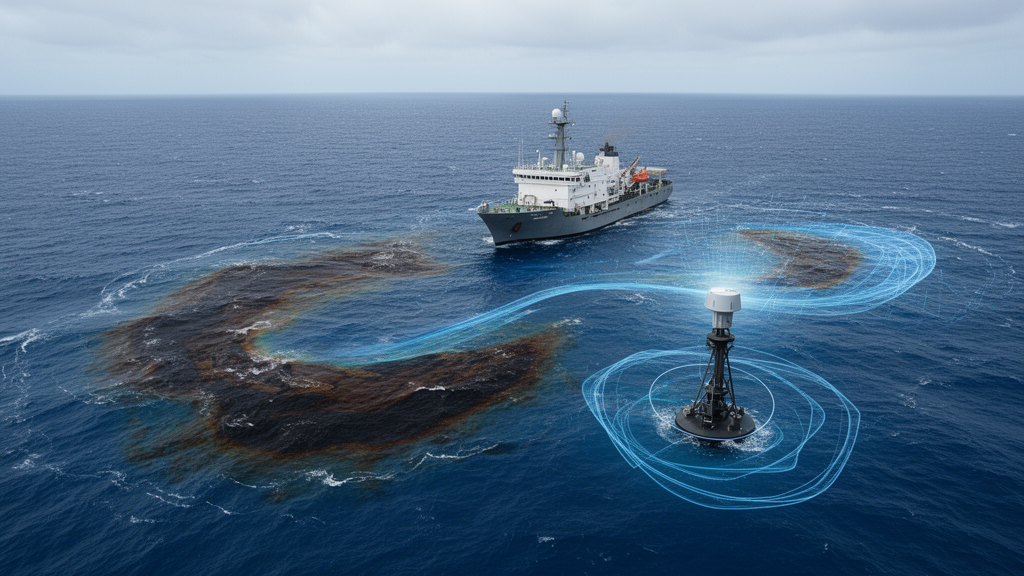
A physics-informed deep-learning framework developed for marine oil-spill forecasting combined a gated recurrent unit with a graph neural network to estimate how spill area changes over time and where it may spread. In the reported study, trained on 403 trajectories derived from 43 historical events, physics-generated simulations and quality-controlled synthetic cases, the framework produced stable forecasts through 48 hours. On a held-out set of 61 trajectories, the integrated model had reconstructed-horizon root mean squared errors of 0.0529, 0.5393, 0.5007 and 1.5473 at 6, 12, 24 and 48 hours, respectively. Its forecasts captured overall spill magnitude at several horizons but compressed case-to-case variability, while the spatial output represented a physics-informed risk distribution rather than a strictly mass-conserving estimate of oil.
The temporal component was a two-layer gated recurrent unit, or GRU, designed to learn dependencies in sequences of environmental and spill measurements. Each input contained 12 two-hour time steps and eight features, including previous spill area and quantity, wind speed, current speed, sea-surface temperature, salinity, significant wave height and bathymetric depth. The network produced four outputs representing one-, three-, six- and 12-step forecasts, equivalent to 2, 6, 12 and 24 hours. Spill area and quantity were transformed with a logarithmic operation, and the model predicted non-negative growth increments rather than absolute future values. Cumulative growth was reconstructed in log space so that forecasts remained non-decreasing, while Softplus output activation, normalization, dropout, gradient clipping and bounded environmental variables were used to stabilize training.
The final temporal architecture had a hidden dimension of 64, used Adam optimization with an initial learning rate of 0.001, weight decay of 0.00001 and batches of 64, and trained for up to 15 epochs without early stopping. The model with the lowest validation loss was retained. Its composite objective combined weighted mean squared error with a monotonic-growth penalty and correlation terms linking predicted growth to wind speed, current speed and spill quantity. The respective weights for these added terms were 0.10, 0.05, 0.05 and 0.10. Because the physics terms were formulated as negative Pearson correlations, the complete training objective could be negative; the training objective declined from 0.3048 in the first epoch to −0.0503 by epoch 15, while validation declined from 0.2330 to 0.0608. The authors found no clear conventional overfitting signal during those 15 epochs, although the validation criterion did not include the same correlation-based terms.
Environmental inputs came from ERA5 reanalysis and the Copernicus Marine Environment Monitoring Service, providing atmospheric, wave and oceanic variables such as wind, currents, temperature, salinity, density and sea state. Raster information was converted into geospatial points, linked to latitude and longitude and organized into 48-hour series sampled every two hours. The final temporal representation contained 403 sequences of 24 observations, or 9,672 records. To limit leakage, whole trajectories were assigned to 282 training, 60 validation and 61 test sets, preventing windows from the same event from appearing in different partitions. The 43 observed events were themselves separated at the event level into 30 training, seven validation and six test cases before augmentation; validation and test events were not used as sources for synthetic training trajectories.
Because 43 independently observed spill cases were insufficient for the proposed deep model, the researchers expanded the training data through two procedures. Physics-generated trajectories combined advection, Fay-style spreading and weathering concepts, with heuristic forcing weights of 50% for wind, 30% for currents and 20% for waves. The authors explicitly described these weights as synthetic-data assumptions rather than universal physical coefficients. A physics-informed generative adversarial network also produced candidate trajectories from an eight-dimensional latent space. Automated filtering and expert validation retained 102, while 258 physics-generated trajectories completed a final dataset of 403: 43 historical cases, 258 physics simulations and 102 retained GAN trajectories. The GAN data were narrower than the historical distribution, which had a mean spill area of 251.1, a median of 94.9 and a maximum of 5,226, compared with a mean of 23.7 and maximum of 624 in the GAN data. That compression and the reliance on generated trajectories limit how completely the test results represent real-world spill diversity.
Spatial behavior was represented with a hierarchical marine grid containing 16,384 nodes, each associated with geographic, bathymetric and environmental information. The final GRU growth estimate was injected into the grid at the node nearest the spill source, then propagated through neighboring cells with distance-weighted, eight-neighbor connectivity. Wind and current directions were represented by unit vectors, and their alignment with each edge was calculated through dot products. Transport coefficients were adjusted for regional and bathymetric conditions, while damping and clipping limited numerical instability. A separate three-layer GraphSAGE network, with hidden dimensions of 64 and 32, learned node-level spatial patterns from environmental and GRU-derived features. Its target was a normalized spill distribution generated by the physics-based transport simulation, not an independently observed satellite map. The resulting spatial fields therefore test reproduction of prescribed transport behavior, while GraphSAGE evaluation produced a node-level mean absolute error of 0.000188 and root mean squared error of 0.009048.
The numerical work supporting the neural model compared classical Runge–Kutta fourth-order integration, Adams–Bashforth–Moulton integration, fractional Adams–Bashforth–Moulton integration and polynomial approximations under three spill-growth equations. Fractional integration introduced memory from previous states and improved the environmental-forcing equation, reducing root mean squared error from 266.709 for Runge–Kutta to 113.301. For the more complex area-feedback equation, however, classical Adams–Bashforth–Moulton performed better, with an RMSE of 14.9154 and mean absolute error of 12.4255, compared with 59.7223 and 47.4307 for the fractional method. The study therefore did not embed the fractional solver in the final GRU–GNN predictor. Instead, the fractional analysis served as a diagnostic baseline showing that memory can matter, while equation-based approaches remained unable to reproduce the full nonlinear spatiotemporal behavior of spills.
Prediction accuracy declined as the temporal component looked farther ahead. Its log-space RMSE was 0.1425 at 2 hours, 0.2537 at 6 hours, 0.3806 at 12 hours and 0.5934 at 24 hours, with corresponding median absolute errors of 0.1203, 0.2030, 0.2729 and 0.1876. On the held-out integrated evaluation, predictions and observations had similar means and dispersions at 6 hours, but the correlation was −0.1647, yielding negative Nash–Sutcliffe efficiency and Kling–Gupta efficiency despite a percentage bias of only +2.06%. At 12 hours, predictions underestimated the observed mean and variability most strongly, with percentage bias of −35.76%, NSE of −0.5611 and KGE of −0.2373. At 24 and 48 hours, mean bias was smaller at −5.41% and −9.56%, but correlations remained only −0.0177 and 0.0578, and NSE and KGE stayed negative. These results show that agreement in average magnitude did not translate into reliable ranking or reproduction of individual events.
All tested forecasts satisfied the imposed monotonicity constraint, but the paper cautions that this is compliance with a modeling prior rather than independent discovery of a physical law. A visible oil footprint can shrink or fluctuate through dispersion, evaporation, emulsification, stranding, redistribution or response activity, whereas the model applies cumulative growth that cannot decrease. The spatial results had another important limitation: successive GRU-derived increments were added to the grid without strict mass conservation, and the reported total spread increased dramatically with time. The framework should consequently be interpreted as a short-to-medium-term, physics-aware forecasting and risk-mapping method, not as an operational system proven to estimate the exact mass or surface extent of a spill in real time. The study also lacked a comprehensive ablation of the GAN, monotonicity constraint, physics losses and graph components, and it did not provide systematic benchmarks against a broad set of persistence, autoregressive, ensemble-learning, long short-term memory and spatial models.
Interpretability and sensitivity analyses nevertheless indicated that the model had learned relationships with relevant inputs. On the held-out set, correlations between predictions and spill quantity, wind speed and current speed were 0.730, 0.405 and 0.413. Permutation analysis ranked spill quantity first, followed by bathymetry and sea-surface temperature, while GradientSHAP assigned the largest local attribution at 24 hours to wave height, followed by regional effects and wind direction. These methods quantify different aspects of influence and are not interchangeable. Scenario tests further indicated the largest response to larger initial spills, followed by changes in currents and wind, and the independently evaluated GRU component retained associations with wind, current and quantity despite those variables being included in physics-guided losses. Taken together, the study shows a promising way to combine sequence learning, graph-based propagation and physical bounds, but its limited observed dataset, synthetic augmentation, variability compression and simulation-derived spatial targets mean that broader independent and cross-region validation are still required before the framework can be considered an established forecasting tool.
Subject of Research: Physics-informed deep learning for multi-horizon marine oil-spill growth and spatial spread forecasting
Article Title: Intelligent framework for oil spill prediction using RNN and fractional derivation
Article References: Ramasubramanian, P., Krishnan, A., Puthiyaveedu, P. E., Pulikkathodi, M. N., Venkatasubbu, P., Ganesan, K., & Venkatesan, L. (2026). Intelligent framework for oil spill prediction using RNN and fractional derivation. Frontiers in Water, 8, Article 1963375. https://doi.org/10.3389/frwa.2026.1963375
Image Credits: AI Generated
DOI: 10.3389/frwa.2026.1963375
Keywords: oil-spill forecasting, gated recurrent units, graph neural networks, spatiotemporal modeling, physics-informed machine learning, marine pollution, synthetic data augmentation, fractional numerical modeling, environmental monitoring, Intelligent, framework, spill
Cite Scienmag News
Blake Davidson. (October 20, 2026). Physics-informed deep learning forecasts marine oil spill growth and spread. Scienmag. https://scienmag.com/physics-informed-deep-learning-forecasts-marine-oil-spill-growth-and-spread/
Blake Davidson. "Physics-informed deep learning forecasts marine oil spill growth and spread." Scienmag, 20 October 2026, https://scienmag.com/physics-informed-deep-learning-forecasts-marine-oil-spill-growth-and-spread/. Accessed 20 October 2026.
Blake Davidson. "Physics-informed deep learning forecasts marine oil spill growth and spread." Scienmag. October 20, 2026. https://scienmag.com/physics-informed-deep-learning-forecasts-marine-oil-spill-growth-and-spread/


