


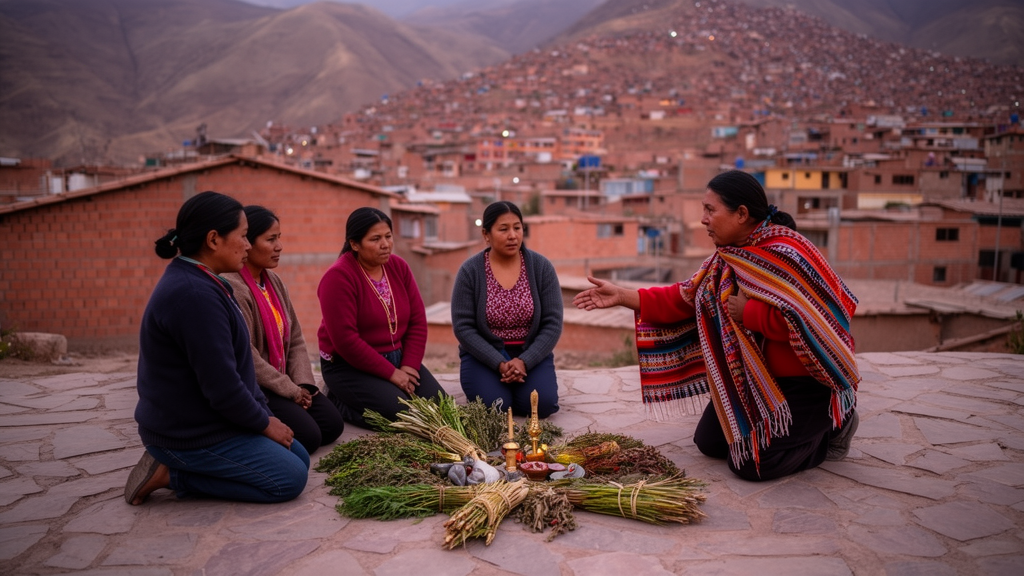
An ethnographic study of Ayacucho, Peru, found that Qayapu, an Andean ritual for “calling back the soul,” remains an active response to childhood fright and the condition locally known as mancharisqa. Nine specialists and 20 adult patients were interviewed, while researchers observed rituals in the atrium of the Church of San Francisco de Asís and at Huamanga’s Central Market. The findings show how the practice has moved from predominantly rural settings into public urban spaces, combining inherited Andean ideas about body–soul relationships with Catholic prayers, natural materials and locally defined signs of illness. Participants reported changes after the ritual, including calmer behavior, improved sleep and a return of appetite, but the research did not test physiological or clinical efficacy.
The study used a qualitative, interpretive design grounded in medical anthropology and hermeneutics. Fieldwork took place from January through May 2026 and involved participant observation, direct observation, life histories, field diaries and semistructured or in-depth interviews. Researchers spoke Ayacucho Quechua and Spanish, recorded some interviews and ritual encounters with informed consent, and translated the material with an emphasis on cultural and semantic fidelity rather than literal equivalence. Data were coded manually and inductively around susto, mancharisqa, the body–soul relationship, symbolic efficacy, syncretism and therapeutic practices. The researchers stopped collection at thematic saturation, although the purposive and snowball sample was small and geographically restricted to urban Huamanga, limiting statistical generalization to other Andean communities.
Within the Andean framework examined here, susto and mancharisqa describe more than a transient emotional response. A frightening event—such as a fall, a barking dog, an accident or an encounter at night—is understood as disrupting the relationship between body and soul. Specialists do not describe the soul as permanently lost; instead, fright can leave the child’s “little soul” sick, mobile or separated from the body until a ritual restores balance. Families and practitioners associate the condition with fever, headache, pallor, vomiting, diarrhea, persistent crying, insomnia, loss of appetite, sunken eyes and altered facial appearance. These are emic signs within a culturally specific explanatory system, not evidence that mancharisqa is a single psychiatric or biomedical disorder. The study also notes that some of the reported physical manifestations could warrant pediatric evaluation, while the local category itself should not be assumed to correspond to a standardized clinical condition.
Qayapu centers on the head because specialists conceive it as the body’s center of control and the place from which the soul’s relation to bodily functioning is restored. During a session, a practitioner may hold or gently rub the patient’s head while reciting prayers, including the Our Father and Hail Mary, and calling the child’s soul to return. One recurrent invocation asks where the “baby’s soul” has gone and commands it to come back because the body is waiting. Procedures vary among specialists and with the circumstances of each case. Some practitioners work two or three times, use carnations, coca, egg or alum, and may carry an egg to flowing water and collect it against the current. Others perform the rite at specific times, with preferences reported for Tuesday or Friday at noon, dawn or moments of silence. The sequence is therefore both performative and technical within the local system: prayer, bodily contact, selected objects, timing and place are joined into a coherent attempt to recover the body–soul relationship.
The ritual’s urban setting is a central part of its transformation. Rural practice is described as more private and often associated with nighttime, whereas in Ayacucho, specialists work openly in the historic center: four men receive patients in the church atrium, while five women, including itinerant vendors, practice around the Central Market. The city therefore provides public visibility for a knowledge system traditionally transmitted through families and rural communities. Migration enabled the movement of Qayapu, but the researchers argue that relocation did not simply reproduce an unchanged rural custom. Urban specialists adapted timing, location, referral patterns and access to an environment dominated by roads, pedestrians, municipal workers, security personnel and biomedical services. A specialist who moved to the city after violence associated with the Shining Path described learning the practice from his parents and worrying that it would disappear because none of his children wanted to inherit it.
Participants described the ritual as socially legitimate, although their accounts concern perceived and observed changes rather than controlled therapeutic effects. Mothers said some children became calmer and slept during the journey home. Researchers also observed participants entering deep relaxation or drowsiness during treatment, while specialists and relatives associated subsequent improvement in appetite, sleep, facial expression and behavior with the rite. These reports form part of what the study calls symbolic efficacy: benefits are recognized through changes that fit the ritual’s understanding of a child’s condition. A practitioner described observing that a child’s appetite returned, fever subsided and the child wanted to eat after waking. Mothers likewise monitored daily changes and consulted neighbors, relatives and acquaintances when deciding how to respond. Such testimony explains the ritual’s persistence and the trust placed in particular specialists, but it cannot establish that the ritual caused the reported improvement or that Qayapu treats the underlying causes of the symptoms.
Specialists do not describe themselves simply as generic healers or shamans. They present their knowledge as a family-lineage gift that must be learned, guarded and performed correctly, and their legitimacy depends heavily on recognition within trusted social networks. Some learned by watching relatives; others developed expertise through repeated requests and practical instruction. Specialist knowledge circulates through oral transmission rather than institutional certification, and practitioners may decline to work with unknown people. Economic exchange follows an ethic of voluntariness: no fixed fee is established, although nominal contributions of five to 10 soles were observed. Practitioners insist that ritual efficacy does not depend on negotiation, while rural forms of reciprocity may involve food rather than money. Women’s participation is also significant, combining Qayapu with market vending and other activities and preserving forms of knowledge that participants associate with women, nature and community relationships.
The coexistence of Qayapu and biomedicine is neither simple opposition nor evidence that one system has displaced the other. Many families sought ritual care because children rejected pills or syrups, and they expressed distrust of hospitals, biomedical explanations and professional attention. At the same time, some practitioners said that doctors themselves had directed patients to them, and the study documents itineraries in which household care, herbal or pharmaceutical treatment and ritual care were used sequentially or simultaneously. Evangelical participants offered a different religious interpretation, rejecting Qayapu and attributing protection from susto to Christian faith. Catholic and Andean elements coexist within Qayapu itself, while evangelical beliefs compete for ritual legitimacy. The study therefore treats the conflict as a structural tension among different knowledge systems rather than as a binary choice between traditional medicine and science.
Several limitations constrain the findings. The sample was intentionally selected and relatively small, with interviews centered on nine practitioners and 20 adult patients in one urban setting; children were present in many observed cases but were not the main interview sample. Participant observation may have altered interactions, and translating culturally specific Quechua expressions into Spanish could lose symbolic nuance. The researchers mitigated these concerns through prolonged engagement, a reflexive diary, triangulation among interviews, observations and field notes, and collective discussion of categories. The results do not demonstrate that Qayapu is clinically effective, nor do they establish that susto is equivalent to a psychiatric diagnosis. What they document is its continuing symbolic and social force: a culturally specific way of interpreting fright, bodily distress and recovery that remains active in Ayacucho, adapts to public urban life, and coexists unevenly with biomedical and religious alternatives. The authors call for further research into ritual efficacy and for intercultural approaches that recognize ancestral knowledge without treating symbolic accounts as substitutes for medical evaluation.
Subject of Research: Ethnographic research on Qayapu, an Andean soul-calling ritual used in urban Ayacucho to address childhood fright and mancharisqa.
Article Title: Qayapu in the reconfiguration of Andean healing and the ritual recovery of the child's soul
Article References: Gutiérrez-Gómez, E., Saboya-Pineda, A. R., Alania-Contreras, R. D., Ortega-Révolo, D. I. D., Bazán-Ramírez, W., & Bazán-Ramírez, A. (2026). Qayapu in the reconfiguration of Andean healing and the ritual recovery of the child's soul. Frontiers in Sociology, 11, Article 1870310. https://doi.org/10.3389/fsoc.2026.1870310
Image Credits: AI Generated
DOI: 10.3389/fsoc.2026.1870310
Keywords: Qayapu, Andean healing, mancharisqa, susto, childhood fright, medical anthropology, Ayacucho, Quechua knowledge, ritual medicine, cultural adaptation, biomedicine, reconfiguration
Cite Scienmag News
Steven Barker. (October 20, 2026). Qayapu persists in urban Ayacucho as a culturally adapted healing ritual. Scienmag. https://scienmag.com/qayapu-persists-in-urban-ayacucho-as-a-culturally-adapted-healing-ritual/
Steven Barker. "Qayapu persists in urban Ayacucho as a culturally adapted healing ritual." Scienmag, 20 October 2026, https://scienmag.com/qayapu-persists-in-urban-ayacucho-as-a-culturally-adapted-healing-ritual/. Accessed 20 October 2026.
Steven Barker. "Qayapu persists in urban Ayacucho as a culturally adapted healing ritual." Scienmag. October 20, 2026. https://scienmag.com/qayapu-persists-in-urban-ayacucho-as-a-culturally-adapted-healing-ritual/


