


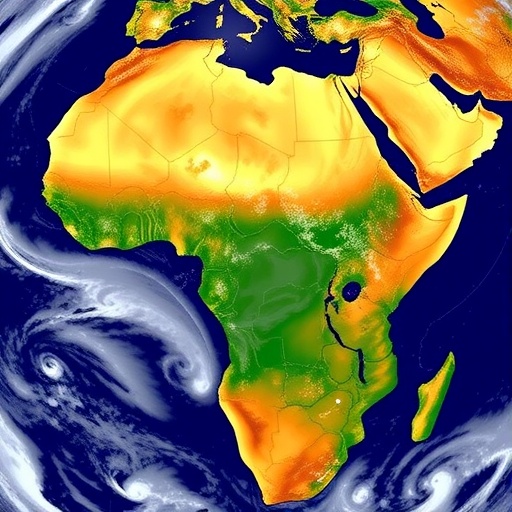
In a groundbreaking new study poised to reshape our understanding of paleoclimate and meteorological history, researchers have revealed that the greening of the Sahara during the mid-Holocene epoch played a pivotal role in diminishing the frequency and intensity of Atlantic tropical cyclones. Published in Communications Earth & Environment, this research presents compelling evidence that the vast Sahara Desert, once a lush and verdant landscape, exerted a profound influence on atmospheric conditions over the North Atlantic, thereby altering tropical cyclone dynamics in ways previously unrecognized.
Around 6,000 to 8,000 years ago, Earth experienced a climatic phase commonly known as the mid-Holocene warm period, marked by extensive vegetation cover across the modern Sahara. Contrary to today’s arid expanse, the Sahara was interspersed with lakes, grasslands, and a rich variety of flora. This greening phenomenon is understood to have occurred due to increased monsoonal precipitation driven by orbital changes affecting solar insolation patterns. The new study explores how this dramatic shift in surface characteristics likely modulated the atmospheric circulation and moisture transport processes critical for tropical cyclone genesis and sustenance.
The research team, led by Ou, Zhang, and Liu, utilized a suite of state-of-the-art climate models combined with paleoproxy data to reconstruct the atmospheric conditions during this verdant phase. By simulating both vegetated and desert Sahara scenarios, they illuminated how surface albedo changes and altered evapotranspiration rates could have disrupted the air-sea interactions essential for maintaining Atlantic hurricane activity. Their models reveal a marked suppression of tropical cyclone activity correlating with peak Sahara greening, suggesting that verdant landscapes cooled surface temperatures relative to the present-day desert.
One of the key findings highlighted in the study is the role of land surface feedback mechanisms in modulating tropical cyclone formation. The expansion of vegetation drastically reduced surface reflectivity (albedo), allowing deeper penetration of solar energy into the soil and promoting increased soil moisture retention. These factors collectively enhanced local atmospheric stability by increasing convective inhibition and altering the temperature gradient between the ocean and land. This subtle yet significant shift curtailed the development of the warm-core structures fundamental to cyclone intensification.
Furthermore, the greening phase intensified the West African monsoon system, leading to enhanced moisture advection inland. This moisture reallocation meant less latent heat flux was available over the adjacent tropical Atlantic, which is a crucial energy source for cyclogenesis. The diminished oceanic heat content directly contributed to fewer favorable environments for tropical cyclones to develop, corroborating sedimentary and geological evidence indicating reduced hurricane landfalls during this epoch.
The study also delves into how these ancient climate dynamics might inform our understanding of future tropical cyclone behavior in the face of global climate change. While modern atmospheric warming trends suggest an increase in hurricane intensity, the mid-Holocene scenario underscores the sensitivity of hurricane activity to land surface conditions and regional atmospheric circulation. It suggests that terrestrial ecosystem dynamics and surface moisture availability must be considered alongside ocean temperatures when projecting future storm patterns.
Additionally, Ou and colleagues emphasize the importance of integrating paleoclimate insights with contemporary meteorological models to enhance predictive accuracy. Their research demonstrates how previous centuries’ natural climate variability, reflected in the Sahara’s transformation, can clarify the intricate interplay between land, ocean, and atmosphere, which governs extreme weather events. This historical perspective is invaluable, as it offers a natural experiment of how vegetation feedbacks influence tropical cyclone climatology.
The implications of the Sahara’s greening extend beyond tropical cyclone frequency. The altered atmospheric circulation likely impacted other meteorological phenomena, including rainfall regimes across North Africa and adjacent areas. The mid-Holocene may have witnessed a fundamentally different intertropical convergence zone (ITCZ) pattern, shifting precipitation belts and influencing ecosystems across multiple continents. This interconnectedness reveals the broad-reaching consequences of land cover changes on Earth’s climate system.
Geological records, such as lacustrine sediments, pollen data, and isotope compositions, provide consistent support for the study’s modeling outputs, reinforcing the notion that the Sahara’s climate transformation was both profound and long-lasting. These proxies indicate a significant reduction in tropical cyclone-related sediment deposition along the Atlantic coastlines concurrent with the greening phase, providing tangible evidence of diminished hurricane activity inferred from simulation studies.
From a methodological perspective, the combination of paleoenvironmental reconstructions with advanced regional climate models marks a critical step forward in paleotempestology—the study of ancient tropical cyclone activity. The interdisciplinary nature of this approach enables more nuanced interpretations of how ancient ecosystems and atmospheric conditions interacted, pushing the boundaries of how we understand climate-hurricane linkages over millennia.
This study invites a critical reevaluation of prevailing assumptions regarding desertification and its climatic effects. While modern desert expansion has been generally associated with land surface warming and regional climate stress, the mid-Holocene greening presents an inverse scenario where restored vegetation exerted a cooling influence, modulating major atmospheric processes such as hurricane genesis. This dual perspective deepens our understanding of land-atmosphere feedback mechanisms and their potential to amplify or dampen climate extremes.
Moreover, the findings have relevance for contemporary climate mitigation strategies. Restoring vegetation across degraded land surfaces, akin to the ancient Sahara greening, might hold promise not only for carbon sequestration but also for regional climate regulation, including the potential moderation of cyclone intensity. Although the present-day climatic and anthropogenic context differs considerably from the mid-Holocene, the principles uncovered here can inform holistic approaches to climate resilience and ecosystem management.
The research also underscores the necessity for high-resolution spatial and temporal climate proxies to refine our understanding of past hurricane variability. Future efforts integrating new sediment cores, fossilized storm deposits, and remote sensing data could complement and validate modeling results, helping to reconstruct a more detailed chronology of tropical cyclone behavior through Earth’s climatic history.
Finally, Ou, Zhang, Liu, and their collaborators have opened a vibrant avenue of research by linking paleovegetation dynamics with tropical cyclone climatology, illuminating one of the most dynamic interactions within Earth’s complex climate system. Their work demonstrates how past environmental conditions can cast long shadows into future climatic events, revealing the evolutionary nature of extreme weather phenomena shaped by the interdependent forces of land, ocean, and atmosphere.
As climate science progresses into a future dominated by anthropogenic influences, the lessons from the mid-Holocene Sahara hold crucial keys to unraveling how terrestrial ecosystems influence atmospheric behavior on a planetary scale, including the frequency and severity of the world’s most devastating storms.
Cite Scienmag News
Violet Maxwell. (April 16, 2026). Sahara Greening Reduced Mid-Holocene Atlantic Cyclones. Scienmag. https://scienmag.com/sahara-greening-reduced-mid-holocene-atlantic-cyclones/
Violet Maxwell. "Sahara Greening Reduced Mid-Holocene Atlantic Cyclones." Scienmag, 16 April 2026, https://scienmag.com/sahara-greening-reduced-mid-holocene-atlantic-cyclones/. Accessed 4 September 2026.
Violet Maxwell. "Sahara Greening Reduced Mid-Holocene Atlantic Cyclones." Scienmag. April 16, 2026. https://scienmag.com/sahara-greening-reduced-mid-holocene-atlantic-cyclones/


