


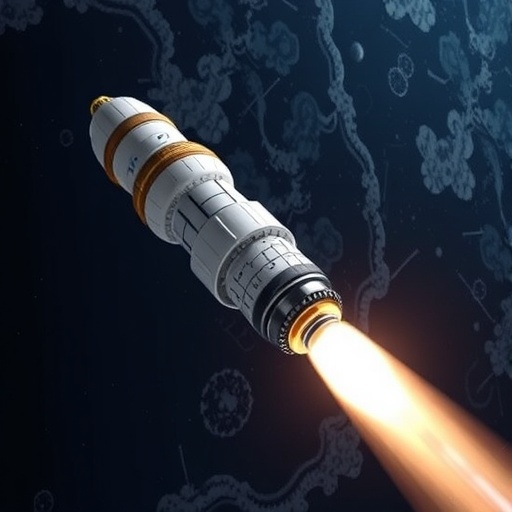
A new study is challenging one of the most persistent assumptions in space manufacturing: that building advanced composite structures beyond Earth is simply a matter of moving terrestrial production methods into orbit. Research published in npj Advanced Manufacturing examines how two defining features of the space environment—reduced gravity and reduced atmospheric pressure—can alter the manufacture of carbon-fiber-reinforced structures, materials widely regarded as essential for future spacecraft, habitats and large orbital infrastructure.
Carbon-fiber-reinforced polymers, commonly known as CFRPs, combine strong, lightweight carbon fibers with a polymer resin that binds the fibers into a rigid composite. Their exceptional strength-to-weight ratio makes them attractive for launch vehicles and spacecraft, where every kilogram matters. Yet manufacturing these materials is a delicate process. Fibers must be positioned accurately, resin must penetrate the reinforcement evenly, and gases or trapped voids must be removed before the material cures. On Earth, gravity and atmospheric pressure quietly assist—or complicate—each of these steps.
In space, those familiar forces change dramatically. Reduced gravity can alter how liquid resin flows through a carbon-fiber structure, while low pressure can encourage dissolved gases and volatile compounds to expand or escape. Together, these effects may influence impregnation, consolidation, curing and the final mechanical performance of a composite part. The new work by R. Strecker, T. Rieger, A. Tabelander and colleagues focuses on understanding these interactions before manufacturers attempt to produce increasingly complex structures in orbit.
The central issue is void formation. A composite that appears solid can contain microscopic pockets of air or vapor between its fibers. These voids interrupt the transfer of stress through the material and can reduce strength, stiffness and fatigue resistance. During conventional manufacturing on Earth, pressure is often applied to compress the layers and drive out unwanted gases while resin fills the spaces between fibers. In a reduced-gravity environment, however, buoyancy-driven movement is weakened, and the pathways through which bubbles travel may change. A bubble that would rise and escape during terrestrial processing could remain trapped inside the structure.
Pressure reduction introduces another layer of complexity. Lower ambient pressure can help remove volatile substances and trapped gases, but it can also cause dissolved gases in the resin to expand. If the resin is not sufficiently mobile, expanding bubbles may become locked in place as the material cures. The balance between degassing and bubble growth therefore becomes a critical manufacturing parameter. The study’s importance lies in treating pressure and gravity not as isolated variables, but as environmental conditions that can interact throughout the production cycle.
Resin flow is equally important. Carbon-fiber reinforcements are made from tightly packed filaments, creating narrow channels through which resin must travel. On Earth, gravity can influence resin distribution, especially in vertically oriented or large components. In reduced gravity, capillary forces and surface tension become relatively more significant. These forces can help draw resin into small spaces, but they may also create uneven wetting patterns depending on the fiber architecture, resin viscosity and processing orientation. Such changes could affect whether a component cures uniformly from its surface to its interior.
The findings carry implications far beyond laboratory samples. Future space manufacturers may seek to fabricate beams, pressure-vessel elements, antenna supports, solar-array components and repair patches directly in orbit. Producing these parts where they are needed could reduce the need to launch bulky finished structures from Earth. It could also enable designs too large to fit inside a rocket fairing, including trusses and habitation modules assembled gradually in space. But the economic and engineering promise of this approach depends on reliable quality control. A component that looks flawless may still fail if its internal fiber alignment, resin distribution or void content is inconsistent.
The research also highlights why manufacturing hardware designed for Earth cannot automatically be considered space-ready. Pumps, heaters, vacuum systems, molds and curing chambers must all operate under conditions in which heat transfer, fluid movement and gas removal behave differently. Temperature control is particularly important because resin viscosity changes strongly with temperature. A resin that flows readily during terrestrial processing might move more slowly or unevenly in orbit, while excessive heating could accelerate curing before impregnation is complete. Space-based production systems will therefore need carefully coordinated control of pressure, temperature, resin chemistry and processing time.
For engineers, the study provides a foundation for developing manufacturing protocols tailored to reduced-gravity environments. Instead of copying Earth-based workflows, future systems may need staged pressure changes, specialized fiber preforms, modified resin formulations or active bubble-management techniques. Sensors could monitor pressure, temperature and resin flow in real time, allowing automated systems to detect defects before a part is finished. Non-destructive inspection, including imaging and ultrasonic testing, will also be essential for verifying the integrity of components that cannot easily be returned to Earth for analysis.
The broader message is that space manufacturing is not merely an extension of industrial production—it is a new manufacturing regime governed by different physics. Understanding how gravity and pressure reshape the behavior of fluids, gases and composite materials could determine whether orbital fabrication remains a promising experiment or becomes a practical industrial capability. By examining the production of carbon-fiber-reinforced structures under space-relevant conditions, Strecker, Rieger, Tabelander and their colleagues are helping identify the hidden variables that will decide how safely and efficiently humanity can build beyond Earth.
Cite Scienmag News
Denise Maddox. (August 9, 2026). How Low Gravity and Pressure Affect Space Manufacturing of Carbon-Fiber Structures. Scienmag. https://scienmag.com/how-low-gravity-and-pressure-affect-space-manufacturing-of-carbon-fiber-structures/
Denise Maddox. "How Low Gravity and Pressure Affect Space Manufacturing of Carbon-Fiber Structures." Scienmag, 9 August 2026, https://scienmag.com/how-low-gravity-and-pressure-affect-space-manufacturing-of-carbon-fiber-structures/. Accessed 3 September 2026.
Denise Maddox. "How Low Gravity and Pressure Affect Space Manufacturing of Carbon-Fiber Structures." Scienmag. August 9, 2026. https://scienmag.com/how-low-gravity-and-pressure-affect-space-manufacturing-of-carbon-fiber-structures/


