


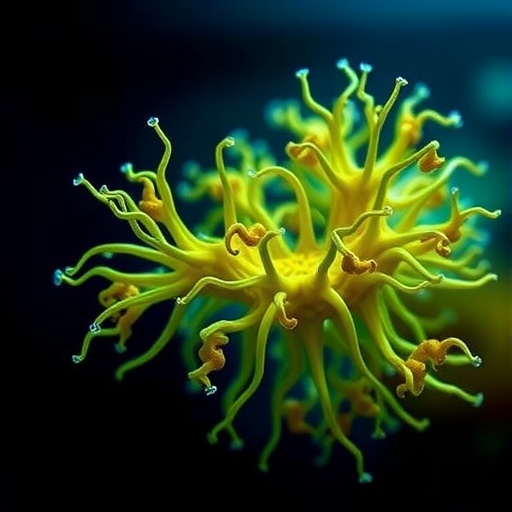
The ocean has just yielded another clue to one of its most important—and least visible—chemical conversations. In a study published in Nature Communications, R. Simó, JF. Mangot, V. Vergé and colleagues report the identification of a membrane transporter that enables marine eukaryotic phytoplankton to take up dimethylsulfoniopropionate, or DMSP. The discovery shines a spotlight on a molecular gateway that may influence the movement of sulfur through the sea, the physiology of microscopic algae and the production of gases that connect ocean biology with the atmosphere.
DMSP is an abundant sulfur-containing organic compound produced by many marine organisms, particularly phytoplankton. For years, scientists have recognized it as far more than a passive chemical by-product. It can help cells regulate their internal water balance, protect proteins and membranes from environmental stress, and serve as a source of carbon and sulfur for other organisms. When DMSP is released or consumed, it enters a network of microbial reactions that can generate dimethyl sulfide, a volatile compound associated with the characteristic smell of the sea.
The newly identified transporter addresses a fundamental question in marine biology: how do eukaryotic phytoplankton acquire DMSP from their surrounding environment? Cell membranes are selective barriers. They allow some molecules to pass while blocking others, and the movement of biologically useful compounds often depends on specialized proteins embedded in the membrane. By identifying a transporter associated with DMSP uptake, the researchers have connected a previously obscure step in marine chemistry to a specific piece of cellular machinery.
This is significant because the ability to absorb DMSP can reshape how phytoplankton respond to changing conditions. Marine microorganisms live in environments where light, temperature, salinity, nutrient availability and oxidative stress can shift rapidly. Transport systems allow cells to sense and exploit compounds outside their membranes, importing molecules that may support metabolism or stress tolerance. A DMSP transporter could therefore function as a molecular interface between the chemical environment surrounding a cell and the cell’s internal physiological state.
The finding also adds a new layer to the ocean’s microbial sulfur cycle. DMSP is continually produced, released, transformed and consumed by organisms ranging from microscopic algae to bacteria. Each of these processes affects how sulfur is stored in seawater and how much is converted into other compounds. Some microbial pathways lead to dimethyl sulfide, which can escape from the ocean into the atmosphere. Once airborne, dimethyl sulfide can be oxidized into sulfur-containing particles that participate in atmospheric chemistry and may influence the formation and properties of clouds.
That does not mean the transporter has been shown to control climate by itself. Ocean-atmosphere interactions are governed by enormous networks of organisms and chemical reactions, and the effects of any single transport system depend on its distribution, activity and environmental regulation. However, identifying the molecular machinery behind DMSP uptake gives researchers a tool for investigating where and when this process occurs. It may eventually help scientists incorporate biological uptake into more accurate models of marine sulfur cycling and oceanic gas emissions.
The discovery is especially notable because eukaryotic phytoplankton are extraordinarily diverse. These organisms include many groups of algae that occupy different ecological niches, from sunlit surface waters to specialized marine habitats. Their genomes and cellular structures can differ substantially, meaning that the mechanisms used to acquire and process DMSP may not be universal. The transporter described in the study provides an entry point for comparing DMSP uptake across species and determining whether related proteins are widespread or restricted to particular evolutionary lineages.
At the molecular level, membrane transporters can operate through several strategies. Some form channels, while others bind a molecule and undergo a conformational change that carries it across the membrane. Their activity can depend on concentration gradients, ion movements or cellular energy. Determining how the newly identified transporter recognizes DMSP, how efficiently it moves the compound and how its activity is regulated will be essential for understanding its biological role. Those questions could reveal whether DMSP uptake is primarily a nutritional process, a stress-response mechanism, or a combination of both.
The work may also change how scientists interpret interactions between phytoplankton and surrounding microbes. DMSP is often discussed as a compound released by algae and consumed by bacteria, but uptake by eukaryotic phytoplankton suggests a more complex exchange in which algae can also retrieve the molecule from seawater. This possibility introduces additional competition and cooperation into the microbial community. Cells may recycle DMSP, recover it after leakage or use it as part of a chemical strategy that helps them survive in fluctuating conditions.
By tracing a major marine compound back to a membrane protein, the study turns a broad ecological mystery into a testable cellular mechanism. Future research can examine how transporter abundance changes with temperature, light, nutrient stress or salinity, and whether environmental shifts alter the balance between DMSP retention, release and transformation. As scientists work to understand how microscopic organisms regulate planetary-scale chemical cycles, this newly identified transporter offers a powerful reminder: some of the ocean’s biggest effects begin with molecular decisions made at the surface of a single cell.
Cite Scienmag News
Violet Maxwell. (August 8, 2026). Scientists identify membrane transporter enabling DMSP uptake in marine phytoplankton. Scienmag. https://scienmag.com/scientists-identify-membrane-transporter-enabling-dmsp-uptake-in-marine-phytoplankton/
Violet Maxwell. "Scientists identify membrane transporter enabling DMSP uptake in marine phytoplankton." Scienmag, 8 August 2026, https://scienmag.com/scientists-identify-membrane-transporter-enabling-dmsp-uptake-in-marine-phytoplankton/. Accessed 4 September 2026.
Violet Maxwell. "Scientists identify membrane transporter enabling DMSP uptake in marine phytoplankton." Scienmag. August 8, 2026. https://scienmag.com/scientists-identify-membrane-transporter-enabling-dmsp-uptake-in-marine-phytoplankton/


