


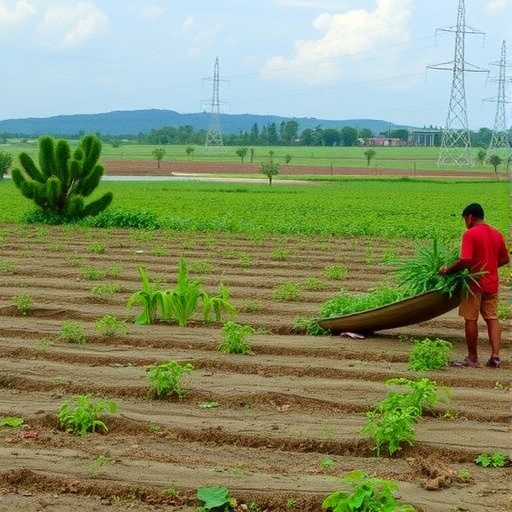
Vegetables grown on former dumping grounds on the eastern edge of Kolkata are carrying enough cadmium, mercury, and lead to pose serious health risks to the people who eat them, according to a new study of the reclaimed farmlands at Dhapa, one of India’s most intensively farmed urban waste landscapes. The research, published in Environmental Science and Pollution Research, tracked eight trace and toxic metals in the soils of the East Kolkata Wetlands, a designated Ramsar site, and found that contamination has grown steadily worse over the past few decades even as the land has become a vital source of food for the metropolis.
The study, led by Arup Dey of the Marine Trace Metal Biogeochemistry Laboratory at the Indian Institute of Technology Kharagpur, together with Parthasarathi Chakraborty, set out to answer a deceptively simple question: is it safe to farm on land that was once a garbage dump? As cities across the world expand and swallow up cultivable land, abandoned landfills and dumping grounds are increasingly being converted to agriculture. Dhapa, which has received Kolkata’s municipal solid waste for generations, is a textbook example of this trend. Its fields, irrigated in part with wastewater and enriched by decomposing refuse, produce large quantities of leafy and other vegetables consumed daily by city residents.
To quantify the problem, the researchers measured the distribution and temporal pollution trends of eight metals: chromium, manganese, nickel, copper, zinc, cadmium, mercury, and lead. Their central metric was the pollution load index, or PLI, a composite measure that aggregates the relative enrichment of all monitored metals against background or reference concentrations. A PLI above 1 is conventionally taken to indicate pollution. In the Dhapa farmlands, the index climbed from roughly 5.8 to 13.6 over recent decades, a progressive deterioration in soil quality that signals not a legacy contamination problem being slowly diluted, but an ongoing accumulation of toxic metal burdens in the very soil from which food is being grown.
The team then traced how these metals move through the soil-plant system, quantifying transfer at each step from soil to root and from root to shoot, the aboveground tissues that frequently constitute the edible portion of a vegetable. The soil-to-root transfer factor ranked cadmium highest, followed by lead, then mercury, indicating that cadmium is the most readily taken up from soil into plant roots. The root-to-shoot transfer factor, however, told a different story: mercury and cadmium were equally mobile within the plant, both exceeding lead. This distinction matters because it separates the problem of metal acquisition by roots from the problem of internal transport toward the harvestable parts of the plant. A metal may be strongly absorbed but poorly translocated, remaining locked in root tissue, or it may move efficiently upward into leaves and stems.
The most striking single number in the study concerns cadmium’s bioaccumulation efficiency, roughly 0.8, meaning that about four-fifths of the cadmium entering the plant system relative to soil concentration ends up accumulated in the vegetable tissues measured. Mercury and lead, by contrast, showed bioaccumulation efficiencies of only about 0.03 and 0.02, respectively. Cadmium, in other words, behaves in an entirely different league from the other two classic toxic metals, a property long recognized in soil chemistry: cadmium is chemically similar to zinc, weakly adsorbed by soil particles, and readily mobilized in the soil solution where roots can absorb it. The ecological and human health consequences of that mobility have been documented extensively in the toxicological literature, ranging from kidney damage and bone disease to carcinogenic risk.
When the metal concentrations in edible tissues were translated into estimates of dietary exposure, and those exposures into probabilistic health risk calculations, the results were alarming. The combined hazard index, a sum of non-carcinogenic risk quotients across the metals studied, came out at 1.0 for adults, sitting precisely at the threshold above which adverse health effects are considered possible, and at 4.5 for children, well into territory of concern. Children are typically more vulnerable in such assessments because they consume more food per unit of body weight and are undergoing critical developmental processes that toxic metals can disrupt.
The carcinogenic risk figures were more dramatic still. The total carcinogenic risk, or TCR, was calculated as 1.8 × 10⁻³ for adults and 6.5 × 10⁻³ for children. Regulatory agencies generally regard a risk range of 10⁻⁶ to 10⁻⁴ as the upper bound of acceptable cancer risk from a given exposure pathway, meaning one additional case per million to one per ten thousand exposed individuals. The Dhapa vegetables deliver risks of roughly one per several hundred to one per thousand, levels that exceed the acceptable ceiling by up to more than an order of magnitude even for the most permissive end of the regulatory range. These are probabilistic estimates, built through Monte Carlo-style simulation to account for variability in consumption rates, body weights, and metal concentrations, rather than predictions that any given individual will develop cancer. But they indicate that a population eating these vegetables daily carries a materially elevated risk burden.
The researchers did not stop at diagnosis. One of the study’s most practical contributions is a proposed bioaccumulation-based classification of vegetables, grouping crops according to how efficiently they accumulate cadmium, mercury, and lead in their edible tissues. The logic is straightforward: if all vegetables on contaminated soil are not equally dangerous, then crop selection itself becomes a risk-management tool. Low-bioaccumulator crops can be grown on the most contaminated parcels, while high-accumulating species, particularly leafy vegetables whose large aboveground biomass and transpiration streams favor metal transport, could be restricted or substituted. The authors argue that this approach could meaningfully minimize dietary metal exposure for communities that depend on reclaimed landfill agriculture, without requiring farmers to abandon their livelihoods.
The researchers also emphasize that a deeper scientific understanding of species-specific metal uptake mechanisms should be integrated into future crop selection strategies. Plant physiology offers multiple points of leverage. Some species exude compounds that immobilize metals in the rhizosphere; others express transport proteins that discriminate against cadmium relative to essential nutrients like zinc and iron. Phytochelatin-mediated detoxification, in which plants chelate metal ions and sequester them in vacuoles, varies widely across genotypes. Understanding these mechanisms at the species and varietal level could allow plant breeders and agronomists to recommend, or even develop, cultivars that keep toxic metals out of edible tissues while still tolerating contaminated growing conditions.
The broader context of the study extends well beyond a single dumping ground. A growing body of global research, including a prominent 2025 assessment in Science, has warned that soil pollution by toxic metals threatens both agriculture and human health on a planetary scale, with urban and peri-urban farming on marginal or contaminated land occupying an increasingly significant share of food production in fast-growing cities. Kolkata’s East Kolkata Wetlands, a Ramsar-listed ecosystem where sewage-fed aquaculture and vegetable cultivation have coexisted for more than a century, illustrate the double bind facing such landscapes: they provide an extraordinary ecological service, treating the city’s waste while producing its food, yet the very wastes they recycle concentrate toxic metals in the soils over time.
Dhapa’s history makes this trajectory particularly visible. Studies dating back years have documented elevated metals in its soils and crops, and regulatory assessments of the dumpsite have flagged leachate contamination of surrounding water resources. What the new study adds is a coherent, quantitative thread connecting temporal soil deterioration, metal-specific transfer behavior within plants, bioaccumulation in edible tissues, and probabilistic estimates of dietary risk across age groups. By quantifying that entire chain, the researchers have provided a template that other cities converting landfills to farmland could adapt: measure the pollution load, characterize metal transfer and bioaccumulation for local crops, estimate dietary exposure for realistic consumption patterns, and use the results to guide which crops are safe to grow where.
The implications for food safety policy in India are direct. Vegetables from such sites enter informal markets where contamination is invisible to consumers, and hazard thresholds in national food standards are often not enforced at the point of sale for peri-urban produce. The study’s proposal of low-bioaccumulator crop selection offers an immediately actionable intervention that does not depend on land remediation, which is expensive and slow. At the same time, the authors caution that crop substitution is a mitigation, not a cure. As long as dumping grounds continue to receive metal-laden municipal waste and reclaimed soils continue to accumulate contamination, the underlying problem will persist. Their findings argue for pairing smarter crop selection with monitoring, restrictions on further waste input, and honest engagement with the communities whose food security depends on these fragile, productive, and poisoned landscapes.
Cite Scienmag News
Daisy Hatcher. (September 4, 2026). Toxic metals linger in India’s reclaimed farmlands, threatening food safety. Scienmag. https://scienmag.com/toxic-metals-linger-in-indias-reclaimed-farmlands-threatening-food-safety/
Daisy Hatcher. "Toxic metals linger in India’s reclaimed farmlands, threatening food safety." Scienmag, 4 September 2026, https://scienmag.com/toxic-metals-linger-in-indias-reclaimed-farmlands-threatening-food-safety/. Accessed 4 September 2026.
Daisy Hatcher. "Toxic metals linger in India’s reclaimed farmlands, threatening food safety." Scienmag. September 4, 2026. https://scienmag.com/toxic-metals-linger-in-indias-reclaimed-farmlands-threatening-food-safety/


