


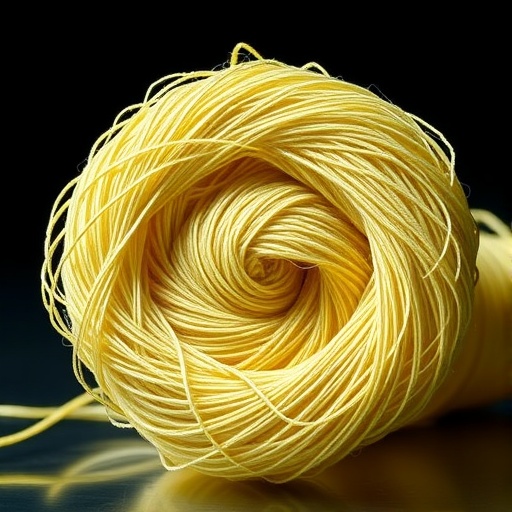
In a development that could reshape how the textile and materials industries think about sustainable fibers, researchers at Cornell University, the State University of New York College of Environmental Science and Forestry, and the Georgia Institute of Technology have succeeded in spinning fully biobased fibers made almost entirely of lignin extracted from corn stover, one of agriculture’s most abundant leftover materials. The study, published in the journal Waste and Biomass Valorization, demonstrates a scalable, water-based wet-spinning route to fibers containing between 46 and 86 percent lignin by weight, fibers that are dimensionally stable in water, thermally robust, and possess inherent antioxidant activity of up to roughly 66 percent without the aid of any toxic chemical finishes. The work addresses a long-standing bottleneck in lignin processing: although lignin is the most abundant aromatic biopolymer on Earth and is rich in desirable properties such as UV-blocking, hydrophobicity, and radical-scavenging capacity, its structural heterogeneity and poor solubility have historically made it nearly impossible to spin into fibers on its own.
The team’s solution was to pair lignin with sodium alginate, a biodegradable polysaccharide derived from brown seaweed that dissolves completely in water and, critically, forms rapidly ionically crosslinked networks in the presence of divalent calcium cations. In the wet-spinning process developed by Dorota B. Szlek and colleagues, suspensions of lignin and sodium alginate in water, with glycerol added as a plasticizer in a water-to-glycerol ratio of 8:3, were extruded through a fine needle into a coagulation bath of 10 percent calcium chloride. As the alginate encountered the calcium ions, it crosslinked into a solid matrix, simultaneously trapping and immobilizing the suspended lignin particles. The fibers were collected on a rotating drum, air-dried, and then subjected to a 24-hour deionized water wash followed by another air-drying period, a step designed to strip out the water-soluble glycerol and test whether the resulting fibers could hold their shape without a plasticizer.
A key innovation of the study lay in how the lignin itself was sourced and prepared. The researchers obtained their lignin from corn stover supplied by the University of California Riverside, extracting it via Co-solvent Enhanced Lignocellulosic Fractionation, or CELF, a pretreatment that uses a tetrahydrofuran-water mixture with dilute sulfuric acid at 160 degrees Celsius for 30 minutes. The CELF process yields a highly pure, reactive lignin that retains many of the native beta-O-4 ether linkages often destroyed in harsher industrial extraction methods. To probe how molecular weight governs fiber behavior, the team then fractionated the CELF lignin by ethanol solubilization, producing a low-molecular-weight fraction labeled LCSL and a high-molecular-weight fraction labeled HCSL. Both fractions exceeded 93 percent lignin purity, and their molecular weight distributions were relatively uniform, with dispersity values between 1.7 and 2.1.
Detailed structural characterization revealed fundamental differences between the two fractions that would prove decisive for fiber performance. Using two-dimensional heteronuclear single quantum coherence nuclear magnetic resonance spectroscopy and quantitative phosphorus-31 NMR, the researchers found that the low-molecular-weight LCSL carried substantially more total hydroxyl groups, particularly phenolic aromatic hydroxyls, at 3.4 millimoles per gram compared with 2.2 millimoles per gram for HCSL. Because hydroxyl groups are the chemical handles through which lignin forms hydrogen bonds with the hydroxyl-rich alginate backbone, the LCSL fraction was inherently better positioned to integrate into the alginate matrix. Conversely, HCSL retained more beta-O-4 interunit linkages and showed a broader, more gradual thermal degradation profile, foreshadowing its superior thermal stability in fiber form.
Rheological measurements of the spinning dopes at 20 degrees Celsius confirmed these expectations. All suspensions exhibited shear-thinning behavior, ideal for extrusion. At low lignin loading of 2 percent by weight, the dopes were actually less viscous than neat alginate solutions, an effect the researchers attribute to surfactant-like behavior of lignin particles at interfaces. As lignin concentration climbed to 10 and 20 percent, viscosity rose well above the alginate baseline, signaling the formation of a thickening supramolecular network. Notably, at equal concentrations the LCSL dopes were more viscous than the HCSL dopes, consistent with the smaller particle size and stronger interactions of the low-molecular-weight fraction with water, alginate, and glycerol, evidence of better dispersion that would carry through to the final fibers.
Morphology told a parallel story. Scanning electron microscopy revealed that LCSL fibers possessed smoother surfaces, while HCSL fibers were rougher and more irregular, breaking more frequently during handling, a consequence of larger, less uniformly dispersed lignin particles. Adding lignin also transformed the fiber cross-section: neat alginate fibers collapse into flat, ribbon-like shapes because their rapidly solidified skin layer crumples as water diffuses out of the core, whereas lignin-loaded fibers retained rounder cross-sections and larger diameters. The water wash removed essentially all of the glycerol, confirmed both by the disappearance of the glycerol-specific FTIR peak at 851 per centimeter and by post-wash mass losses correlating strongly with initial glycerol content, and the remaining fibers stayed intact thanks to calcium crosslinking, hydrogen bonding, and lignin’s own water insolubility. Energy-dispersive X-ray spectroscopy detected sodium, calcium, and chlorine in the washed fibers, direct evidence that the ionic crosslinking survived the wash.
Thermogravimetric analysis underscored the thermal dividends of lignin enrichment. After washing, the onset of degradation increased for every fiber composition, and at the highest lignin loadings the fibers reached 85 to 86 percent lignin content. HCSL-based fibers showed higher degradation onset temperatures and slower degradation rates, while the LCSL fibers displayed a distinctive volatile release between 230 and 260 degrees Celsius, associated with vanillin liberated from cleaved beta-O-4 linkages. Indeed, the researchers noted a strong vanillin aroma during handling of LCSL-containing samples, a sensory confirmation of the aldehyde carbonyl signatures detected by infrared spectroscopy near 1700 per centimeter. These findings indicate that even after the plasticizer is gone, the supramolecular lignin-alginate network, held together by hydrogen bonds and calcium-mediated ionic bridges rather than covalent chemistry, provides genuine structural and thermal resilience.
Perhaps the most striking functional result was antioxidant performance. In a DPPH radical-scavenging assay, fibers made with the low-molecular-weight lignin neutralized more than 50 percent of the applied oxidant within just ten minutes at moderate loading, and after 24 hours the LCSL fibers achieved antioxidant activity index values between 59 and 66 percent, compared with 24 to 62 percent for HCSL fibers. Neat alginate fibers showed no scavenging activity at all, confirming that the antioxidant behavior stems directly from the phenolic chemistry of the lignin rather than any additive or surface treatment. This built-in functionality, delivered without toxic finishing chemicals, opens doors to applications in wound care dressings, food packaging, and geotextiles where biodegradability and non-toxicity are paramount, and where oxidative protection would otherwise require synthetic antioxidants.
The mechanical properties, while modest, followed interpretable trends. LCSL fibers outperformed their high-molecular-weight counterparts in tensile strength, stiffness, and elongation, achieving up to 54 percent elongation at break at intermediate lignin loading, and the researchers attribute this to stronger intermolecular hydrogen bonding and lower linear density. As expected, increasing lignin concentration gradually plasticized the fibers relative to the alginate matrix, reducing tensile strength, and the complete removal of glycerol during washing left the fibers brittle. The authors are candid about these limitations, noting that future work will explore better-suited plasticizers such as polyethylene glycol and pre-crosslinking strategies already shown to produce high-strength alginate fibers. Nevertheless, the study establishes a complete, quantitative structure-processing-property map for a materials platform that had barely been explored in fiber form.
What makes this work resonate beyond the laboratory is its convergence of three sustainability imperatives: valorizing agricultural waste, eliminating organic solvents and hazardous additives from fiber manufacturing, and building functionality into materials by design rather than by treatment. Corn stover accumulates by the hundreds of millions of tons annually as a byproduct of maize cultivation, and converting a fraction of it into durable, antioxidant, thermally stable fibers represents exactly the kind of circular-economy chemistry that the materials sector is racing to develop. The supramolecular, non-covalent nature of the lignin-alginate network also hints at dynamic, tunable materials whose properties could be adjusted by controlling intermolecular interactions, a frontier the authors explicitly identify for future investigation. From a bench-top wet-spinning rig assembled partly from commodity components to fibers with composition and performance verified at every step, this study offers a template for turning lignin’s stubborn heterogeneity from a liability into an asset, and it may well mark the moment when waste-derived lignin fibers stopped being a curiosity and started becoming a credible ingredient of the sustainable materials economy.
Cite Scienmag News
Denise Maddox. (September 4, 2026). Agricultural waste turned into sustainable supramolecular fibers via wet spinning. Scienmag. https://scienmag.com/agricultural-waste-turned-into-sustainable-supramolecular-fibers-via-wet-spinning/
Denise Maddox. "Agricultural waste turned into sustainable supramolecular fibers via wet spinning." Scienmag, 4 September 2026, https://scienmag.com/agricultural-waste-turned-into-sustainable-supramolecular-fibers-via-wet-spinning/. Accessed 4 September 2026.
Denise Maddox. "Agricultural waste turned into sustainable supramolecular fibers via wet spinning." Scienmag. September 4, 2026. https://scienmag.com/agricultural-waste-turned-into-sustainable-supramolecular-fibers-via-wet-spinning/


