


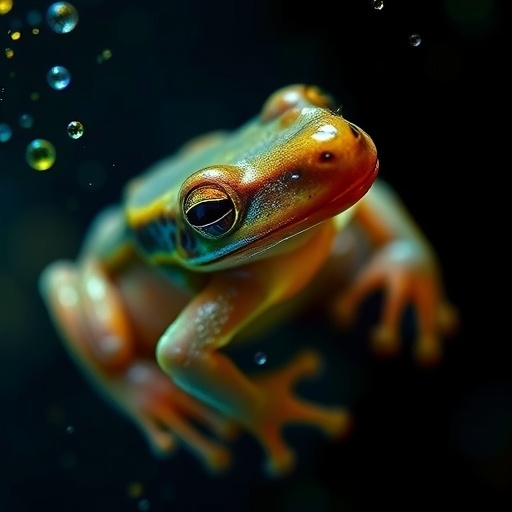
The echoes of a tadpole’s early life can reverberate through a frog’s entire existence, but new research suggests those echoes are far stranger than scientists anticipated. In a long-term experiment conducted on the Iberian green frog (Pelophylax perezi), researchers Francisco Javier Zamora-Camacho and Pedro Aragón of the Spanish National Research Council have found that the combined effects of warming and fertilizer pollution experienced during the larval stage do not simply fade away when young frogs leave the water. Instead, these early exposures appear to rewrite the biology of adult frogs more than a year later, producing unexpected patterns in body size, energy reserves, and jumping ability that challenge some of the most basic assumptions in amphibian ecology.
The study, published in Frontiers in Zoology, stems from a straightforward but sobering premise. Two of the defining features of global change are rising average temperatures and the agricultural fertilizers that increasingly contaminate natural waterways. Nitrogen-based fertilizers such as ammonium wash into ponds and streams from surrounding cropland, while greenhouse gas emissions drive ambient temperatures ever upward. For pond-dwelling tadpoles, both stressors are essentially inescapable. Unlike adult amphibians, which can move across the landscape to seek out favorable microclimates and cleaner habitats, larvae are trapped in the water bodies where they hatched, forced to endure whatever thermal and chemical conditions prevail there. What makes the situation doubly concerning is that stress experienced during these confined early stages can leave lasting marks on an animal’s physiology and performance long after exposure ends, a phenomenon ecologists call carryover effects.
To investigate how these two global change drivers interact across life stages, the researchers designed a two-by-two factorial experiment. They collected egg masses from frogs bred in a semi-natural outdoor enclosure at Pinares de Cartaya in the southwest of the Iberian Peninsula, then randomly assigned individual eggs from each mass to plastic tanks containing either heated or unheated water, with or without ammonium contamination. Heated tanks were fitted with continuous 50-watt submersible water heaters, while the ammonium treatment involved adding ammonium chloride to reach a concentration of 10 milligrams of NH4+ per liter. That dose was chosen deliberately: a slightly higher concentration of 13.5 milligrams per liter is known to kill 70 percent of P. perezi tadpoles over three weeks, so the researchers opted for a sublethal level that would induce physiological stress without mass mortality. The concentration is also commonly found in Spanish freshwater bodies, making the exposure ecologically realistic rather than a laboratory artifact.
Throughout the larval period, which ran from spring into July 2023, the team maintained the tanks carefully. Water was changed twice a week, with heaters and ammonium replenished at each change, and tank positions were shuffled regularly to prevent subtle shelf-to-shelf differences in light or temperature from confounding the results. Temperature and ammonium concentration were measured with calibrated instruments, and tadpoles were fed boiled spinach ad libitum. Once metamorphosis occurred, fifty metamorphs from each treatment combination were moved to four identical, adjacent outdoor enclosures, each equipped with refuges, a small pond, and a mesh roof that excluded predators but admitted the small invertebrates the frogs eat. Crucially, the young frogs spent the next fourteen months in completely clean conditions, free of contamination and thermal manipulation, ensuring that any differences detected in adulthood could be attributed to their larval experience rather than ongoing exposure.
When the surviving frogs reached sexual maturity in September 2024, thirty-nine females and thirty-seven males were brought to the laboratory for a battery of measurements. The researchers recorded snout-vent length with a ruler, body mass with a digital scale, and calculated a scaled mass index, a body condition metric that reliably estimates energy reserves by adjusting mass for body length using a standardized major axis regression. Locomotor performance was assessed by measuring jumping distance on a two-meter metallic arena: each frog was gently prodded to leap forward five times, with magnets placed behind the animal’s urostyle as landmarks, and the longest jump of the five was recorded. This suite of traits matters because size, condition, and locomotion are all tightly linked to survival and reproductive success in frogs, which escape predators by leaping and compete for mates through chorusing rather than physical pursuit.
The results defied expectations at nearly every turn. In unheated water, the classic pattern held: tadpoles exposed to ammonium grew into smaller adults, consistent with the idea that pollution imposes developmental costs. But in heated water, the pattern reversed entirely. Frogs that had experienced both warming and ammonium as larvae emerged as adults with larger body sizes than any other group, meaning warmth somehow neutralized and even inverted ammonium’s negative influence on growth. The authors propose that elevated temperature may accelerate detoxification pathways in tadpoles. Certain detoxifying enzymes, including antioxidant enzymes involved in neutralizing reactive compounds, are known to become more active at higher temperatures in some amphibian larvae, potentially allowing heated tadpoles to eliminate not only the immediate but also the delayed costs of ammonium exposure. Intriguingly, this finding contradicts the widely held assumption that size at metamorphosis reliably predicts adult size, since heated tanks had actually produced smaller metamorphs despite yielding larger adults.
Body condition told its own story. Regardless of temperature, frogs that had been reared with ammonium as tadpoles showed significantly higher scaled mass index values as adults than their uncontaminated counterparts, suggesting they accumulated proportionally greater energy reserves. One possible interpretation is a life-history shift: when conditions reduce expected lifespan, evolutionary theory predicts that organisms should prioritize resource storage and early reproduction over long-term maintenance. Consistent with that logic, previous work by the same team found that natterjack toads living in intensively farmed, contaminated landscapes live shorter lives but invest more heavily in reproduction than toads in pristine habitats. The researchers also noted, with appropriate caution, that survivorship to adulthood was highest in the group exposed to both ammonium and heat, although the post-hoc statistical comparisons for that particular pattern did not reach conventional significance thresholds.
Locomotor performance, however, painted a darker picture. Frogs with a larval ammonium history jumped significantly shorter distances as adults, averaging roughly 38 centimeters compared with nearly 49 centimeters for uncontaminated animals, an effect that held irrespective of temperature. Because jumping ability directly influences escape from predators and is correlated with survival in anurans and many other animals, this impairment could translate into heightened predation risk in the wild, even though predators were deliberately excluded from the study enclosures. Reduced locomotion might also carry reproductive consequences, although the authors note that frog mating systems, which rely on male choruses rather than chases or territorial combat, may soften the impact of poor jumping on mating success. The combination of better condition but worse performance suggests that ammonium-exposed frogs either prioritize storing resources at the expense of locomotor investment, or that contamination limits their capacity to optimize movement without similarly constraining energy storage.
Taken together, the findings underscore how profoundly the timing and context of stress exposure shape its legacy. During the larval and metamorphic stages of this same cohort, reported in an earlier paper, the effects of temperature were so dominant that ammonium’s consequences were almost entirely masked: heated larvae grew larger and faster but metamorphosed into smaller froglets with poorer jumping performance, regardless of contamination. Yet by adulthood, fourteen months after release from all experimental conditions, the roles had reversed, with ammonium’s long-term effects proving stronger than those of warming. The authors caution that their results could be influenced by unmeasured sex-dependent mortality, though the near-even adult sex ratio of 37 males to 39 females argues against that possibility, and there is no evidence that temperature-induced sex reversal occurs in this species.
The broader implications extend beyond a single frog species. Because nitrogen pollution is pervasive in agricultural landscapes worldwide, and because warming continues to intensify, interactions of the kind documented here are likely already playing out in ponds bordering croplands across the Mediterranean and beyond. If ammonium exposure during larval life reshapes the bodies and athletic capacities of adult amphibians in ways that depend on temperature, then predicting the fate of populations in polluted, warming environments requires models that span entire life cycles rather than snapshots of a single stage. What this experiment makes vividly clear is that for animals with complex life histories, the past is never truly past: the water a frog swam in as a tadpole may determine, in unexpected and sometimes contradictory ways, how big it grows, how much energy it banks, and how far it can leap for the rest of its life.
Cite Scienmag News
Drew Townsend. (September 4, 2026). Warming and ammonium exposure in larvae shape adult frog outcomes. Scienmag. https://scienmag.com/warming-and-ammonium-exposure-in-larvae-shape-adult-frog-outcomes/
Drew Townsend. "Warming and ammonium exposure in larvae shape adult frog outcomes." Scienmag, 4 September 2026, https://scienmag.com/warming-and-ammonium-exposure-in-larvae-shape-adult-frog-outcomes/. Accessed 4 September 2026.
Drew Townsend. "Warming and ammonium exposure in larvae shape adult frog outcomes." Scienmag. September 4, 2026. https://scienmag.com/warming-and-ammonium-exposure-in-larvae-shape-adult-frog-outcomes/


