


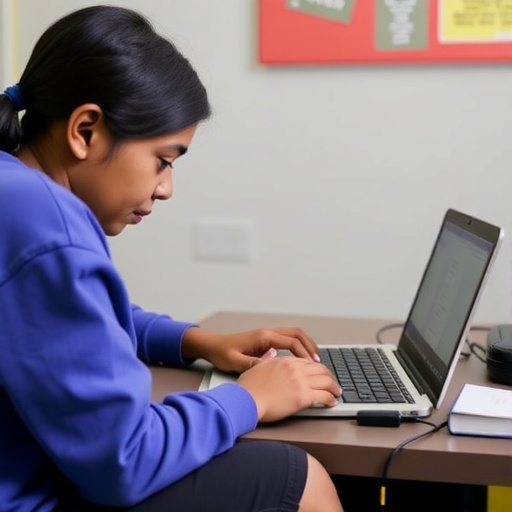
In a groundbreaking study that explores the intersection of education, career choice, and gender dynamics, researchers have unveiled the intricate ways in which exposure to role models can influence the academic trajectories of youth, particularly in STEM (science, technology, engineering, and mathematics) fields and entrepreneurship. Conducted at a remarkable scale across Ecuadorian high schools, this study leverages the power of remote, video-based interventions to dissect how multiple career role models shape college major preferences, revealing nuanced shifts in gendered educational pathways.
The challenge inherent in aiding young students’ decision-making about their future careers has long been the limited exposure to diverse professional role models. Traditionally, interactions with career mentors have been localized and one-on-one, often in an in-person setting where logistical and financial constraints prevent scaling. This limitation means many students miss out on the broad spectrum of career possibilities, particularly underrepresented and high-paying fields. To overcome these barriers, the researchers implemented an innovative, scalable model that harnesses online video interviews with multiple role models from STEM and entrepreneurial disciplines, reaching over 29,000 students in 813 high schools across Ecuador.
This experimental design—one of the largest of its kind—randomized schools to receive the intervention, allowing for strong causal inference on the effect of exposure to diverse professional role models. The roles represented ranged from engineers and scientists to business founders and agricultural innovators, offering multidimensional glimpses into varied career landscapes seldom available to students in geographically or economically isolated regions. The remote nature of the intervention democratizes access to real-world insights without the constraints of physical visits, enabling a systemic approach to career guidance.
Contrary to expectations where exposure to inspiring STEM role models might boost STEM enrollment, the findings reveal an intriguing divergence. Girls who were exposed to multiple role models in STEM and entrepreneurship actually demonstrated a decreased likelihood of choosing a STEM major in college. Instead, they showed increased enrolment in business-related fields. This shift suggests that rather than reinforcing aspirations for STEM careers, the intervention may have heightened perceived barriers or challenges associated with STEM pathways, leading to a preference for entrepreneurship or business, fields stereotypically viewed as more accessible or aligned with social norms for women.
Boys also exhibited notable shifts in college major selection following the intervention. Similar to girls, boys reduced their propensity to choose STEM majors, but their migration patterns favored agricultural sciences and other disciplines outside the traditional STEM business dichotomy. The gendered divergence in responses highlights how perceptions of field difficulty, social reinforcement, and possibly cultural expectations influence how youth process information from role models and translate it into educational choices.
The study’s findings elucidate a complex interaction between exposure, representation, and internalized stereotypes. While the intention behind introducing role models was to broaden horizons and encourage diverse career aspirations, the outcome underscores that simply increasing visibility of STEM and entrepreneurial role models might inadvertently consolidate existing gender biases. Girls, when faced with role models in contrasting fields, appear to interpret STEM as more difficult or less fitting, thereby gravitating toward “safer” or societally endorsed career avenues. Boys, meanwhile, reportedly show less enthusiasm for the conventional STEM path as presented, signaling possible disengagement or alternative interest development.
Delving deeper, the study prompts a reevaluation of how role model interventions are designed and deployed. The uniform presentation of STEM and entrepreneurship role models without tailored gender-sensitive messaging may be insufficient to disrupt entrenched stereotypes or to build genuine self-efficacy among youth. The perception of challenge versus opportunity needs to be carefully managed to ensure young people, particularly girls, recognize STEM fields as accessible, rewarding, and congruent with their aspirations.
Moreover, educational policymakers and practitioners must reckon with the nuances discovered herein. Scaling career exposure through remote digital interventions offers promise but must be coupled with mechanisms that address the socio-cultural context within which students form their academic identities. The role models need to not only inspire but also dismantle perceived obstacles, providing concrete strategies to navigate barriers and fostering a growth mindset oriented toward persistence and achievement in STEM.
The innovative use of video interviews as a delivery format points to the potential of technology to bridge gaps in educational equity. This approach enables reaching remote and underserved populations at scale, bringing a diversity of career narratives directly into classrooms. Yet, the quality and framing of these narratives become critical—emphasis on relatable role models, authentic storytelling about challenges and triumphs, and gender-inclusive language may modulate the intervention’s impact.
Furthermore, this research opens the door for subsequent inquiries into the psychological and social mediators of career choice influenced by role model exposure. How do self-perception, stereotype threat, and self-efficacy interact with externally presented career alternatives? Longitudinal tracking could reveal whether shifts observed at college entry persist into degree completion and eventual career engagement, providing a full picture of the role model intervention’s long-term effects.
It is also important to situate these findings in the broader landscape of gender disparity in STEM fields globally. Despite increased attention to closing the gender gap, many countries still witness underrepresentation of women in engineering, computer science, and physical sciences. Initiatives targeting young students to cultivate interest and confidence in STEM remain central to policy debates. This study’s demonstration of counterintuitive effects from exposure cautions against simplistic assumptions and highlights the necessity of context-aware approaches.
The Ecuadorian setting offers a unique perspective, representing emerging economies where educational resources and career opportunities may differ markedly from developed regions. Rural-urban divides, varying cultural norms, and economic incentives intersect with gender dynamics, shaping how students evaluate and select majors. This context helps to enrich the global understanding of STEM participation and could inform targeted interventions tailored for similar socioeconomic environments.
In conclusion, the research spearheaded by Asanov, Åstebro, Buenstorf and colleagues pioneers an ambitious large-scale experimental approach to understanding how remote role model exposure affects youth career choices. While the promise of technology-enabled interventions is evident, the findings beckon a more nuanced design sensitive to gender stereotyping and perceived academic challenges. Encouraging girls and boys to embrace STEM pathways requires more than role model visibility; it demands systemic cultural shifts, supportive messaging, and realignment of how challenges in these fields are framed. These insights offer vital guidance for educators, policymakers, and innovators aiming to nurture the next generation of diverse STEM professionals worldwide.
Cite Scienmag News
Glenn Wilkins. (May 14, 2026). Remote STEM Role Models Shift Ecuador College Majors. Scienmag. https://scienmag.com/remote-stem-role-models-shift-ecuador-college-majors/
Glenn Wilkins. "Remote STEM Role Models Shift Ecuador College Majors." Scienmag, 14 May 2026, https://scienmag.com/remote-stem-role-models-shift-ecuador-college-majors/. Accessed 4 September 2026.
Glenn Wilkins. "Remote STEM Role Models Shift Ecuador College Majors." Scienmag. May 14, 2026. https://scienmag.com/remote-stem-role-models-shift-ecuador-college-majors/


