


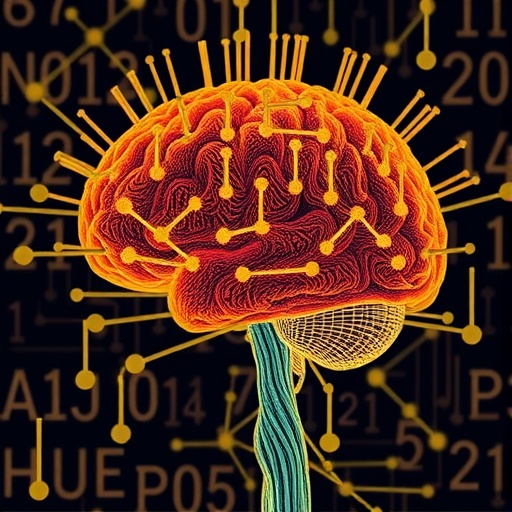
In a groundbreaking advance that straddles the worlds of neuroscience and artificial intelligence, researchers have unveiled a novel approach capable of extracting the intricate contents of human memory by harnessing natural language processing (NLP). This innovative methodology enables the decoding of memory with unprecedented precision, mapping the intersecting neural patterns activated during both the initial encoding of memories and their subsequent retrieval. Such insights not only deepen our understanding of the brain’s memory mechanisms but also herald transformative possibilities in mental health, cognitive neuroscience, and even artificial intelligence.
The study, conducted by a team led by Kim, Koh, and Ranganath and published in Communications Psychology (2026), employs cutting-edge NLP techniques—traditionally the domain of language analysis—to decode neural signals correlated with autobiographical and experiential memory recall. For decades, cognitive scientists have sought to unravel how the brain encodes, stores, and retrieves the wealth of narratives that form our conscious experience. The challenge has always been the translation of raw neural activity into coherent, interpretable information that corresponds to the content of memory.
Central to this research is the concept of “shared neural patterns” — a distinctive neural fingerprint that emerges when an individual both encodes (experiences and internalizes) and later retrieves (remembers) specific memory content. Using advanced brain imaging technologies such as functional magnetic resonance imaging (fMRI), the authors captured these neural signatures in fine detail. By integrating this neuroimaging data with sophisticated NLP models, the team successfully matched verbal descriptions derived from memory reports to neural activation patterns, revealing a striking degree of correspondence.
At the heart of their methodology lies a two-step process. Initially, participants were exposed to rich, complex stimuli—stories, images, or videos—that they were then asked to recall in detail. During both encoding and retrieval phases, participants underwent fMRI scans to monitor brain activity. The NLP component then parsed the verbal recall data, extracting semantic features, narrative structure, and thematic elements. These linguistic outputs were paired with neural data to identify commonalities in brain activation—effectively decoding which elements of the memory were consistently represented in the neural substrate.
This multimodal fusion of language and neural data heralds a major shift in how scientists understand memory content. Traditionally, memory studies have focused heavily on behavioral outcomes or isolated neural regions. Here, the integration of machine learning-based language understanding with neuroimaging provides a more holistic mapping of memory traces, elucidating how the brain orchestrates the episodic reconstruction of past events through shared neural pathways. The ability to algorithmically link linguistic content to brain activity bridges a crucial gap in cognitive neuroscience.
One of the most compelling findings in the study is that the shared neural patterns predominantly localized within the hippocampus, medial temporal lobe, and prefrontal cortex—areas long implicated in episodic memory function. This reinforces prevailing theories about the distributed network for memory encoding and retrieval. However, novel insights emerged regarding how these regions coordinate dynamically during recall, with distinct temporal sequences of activation that mirror narrative flow in verbal reports. The relationship between narrative complexity and neural pattern overlap sheds light on why some memories are more vivid or accessible than others.
The implications extend far beyond academic curiosity. This research opens avenues for clinical applications in diagnosing and treating memory disorders such as Alzheimer’s disease, post-traumatic stress disorder (PTSD), and other forms of cognitive decline. By identifying neural correlates of memory content, clinicians might better track disease progression, tailor rehabilitation strategies, or even develop brain-computer interfaces to assist memory-impaired individuals. More provocatively, it hints at the very possibility of “reading” memories, offering ethical and philosophical debates about privacy, consent, and identity.
Moreover, the marriage of NLP and neuroscience may inspire new directions in artificial intelligence research. Current AI models typically lack the rich contextual and affective coding inherent to human memories. By modeling how linguistic memories correspond to neural circuits, AI systems might be designed to mimic human-like memory processes—potentially enhancing natural language understanding, contextual reasoning, and even empathy in human-computer interaction. The research underscores the value of interdisciplinarity in solving complex cognitive puzzles.
While the study’s findings are robust, the authors acknowledge limitations inherent in the current techniques. Neuroimaging resolution, though improving, still imposes constraints on capturing the full neural complexity of memory. The reliance on verbal recall also introduces potential biases stemming from subjective memory distortion or incomplete reporting. Future research may combine electrophysiological measures, longitudinal designs, or non-verbal memory assessments to further refine the models. Nonetheless, this breakthrough sets a new benchmark.
Technically, the NLP framework utilized transformer-based architectures, known for capturing long-range dependencies in textual data, which proved crucial in faithfully representing the multi-faceted, temporal nature of memory narratives. By training these models on richly annotated datasets of memory recall, the system learned to predict neural activation patterns associated with specific semantic and episodic features. This bidirectional mapping exemplifies how machine learning can decode not only static linguistic information but temporally evolving neural signatures.
Another noteworthy aspect is the dataset diversity embraced by the researchers. Recruiting participants from multiple demographic backgrounds and ensuring exposure to a wide array of memory stimuli enhanced the generalizability of the findings. The experimental design included both personally relevant autobiographical memories and externally provided material, allowing the team to distinguish between the neural patterns linked to self-referential versus externally prompted recall. This distinction may inform personalized cognitive therapies or memory enhancement protocols.
The study’s impact reverberates in the broader landscape of cognitive science, as it offers a blueprint for investigating other facets of human cognition—such as imagination, future planning, and language production—through the prism of shared neural-linguistic mapping. By demonstrating that natural language processing can be systematically linked to brain activity in memory, it invites analogous explorations in emotional processing, decision-making, or social cognition. This integrative approach may catalyze new research paradigms.
Ethically, the prospect of decoding memory content invites caution and deliberation. While the technology remains nascent, safeguarding individual privacy and autonomy is paramount. The authors stress the importance of establishing strict protocols governing data use, as well as transparent dialogues around consent and the possible misuse of memory decoding technologies. As the field moves forward, collaboration between scientists, ethicists, and policymakers will be essential to harness these advances responsibly.
In summary, the integration of natural language processing and neural imaging delineated by Kim, Koh, Ranganath, and colleagues marks a transformative milestone in cognitive neuroscience. Their work reveals how the brain weaves complex narratives into measurable neural patterns, opening gateways previously closed to science. Beyond the laboratory, this fusion of AI and brain science promises revolutionary applications, from clinical diagnostics to enhancing human-AI communication, reshaping our understanding of memory and cognition in profound ways.
As this technology evolves, ongoing research will likely deepen our grasp of the intricacies of memory formation and retrieval, enabling us to decode not just what we remember, but how we remember it. The convergence of linguistic nuance and neural dynamics holds immense potential to unravel the mysteries of human experience, promising a future where the inner workings of the mind become ever more accessible to empirical scrutiny and compassionate intervention.
Cite Scienmag News
Cassandra Pierce. (June 4, 2026). Natural Language Processing Decodes Memory’s Neural Patterns. Scienmag. https://scienmag.com/natural-language-processing-decodes-memorys-neural-patterns/
Cassandra Pierce. "Natural Language Processing Decodes Memory’s Neural Patterns." Scienmag, 4 June 2026, https://scienmag.com/natural-language-processing-decodes-memorys-neural-patterns/. Accessed 5 September 2026.
Cassandra Pierce. "Natural Language Processing Decodes Memory’s Neural Patterns." Scienmag. June 4, 2026. https://scienmag.com/natural-language-processing-decodes-memorys-neural-patterns/


