


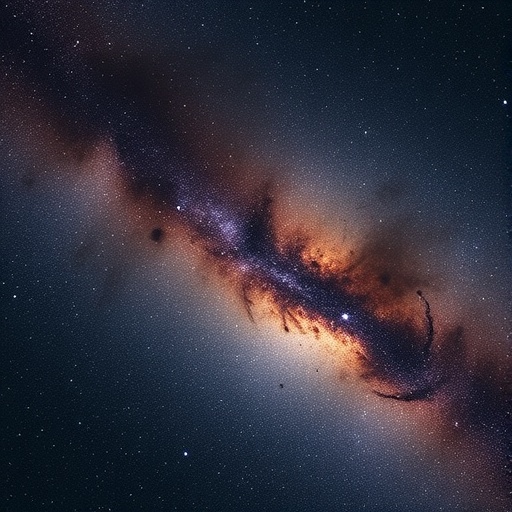
For decades, astronomers have known that the Milky Way is not a perfectly flat disk. Far from the Galactic centre, its outer regions bend upward and downward in a broad structure known as the Galactic warp. Now, a new study has revealed that this warped molecular disk is also covered by enormous wave-like ripples, or “corrugations,” extending across much of the outer Galaxy. The discovery suggests that the Milky Way’s cold gas is shaped by a complex three-dimensional pattern of motion rather than by a simple, smoothly bent disk.
The research, based on more than 30,000 molecular clouds, provides the most systematic view yet of widespread vertical corrugations in the Milky Way’s outer carbon-monoxide, or CO, disk. Molecular clouds are dense concentrations of cold gas where stars are born, and astronomers often use carbon monoxide as an indirect tracer of molecular hydrogen, the dominant constituent of these clouds. Because the clouds are distributed throughout the Galactic disk, their positions can reveal subtle changes in the structure of the Milky Way on scales of thousands of light-years.
Detecting these ripples is challenging because the corrugations are superimposed on the much larger Galactic warp. The warp causes the outer disk to rise and fall over broad distances, potentially masking smaller vertical displacements. To isolate the corrugations, the researchers first constructed and subtracted a global model of the CO warp. The remaining vertical offsets, measured relative to the expected warped disk, revealed coherent patterns that could not be explained as random scatter among individual clouds.
The residual structure resembles a series of giant waves running through the outer molecular disk. The measured vertical amplitudes are approximately 100 to 200 parsecs, meaning that the molecular gas can be displaced hundreds of light-years above or below the underlying warped mid-plane. Although these amplitudes are modest compared with the overall size of the Galaxy, they are enormous on the scale of star-forming clouds and are large enough to alter the vertical environment in which new stars emerge.
The study also identifies radial wavelengths between roughly 3.9 and 7.9 kiloparsecs. A wavelength describes the distance between repeating peaks and troughs in a wave, so these values indicate that the corrugations are not small, local disturbances. Instead, they form broad structures spanning several thousand light-years. Their coherence across such distances points to large-scale dynamical processes affecting the Galactic disk as a whole.
One particularly striking feature is an azimuthal corrugation mode detected near a Galactocentric radius of about 12.7 kiloparsecs. Rather than varying mainly with distance from the Galactic centre, this pattern changes around the disk’s circumference, with an angular wavelength of 52.6 degrees. At that radius, the angular spacing corresponds to approximately 11.6 kiloparsecs. The mode appears to extend across nearly 40 kiloparsecs, making it one of the clearest indications that vertical gas motions are organized over a substantial fraction of the outer Milky Way.
The origin of the corrugations remains an open question, but their scale and coherence provide important clues. Such structures could be connected to gravitational interactions with satellite galaxies, disturbances caused by the Milky Way’s past encounters, or the long-term response of the disk to asymmetries in its surrounding dark-matter halo. Spiral structure, gas dynamics and bending waves within the disk may also contribute. The new measurements do not identify a single cause, but they offer a set of observational constraints that future models of Galactic evolution will have to reproduce.
The discovery is especially significant because the molecular gas records the current architecture of the star-forming disk. Earlier observations of young stars had already suggested that large-scale vertical corrugations exist in the Milky Way, but gas clouds provide an independent and dynamically important tracer. Since molecular clouds are short-lived compared with the age of the Galaxy, their arrangement may preserve information about ongoing or relatively recent perturbations. At the same time, their concentration in star-forming regions allows astronomers to investigate whether vertical waves influence where and how new stars are produced.
The findings establish that corrugations are not isolated curiosities but a widespread feature of the outer Galactic molecular disk. By revealing vertical amplitudes of 100–200 parsecs, radial wavelengths of 3.9–7.9 kiloparsecs and a coherent azimuthal mode spanning tens of thousands of light-years, the study transforms the Milky Way from a two-dimensional map into a dynamic, rippling structure. As surveys improve and simulations become more realistic, these immense gas waves may become a powerful record of the Galaxy’s encounters, internal evolution and continuing transformation.
Cite Scienmag News
Grant Pearson. (August 7, 2026). Widespread Ripples Found Along the Milky Way’s Warped Outer Carbon Monoxide Disk. Scienmag. https://scienmag.com/widespread-ripples-found-along-the-milky-ways-warped-outer-carbon-monoxide-disk/
Grant Pearson. "Widespread Ripples Found Along the Milky Way’s Warped Outer Carbon Monoxide Disk." Scienmag, 7 August 2026, https://scienmag.com/widespread-ripples-found-along-the-milky-ways-warped-outer-carbon-monoxide-disk/. Accessed 4 September 2026.
Grant Pearson. "Widespread Ripples Found Along the Milky Way’s Warped Outer Carbon Monoxide Disk." Scienmag. August 7, 2026. https://scienmag.com/widespread-ripples-found-along-the-milky-ways-warped-outer-carbon-monoxide-disk/


