


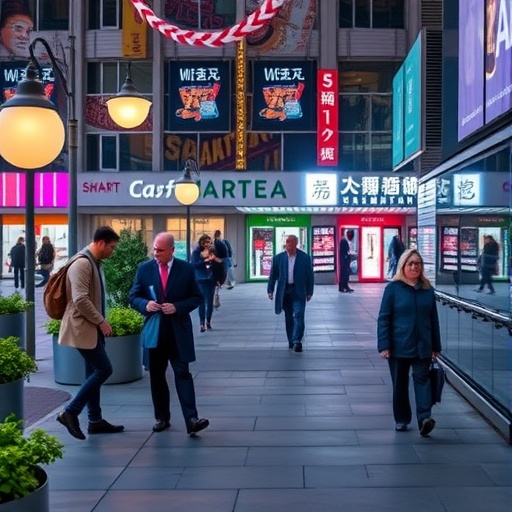
In an era increasingly defined by urban innovation and digital transformation, the integration of smart technologies within city infrastructures promises profound shifts in socioeconomic dynamics. A groundbreaking new study published in BMC Geriatrics explores the nuanced impact of smart city pilot policies on household consumption patterns, with a specific focus on households containing older adults. This research illuminates the multifaceted consequences these technological advancements exert not only on consumption behavior but also on underlying mechanisms, heterogeneity among different demographic groups, and the stark realities of inequality embedded within urban environments.
Smart city initiatives, characterized by the deployment of Internet of Things (IoT) devices, data-driven governance, and enhanced connectivity, seek to optimize urban living conditions and resource management. However, while benefits such as energy efficiency, improved transportation, and enhanced healthcare access are widely touted, the economic repercussions at the household level remain less thoroughly understood, especially among vulnerable populations like the elderly. This study fills a critical gap by rigorously analyzing how these policies reshape consumption decisions, considering both direct and indirect pathways through which smart city technologies influence the financial behaviors of older households.
The research employs a rich dataset derived from pilot smart city programs, focusing on a range of consumption categories including essentials, discretionary spending, healthcare services, and digital goods. It uncovers that households with older adults adjust their spending patterns significantly in response to smart city frameworks. For example, these households tend to reduce expenditures on traditional utilities, benefiting from energy savings afforded by smart meters and IoT-enabled appliances. Simultaneously, an increase in spending on healthcare-related services and digital communication tools reflects a pivot towards needs that smart infrastructure helps to address more effectively.
One crucial mechanism identified is the accessibility and utilization of smart services tailored to the elderly, such as telemedicine, emergency response systems, and digital social platforms. These innovations enable older adults to maintain independence and social connectedness, which in turn influences household consumption in subtle ways. For instance, enhanced telehealth services reduce the need for costly in-person medical visits or prolonged hospital stays, reallocating household resources towards preventive care and wellness products that enhance quality of life over time. This dynamic underscores the embedded relationship between technological accessibility and consumption transformation driven by smart city initiatives.
However, the study does not portray a uniformly positive impact. It highlights significant heterogeneity in outcomes across different socioeconomic strata and urban-rural divides. Older households in more affluent neighborhoods experience pronounced benefits from pilot policies, as they possess the digital literacy and infrastructure to harness smart technologies effectively. Conversely, those in lower-income areas encounter barriers such as limited internet access and lower familiarity with digital tools, which skew the economic advantages towards already privileged groups. This divergence exacerbates existing inequalities, as not all older adults can equally participate in or benefit from the smart city revolution.
Furthermore, the analysis delves into how inequality manifests in consumption patterns induced by smart city policies. The acceleration of digital service adoption, while boosting convenience for many, inadvertently marginalizes subpopulations with restricted access or lower adaptability. Digital exclusion, exacerbated by age-related challenges such as cognitive decline and physical impairments, constrains consumption opportunities. Consequently, some older households witness a reduction in spending power or are compelled to allocate resources towards overcoming technology barriers, such as purchasing devices or paying for digital literacy training, thereby deepening financial strain.
These findings challenge policymakers to rethink the design and implementation of smart city initiatives with an acute awareness of demographic disparities. Incorporating inclusive strategies that address technological literacy gaps, subsidize connectivity, and customize digital services to the unique needs and capacities of older populations emerges as a necessity. By fostering equitable access and support systems, cities can mitigate unintended negative externalities and ensure that consumption benefits realized through smart policies extend comprehensively across diverse household profiles.
The study also inspires a broader reflection on the concept of consumption itself in the context of aging populations within increasingly digitized urban ecosystems. Rather than viewing consumption solely through transactional economic lenses, it encourages a holistic understanding embracing social, psychological, and health-related dimensions. For older adults, consumption entangles with autonomy, dignity, and social inclusion—elements that smart city technologies can enhance but must be consciously embedded within policy frameworks to avoid unintentional exclusion.
In terms of methodology, the research leverages advanced econometric models to distinguish causal relationships from correlational observations, employing fixed-effects regressions and instrumental variable approaches to isolate the effect of smart city pilot policies. This rigor lends robustness to conclusions drawn about how consumption patterns shift specifically due to the innovative urban programs rather than confounding factors. Such precision equips stakeholders with actionable insights validated through comprehensive empirical scrutiny.
The intersection of urban technology and aging demographics is poised to shape the blueprint for future cities globally. This study by Li Z. exemplifies how targeted research can unravel the intricate ways technology alters household economies, enabling informed decisions that bridge innovation with social equity. It signals a clarion call for integrating gerontological perspectives within smart city development paradigms to foster environments where older adults thrive economically and socially.
Moreover, the implications of this work extend beyond national borders, applicable to metropolitan centers worldwide facing rapid urbanization and demographic shifts toward older populations. Smart city policies, when systematically evaluated through lenses like those deployed here, can be refined to accommodate diverse needs while reinforcing cohesive, inclusive urban growth. Such frameworks could prioritize elderly-friendly infrastructures, digital competence programs, and equitable resource distribution mechanisms that collectively strengthen urban resilience.
As cities continue evolving under the pressures of climate change, pandemic threats, and technological advancement, understanding the nuanced impact on household consumption becomes vital. Older adults often represent a vulnerable sector, with their economic behaviors influencing household stability and broader market dynamics. The research highlights that the promise of smart cities can be fully realized only if inclusivity and equality reside at the heart of innovation policies, guiding adaptive, humane urban futures.
In conclusion, this seminal research serves as an essential reference point for academics, policymakers, and urban planners striving to balance technological progress with social justice. The detailed examination of mechanisms, heterogeneity, and inequality in consumption patterns among elderly households offers a rare, in-depth perspective that elevates discourse around smart cities beyond infrastructure upgrades to encompass lived human experiences. It sets a precedent for interdisciplinary collaboration marrying gerontology, economics, urban studies, and digital technology for holistic urban innovation.
The study not only enriches academic knowledge but also wields practical relevance, encouraging governments and stakeholders to implement inclusive digital urban solutions that empower older adults economically and socially. As smart cities proliferate, thoughtful integration of findings such as those from this research will be critical to ensure future cities fulfill their transformative potential equitably and effectively.
Cite Scienmag News
Beatrice Stafford. (May 14, 2026). Smart City Policies Boost Aging Household Consumption Inequality. Scienmag. https://scienmag.com/smart-city-policies-boost-aging-household-consumption-inequality/
Beatrice Stafford. "Smart City Policies Boost Aging Household Consumption Inequality." Scienmag, 14 May 2026, https://scienmag.com/smart-city-policies-boost-aging-household-consumption-inequality/. Accessed 4 September 2026.
Beatrice Stafford. "Smart City Policies Boost Aging Household Consumption Inequality." Scienmag. May 14, 2026. https://scienmag.com/smart-city-policies-boost-aging-household-consumption-inequality/


