


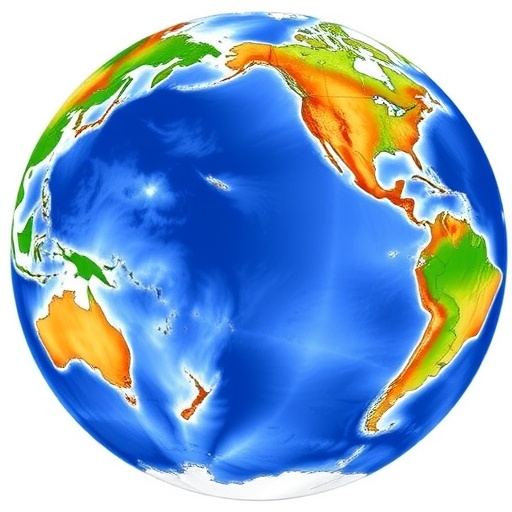
In a groundbreaking study poised to reshape our understanding of global climate dynamics, researchers have uncovered an asymmetric response between the Earth’s hemispheres to extratropical climate forcings, intricately mediated by the complex interplay with tropical Pacific oceanic and atmospheric coupling. This revelation, published in Communications Earth & Environment in 2026, challenges conventional paradigms that have largely treated hemispheric climate responses as symmetric or similarly lagged reactions to external forcing. The team, led by JY Moon, SI An, and MT Luongo, meticulously dissected the mechanisms by which extratropical inputs propagate their effects across global climatic systems, emphasizing the pivotal role played by the tropical Pacific basin.
Traditionally, climate models have assumed that forcing events in the extratropics—regions outside the tropics encompassing mid to high latitudes—result in relatively balanced or spatially predictable responses across the Northern and Southern Hemispheres. However, this study demonstrates that the hemispheres respond in markedly different manners, a phenomenon that has significant implications for climate prediction and risk assessment. Their results emerge from comprehensive simulations combining coupled ocean-atmosphere models with observational datasets that spanned multiple decades, allowing for unprecedented resolution of interhemispheric variability and feedback mechanisms.
Central to the researchers’ findings is the mediating role of the tropical Pacific Ocean, a region known for its climatic influence through phenomena like El Niño Southern Oscillation (ENSO). The study highlights how tropical Pacific coupling acts as a dynamic conduit, modulating and amplifying the signals from extratropical forcing. The interaction between sea surface temperatures, atmospheric circulation patterns, and ocean currents in this region orchestrates a cascade of processes that differentially impact hemispheric climates. This asymmetry, the scientists argue, hinges upon the distinct ocean-atmosphere dynamics unique to tropical Pacific coupling, which create divergent teleconnection patterns that alter how extratropical forcings manifest in each hemisphere.
One of the most remarkable insights from this work is the identification of feedback loops in the tropical Pacific that sustain and even enhance the climate asymmetry. For instance, changes in trade wind patterns initiated by extratropical disturbances can shift ocean upwelling and sea surface temperature distributions. These shifts, in turn, influence atmospheric convection and jetstream configurations, resulting in hemispheres exhibiting contrasting climate responses. The interplay between these feedbacks suggests that even subtle extratropical changes can induce disproportionately large and asymmetric impacts through tropical Pacific mediation.
Moreover, the spatial heterogeneity in the response contrasts with the previously held notion of relatively uniform hemispheric climate adjustment. The Northern Hemisphere exhibits a certain sensitivity tied to land-ocean contrasts and the presence of extensive continental masses which modulate atmospheric pressure systems differently than the ocean-dominated Southern Hemisphere. Simultaneously, the Southern Hemisphere’s vast oceanic expanses and the influence of the Antarctic Circumpolar Current introduce distinct pathways and timescales for the propagation of extratropical forcing signals. The tropical Pacific coupling effectively channels these distinct baseline conditions into asymmetric climate outcomes, a discovery with profound consequences for future climate projections.
The authors carefully dissect the role of ocean-atmosphere coupling by employing state-of-the-art climate models that incorporate realistic oceanic dynamics and atmospheric physics. Their simulations exclude symmetric forcing assumptions by isolating extratropical forcing effects and observing subsequent tropical Pacific responses. The results reveal how the tropical Pacific’s ocean-atmosphere interaction mechanisms, such as the Walker circulation and equatorial Kelvin waves, selectively amplify extratropical signals, creating a cross-hemispheric gradient in climate response. This selective amplification underscores the nonlinear and complex nature of climate system feedbacks.
Importantly, the work also sheds light on implications for extreme weather events and long-term climate variability. The asymmetric hemispheric response can modulate storm tracks, monsoon intensity, and drought-flood cycles differently across the hemispheres. As the climate system evolves under anthropogenic pressures, understanding these asymmetric responses becomes critical to improving predictive skill for regional climates, particularly for societies vulnerable to extreme weather impacts in the tropics and extratropics alike.
From a methodological perspective, the researchers bridged observational climatology and numerical modeling through rigorous data assimilation techniques. By combining high-resolution satellite datasets with in situ measurements and climate reanalysis products, they validated model outputs against observed hemispheric anomalies. This robust approach lent credibility to their discovery of asymmetric responses, grounding their conclusions not only in computational results but also in empirical evidence.
The ecological and socioeconomic ramifications of these asymmetric hemispheric changes are considerable. Differential shifts in precipitation and temperature regimes could impact agriculture, water resource management, and biodiversity conservation differently in the two hemispheres. Policymakers and climate mitigation strategists will need to incorporate hemispherically differentiated projections into adaptation planning to account for the uneven distribution of climate impacts highlighted by this study.
In a broader scientific context, this research challenges the prevailing assumption that tropical regions merely passively respond to extratropical forcings. Instead, it positions the tropical Pacific as an active dynamical hub capable of modulating global climate patterns through asymmetric hemispheric teleconnections. This reconceptualization encourages future research aimed at disentangling additional regional feedbacks and their coupling with global circulations.
The study also prompts reconsideration of future climate change scenarios under ongoing greenhouse warming. Since tropical Pacific coupling critically governs the asymmetric response, potential shifts in ENSO behavior, ocean stratification, and tropical convection patterns due to warming could further amplify or modify these hemispheric differences. Incorporating these complex dynamics into next-generation climate models will be essential for accurate climate sensitivity assessments and for anticipating shifts in climate variability modes.
Furthermore, the research opens new avenues for interdisciplinary collaboration, linking oceanography, atmospheric science, and climate physics. By elucidating the mechanisms through which extratropical forcing is relayed asymmetrically through tropical regions, it fosters integrated Earth system science approaches that transcend traditional zonal boundaries.
In conclusion, the study by Moon and colleagues represents a major leap forward in our understanding of hemispheric climate responses. By unveiling the asymmetric cross-hemispheric effects driven by tropical Pacific coupling, it enriches climate science with a nuanced perspective on global climate teleconnections. This insight offers a crucial step toward refining climate predictions, informing policy frameworks, and safeguarding societies from the multifaceted impacts of climate variability and change.
As humanity grapples with the intensifying challenges of climate change, the work underscores the intricate interconnectedness of Earth’s climate components. The tropical Pacific emerges not just as a passive region but as a formidable engine shaping hemispheric fates under extratropical influences. Future research inspired by these findings will be vital to unraveling further complexities and enhancing resilience in a warming world.
Cite Scienmag News
Violet Maxwell. (June 5, 2026). Tropical Pacific Links Uneven Climate Response Across Hemispheres. Scienmag. https://scienmag.com/tropical-pacific-links-uneven-climate-response-across-hemispheres/
Violet Maxwell. "Tropical Pacific Links Uneven Climate Response Across Hemispheres." Scienmag, 5 June 2026, https://scienmag.com/tropical-pacific-links-uneven-climate-response-across-hemispheres/. Accessed 4 September 2026.
Violet Maxwell. "Tropical Pacific Links Uneven Climate Response Across Hemispheres." Scienmag. June 5, 2026. https://scienmag.com/tropical-pacific-links-uneven-climate-response-across-hemispheres/


