


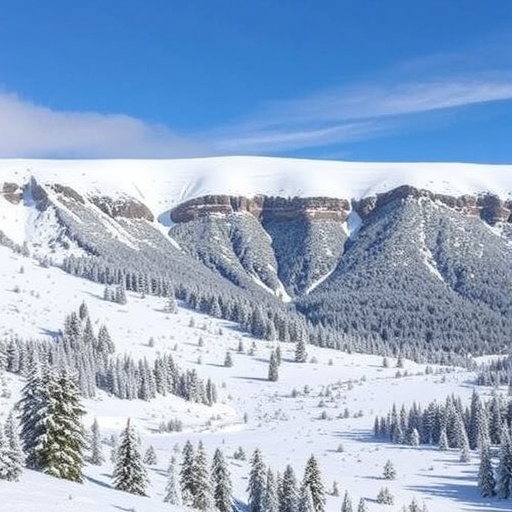
A severe snow drought like the one that affected the western United States in 2026 would have been about four times less likely before human-driven climate change, according to a new study published in the Proceedings of the National Academy of Sciences. The research suggests that the event was not impossible under preindustrial conditions, but that the warming climate has sharply increased the frequency with which unusually depleted snowpacks occur across the Pacific and Mountain West.
The study was conducted by scientists from Montana State University, the University of Wyoming and Colorado School of Mines. Marianne Cowherd, an assistant professor in MSU’s Department of Earth Sciences, was part of the research team. The scientists examined snow conditions across an 11-state region that included Montana and compared the statistical likelihood of a 2026-style snow drought under modern and preindustrial climates.
Snow droughts occur when a region receives unusually little snow or when existing snow disappears earlier than expected. Because mountain snowpack acts as a natural reservoir, these events can have consequences far beyond winter recreation. As snow accumulates during the cold season and melts during spring and early summer, it supplies water for cities, agriculture, ecosystems and hydropower. A reduced snowpack can therefore create water shortages months after the original winter weather has passed.
The researchers focused on snowpack conditions measured on March 15, a point in the season when mountain snow stores are typically near their annual maximum. Rather than relying on a single network of ground-based instruments, the team used a physics-based weather and snow model that incorporated satellite observations and measurements of the liquid-water content within the snowpack. This measurement, known as snow water equivalent, estimates how much water would be produced if the snow melted completely.
The analysis showed that the 2026 snowpack was not the lowest ever recorded. However, it was at or below the 10th percentile across the study region when compared with observations dating back to 1987. In other words, snow conditions were more depleted than those seen in roughly 90% of the years in the observational record. The researchers described the event as the lowest broadly distributed western U.S. snowpack observed during that approximately 40-year period.
The winter produced striking signs of unusual warmth and early snow loss. Ski areas experienced shortened seasons, and Bridger Bowl in Montana closed earlier than expected. Warm conditions in February raised a question that often follows extreme weather: was the event simply a rare example of natural climate variability, or had human-caused warming made it more likely? To answer that question, the scientists used a method known as climate attribution, which compares the probability of an event in different climate states.
Before conducting the attribution analysis, the team tested whether its model could reproduce the observed characteristics of the 2026 snow drought. Once the model demonstrated that it could represent the event, the researchers simulated large sets of winters under two different climate backgrounds. One represented the current climate, using conditions beginning in 2016 and projecting them through 2036. The other represented the preindustrial climate between 1850 and 1900, before large-scale carbon emissions from industry substantially altered global temperatures.
The simulations produced a major difference in the frequency of snow drought. Under the current climate, a drought meeting the study’s criteria was expected to occur approximately once every 6.8 years. Under preindustrial conditions, the same type of event was projected to occur only once every 30 years. These estimates indicate that the modern event was roughly four times more likely because of climate change, even though natural variability could still produce an isolated snow drought in a world without industrial warming.
The physical explanation is closely tied to temperature. A warmer atmosphere can hold more moisture, which may increase heavy snowfall under the right conditions. But in many western mountain regions, winter temperatures are already close to the freezing point. Small increases in temperature can therefore shift precipitation from snow to rain, particularly at lower and middle elevations. Warmer conditions also accelerate the melting of snow that has already accumulated, causing the seasonal reservoir to shrink earlier and leaving less water available during the dry season.
The findings do not mean that every year with low snowpack is directly caused by climate change, nor do they predict identical conditions across every mountain range. Instead, they show how a warming climate changes the odds. Events that were once rare can become recurring features of the western winter landscape, increasing pressure on water managers and communities that depend on reliable spring runoff. “It is not impossible for these types of events to happen without climate change,” Cowherd said, “but they’re so much more rare.”
Web References: https://www.pnas.org/doi/10.1073/pnas.2612961123
References: Proceedings of the National Academy of Sciences; DOI: 10.1073/pnas.2612961123
Cite Scienmag News
Sloane Callahan. (August 6, 2026). Climate change increases severe snow droughts across western U.S., study finds. Scienmag. https://scienmag.com/climate-change-increases-severe-snow-droughts-across-western-u-s-study-finds/
Sloane Callahan. "Climate change increases severe snow droughts across western U.S., study finds." Scienmag, 6 August 2026, https://scienmag.com/climate-change-increases-severe-snow-droughts-across-western-u-s-study-finds/. Accessed 3 September 2026.
Sloane Callahan. "Climate change increases severe snow droughts across western U.S., study finds." Scienmag. August 6, 2026. https://scienmag.com/climate-change-increases-severe-snow-droughts-across-western-u-s-study-finds/


