


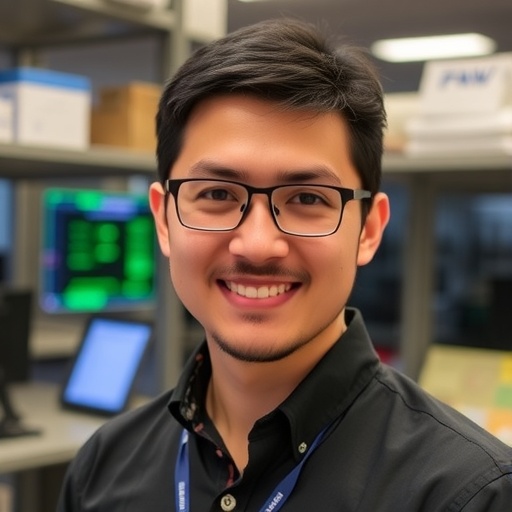
Artificial intelligence is moving from the laboratory into the machinery of scientific discovery, and a University of Central Florida researcher is helping lead that transformation through the U.S. Department of Energy’s Genesis Mission. Haonan Ling, an assistant professor of mechanical and aerospace engineering, is developing an AI-powered “digital twin” designed to make biomanufacturing faster, more reliable and easier to scale. The technology could help engineers produce fuels and chemicals from biological systems while reducing the costly trial and error that has slowed industrial adoption of sustainable manufacturing.
The Genesis Mission is a nationwide effort to create advanced artificial intelligence models and scientific workflows capable of tackling major challenges in energy, biotechnology, advanced manufacturing, critical materials and quantum information. Its central idea is to combine the power of AI with the expertise of researchers, industry partners and national laboratories. Instead of treating AI as a tool used only after experiments are completed, the initiative aims to integrate intelligent systems directly into the scientific process, allowing them to analyze data, predict outcomes and guide the next experiment in near real time.
Ling’s project focuses on a persistent problem in biomanufacturing: processes that work successfully in a small laboratory vessel often become unstable, inefficient or prohibitively expensive when they are expanded to industrial scale. Microorganisms and biological catalysts can be used to convert renewable feedstocks into fuels, chemicals and other valuable products, but their performance depends on tightly coupled variables such as temperature, acidity, nutrient concentrations, oxygen availability, mixing and metabolic activity. A minor change in one factor can disrupt the entire process, making scale-up slow and vulnerable to failure.
To address this challenge, Ling and his collaborators will create an AI digital twin, a computational replica of a physical biomanufacturing process. The system will combine sensor measurements, mechanistic knowledge and machine-learning algorithms to represent how the process behaves over time. Unlike a static simulation, the digital twin is intended to update continuously as new data arrive. It could identify patterns that are difficult for human operators to detect, forecast how a culture or reactor will respond to changing conditions, and recommend adjustments before production problems become irreversible.
The approach could transform bioprocess monitoring and control. In a conventional facility, engineers may need to collect samples, analyze them in a laboratory and then decide how to modify operating conditions. That sequence can introduce delays, particularly when biological systems change rapidly. Ling’s project will pursue real-time sensing and data interpretation so that the digital twin can provide a constantly updated picture of the process. By comparing observed behavior with predicted behavior, the system may detect early signs of contamination, declining productivity or unwanted shifts in metabolism and help operators respond more quickly.
A key component will be a real-time sensor developed and tested by Pinzhen Lin, who is scheduled to begin a doctoral program at UCF’s College of Optics and Photonics in fall 2026. Lin will lead the sensor’s development, characterization and performance benchmarking. The sensor is expected to supply the digital twin with timely information about the biological process, while testing will determine how accurately and consistently it performs under changing operating conditions. Jirui Fu, a 2024 doctoral graduate in mechanical engineering and a postdoctoral scholar in UCF’s College of Engineering and Computer Science, will also contribute to the project.
Ling is working with Kansas State University Assistant Professor Yian Chen and researchers from the National Laboratory of the Rockies, including Ajinkya Pal, Jason DesVeaux and Evan Komp. Their collaboration reflects the Genesis Mission’s emphasis on connecting universities, national laboratories and industry. Such partnerships are especially important for digital-twin technology because the system must work across several layers at once: advanced sensors must capture reliable data, mathematical models must describe biological and physical behavior, machine-learning systems must identify useful patterns, and engineers must translate predictions into safe operating decisions.
The potential impact extends beyond a single biomanufacturing facility. If the digital twin can accurately predict and optimize production, it could shorten development timelines and reduce the financial risk associated with scaling new biological processes. Companies could use similar systems to evaluate alternative feedstocks, optimize fermentation conditions, test process changes virtually and identify the most promising routes before investing in large equipment. The framework could also support more flexible facilities capable of producing multiple fuels or chemicals, a capability that may become increasingly valuable as industries seek lower-carbon alternatives to petroleum-based manufacturing.
The project arrives as artificial intelligence is becoming increasingly embedded in scientific research, but Ling emphasizes that its value will depend on more than impressive algorithms. An AI system used in biomanufacturing must operate with incomplete data, account for complex biological interactions and provide predictions that engineers can interpret and trust. It must also remain robust when conditions differ from those used to train it. By combining real-time measurement with physical understanding of the process, the team hopes to create a system that is not merely capable of recognizing correlations, but useful for making dependable decisions in the real world.
Supported by the Department of Energy’s Office of Science through the Genesis Mission, the work could offer a model for how AI accelerates discovery in fields where experimentation is expensive and biological systems are difficult to control. Ling says the long-term goal is to make sustainable biomanufacturing faster, cheaper and less risky, potentially lowering the barriers for industrial partners to adopt bio-based processes. If successful, the digital twin could become a commercial platform applicable across energy, chemicals and materials, demonstrating how virtual replicas of physical systems can turn scientific data into faster innovation.
Web References: https://www.ucf.edu/artificial-intelligence/ ; https://www.ucf.edu/college/optics-photonics/ ; https://www.ucf.edu/degree/mechanical-engineering-phd/ ; https://www.ucf.edu/college/engineering-computer-science/
Cite Scienmag News
Courtney Benton. (August 6, 2026). UCF Researcher Joins DOE Project Using AI to Accelerate Scientific Discovery. Scienmag. https://scienmag.com/ucf-researcher-joins-doe-project-using-ai-to-accelerate-scientific-discovery/
Courtney Benton. "UCF Researcher Joins DOE Project Using AI to Accelerate Scientific Discovery." Scienmag, 6 August 2026, https://scienmag.com/ucf-researcher-joins-doe-project-using-ai-to-accelerate-scientific-discovery/. Accessed 3 September 2026.
Courtney Benton. "UCF Researcher Joins DOE Project Using AI to Accelerate Scientific Discovery." Scienmag. August 6, 2026. https://scienmag.com/ucf-researcher-joins-doe-project-using-ai-to-accelerate-scientific-discovery/


