


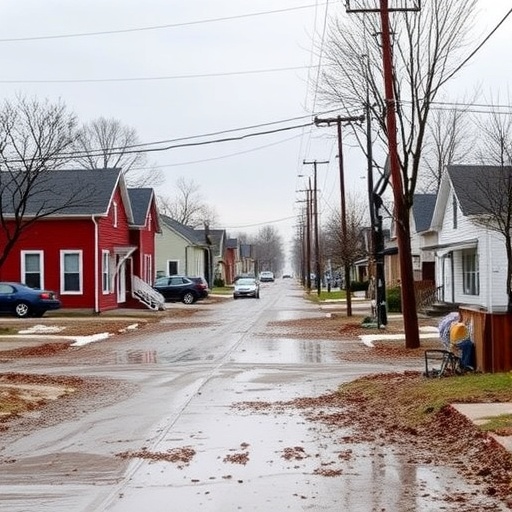
A new study is putting a critical question at the center of disaster science: what happens after the emergency ends, when communities must rebuild while the next threat may already be approaching? In “Enhancing resilience through recovery modeling in multi-hazard contexts,” published in Communications Engineering, researchers P. Kourehpaz, C. Galasso and C. Molina Hutt examine how recovery can be modeled in places exposed to several hazards at once. Their work highlights a major weakness in conventional disaster planning: recovery is often treated as a single, predictable process, even though real communities face overlapping shocks, cascading failures and highly uneven rebuilding timelines.
Traditional resilience assessments frequently focus on whether buildings, bridges or infrastructure systems can withstand a single event such as an earthquake, flood or hurricane. But hazards rarely respect those boundaries. A flood can damage roads needed for emergency access, an earthquake can disrupt water and electricity networks, and a later storm can strike while repairs are still underway. These interactions create what scientists call compound or multi-hazard conditions. The researchers’ approach centers on modeling recovery as a dynamic process, allowing analysts to explore how damage, repair capacity and future hazards influence one another over time.
Recovery modeling differs from simply calculating initial losses. It attempts to represent the trajectory of a system as it moves from disruption toward restored—or sometimes transformed—function. That trajectory may be described through recovery curves, which track how quickly services such as transportation, power, healthcare or housing return to operation. A rapid initial repair may not guarantee full recovery if critical bottlenecks remain. Likewise, a community may appear to be recovering while vulnerable households, small businesses or isolated neighborhoods continue to experience prolonged disruption.
The technical challenge becomes significantly more complex when multiple hazards are included. Models must account not only for the probability and intensity of each event, but also for dependencies between infrastructure systems and the possibility that one disaster changes the consequences of another. A damaged road network can slow repair crews; a power outage can disable water treatment; and a shortage of construction materials can delay rebuilding across an entire region. By incorporating these relationships, recovery models can move beyond static maps of risk and simulate how disruption propagates through interconnected social and engineered systems.
One of the most important implications of this framework is that resilience cannot be measured solely by the strength of individual structures. A building may survive an earthquake, yet the surrounding community may remain functionally disconnected if roads, communications or hospitals fail. In the same way, an upgraded drainage system may reduce flood damage but provide limited protection if housing, electricity and emergency services are not able to recover together. Multi-hazard recovery modeling therefore encourages decision-makers to assess infrastructure as part of a larger network rather than as isolated assets.
Such models can also expose hidden trade-offs in disaster investment. Strengthening one component may produce limited benefits if another critical dependency remains weak. For example, hardening a hospital against flooding may not ensure continuity of care if access roads are impassable or backup power systems depend on fuel deliveries that cannot reach the facility. Modeling different interventions allows planners to compare strategies, identify bottlenecks and prioritize measures that improve recovery across several systems simultaneously. The result is a shift from asking how much damage a hazard causes to asking how quickly essential functions can be restored and for whom.
The human dimension is equally important. Recovery is rarely uniform across a city or region. Wealthier households may have insurance, savings and access to temporary housing, while lower-income residents can face extended displacement and reduced employment opportunities. People with disabilities, older adults and communities located far from major services may experience additional barriers. A technically sophisticated recovery model that overlooks these differences could present an overly optimistic picture of resilience. The study’s emphasis on recovery modeling points toward a more comprehensive assessment in which social vulnerability and unequal access to resources are treated as central variables.
The approach is particularly relevant as climate change increases the likelihood of repeated and interacting hazards. Rising temperatures, shifting rainfall patterns, sea-level rise and more intense storms are altering the conditions under which infrastructure is designed and maintained. At the same time, urban growth is placing more people and economic activity in exposed areas. A community may no longer have decades between major disasters to rebuild according to a traditional timetable. Planning tools that can represent repeated shocks, partial recovery and changing risk could help authorities test whether current strategies remain effective under future conditions.
The researchers’ contribution arrives at a moment when resilience is becoming less about returning to an earlier normal and more about making informed choices under uncertainty. Recovery models cannot predict every disaster or eliminate the political and financial challenges of rebuilding, but they can make complex consequences easier to see before a crisis occurs. By connecting hazard analysis with infrastructure dependencies, repair processes and social impacts, this line of research offers a way to turn resilience from a slogan into a measurable, testable planning objective. The central message is strikingly simple: surviving the first disaster is only the beginning; true resilience is demonstrated by how a community recovers when hazards keep coming.
Cite Scienmag News
Denise Maddox. (August 6, 2026). Recovery Modeling Helps Communities Build Resilience Against Multiple Hazards. Scienmag. https://scienmag.com/recovery-modeling-helps-communities-build-resilience-against-multiple-hazards/
Denise Maddox. "Recovery Modeling Helps Communities Build Resilience Against Multiple Hazards." Scienmag, 6 August 2026, https://scienmag.com/recovery-modeling-helps-communities-build-resilience-against-multiple-hazards/. Accessed 3 September 2026.
Denise Maddox. "Recovery Modeling Helps Communities Build Resilience Against Multiple Hazards." Scienmag. August 6, 2026. https://scienmag.com/recovery-modeling-helps-communities-build-resilience-against-multiple-hazards/


