


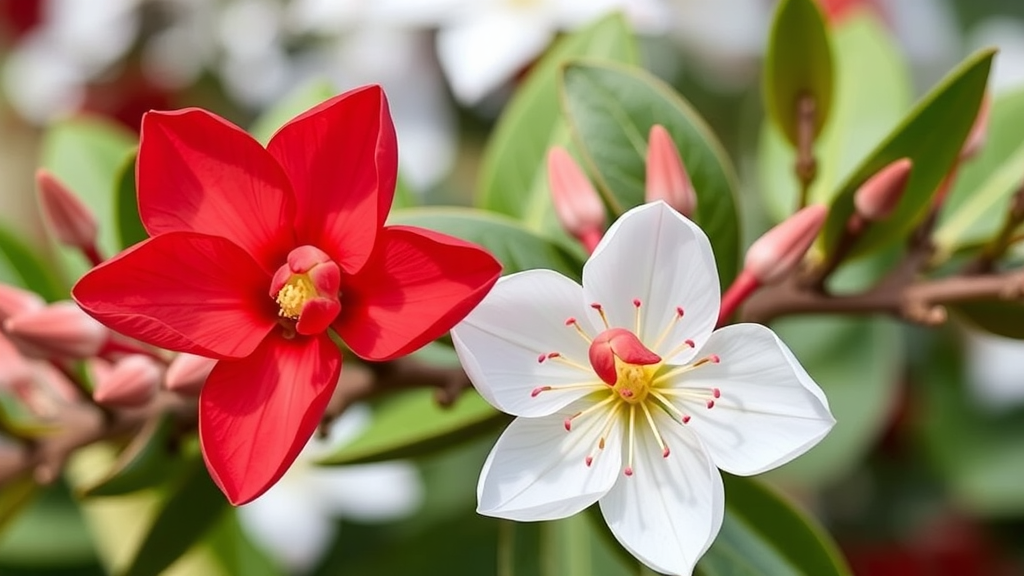
A single eucalyptus tree species can wear two very different floral costumes, and according to new research, the color of its blossoms may hint at a deeper chemical story unfolding inside its leaves. In a study published in Plant Biosystems, a team of Algerian researchers compared the red-flowered and white-flowered forms of Eucalyptus sideroxylon, a member of the Myrtaceae family prized both as an ornamental and as a source of bioactive plant compounds. By combining classical phytochemical assays with chromatographic and spectroscopic profiling, the scientists mapped out how secondary metabolites distribute across the two color forms and tested how those chemical differences translate into antioxidant, antimicrobial, antidiabetic and anti-inflammatory activity in the laboratory.
The investigation began with a deceptively simple question: does flower color correlate with leaf chemistry? Understanding phytochemical variability within a species matters because it shapes how researchers and industries select plant material for natural product discovery. If two visually distinct forms of the same tree accumulate different suites of phenolic compounds, then any pharmacological or food-industry application of E. sideroxylon could depend heavily on which form is harvested, and even on which solvent is used during extraction. The team therefore designed a systematic comparison, extracting leaf material from each form with both methanol and ethanol and then subjecting the resulting extracts to a battery of quantitative and analytical tests.
The quantitative results were striking. Methanolic extracts consistently outperformed their ethanolic counterparts in total secondary metabolite content, and the red-flowered form stood out with a total phenolic content reaching 528.40 milligrams of gallic acid equivalents per gram of dry weight. Condensed tannins were also abundant, peaking at 334.60 milligrams of tannic acid equivalents per gram of dry weight, while flavonoid contents ranged between 60.40 and 64.60 milligrams per gram of dry weight. These figures place E. sideroxylon among the more phenolic-rich eucalypts examined in the broader literature, and they underscore why solvent choice is such a critical variable: methanol, being more polar, appears to draw a richer load of phenolics out of the leaf matrix than ethanol does.
To move beyond bulk measurements, the researchers turned to high-performance liquid chromatography coupled with diode-array detection, a technique that separates individual compounds and records their characteristic light absorption spectra. This HPLC-DAD profiling allowed the tentative annotation of seventeen phenolic compounds, whose relative abundances shifted according to both the extraction solvent and the flower-color form. Rutin, myricetin and diosmin emerged as among the most abundant putatively assigned compounds in the methanolic extract of the white-flowered form, whereas morin hydrate was particularly prominent in the ethanolic extract of the red-flowered form. Such differences are chemically meaningful: rutin and myricetin are flavonoids with well-documented antioxidant behavior, while morin hydrate has attracted attention for its wide-ranging pharmacological potential.
Complementing the chromatography, the team applied attenuated total reflectance Fourier-transform infrared spectroscopy, or ATR-FTIR, a rapid fingerprinting method that identifies functional groups within a sample by measuring how its molecular bonds absorb infrared light. The spectra revealed absorption features consistent with phenolic compounds, including signals attributable to hydroxyl groups and aromatic ring structures, and the spectroscopic patterns supported the trends observed chromatographically. This dual confirmation matters because it demonstrates that two independent analytical windows, one separation-based and one vibration-based, tell a coherent story about the chemical composition of the extracts, lending weight to the tentative compound assignments made by HPLC-DAD alone.
Biological testing followed, and the extracts delivered a series of concentration-dependent effects. In the DPPH radical scavenging assay, a standard measure of antioxidant capacity, all four extracts neutralized free radicals in a dose-dependent fashion, with the methanolic extracts again leading the pack. The white-flowered methanolic extract achieved an IC50 of 109.30 micrograms per milliliter, meaning that concentration sufficed to quench half of the radicals present, while the red-flowered methanolic extract required 151.10 micrograms per milliliter. Lower IC50 values indicate stronger antioxidant activity, so the white-flowered form’s methanolic extract was the most potent radical scavenger in this comparison, an outcome consistent with its flavonoid-rich profile.
Antimicrobial screening added another dimension. The extracts inhibited microbial growth in a concentration-dependent manner, with the largest inhibition zones measuring 15 millimeters against the Gram-positive bacterium Bacillus subtilis and 18 millimeters against the yeast Candida albicans. The authors are careful to frame these results as initial screening evidence rather than definitive antimicrobial potency data, but the pattern aligns with a substantial body of literature showing that plant phenolics, particularly flavonoids, can disrupt microbial membranes and interfere with microbial metabolism. The activity against Candida albicans is especially noteworthy given the clinical challenge posed by fungal infections and the ongoing search for plant-derived antifungal leads.
Perhaps the most pharmacologically intriguing results concerned enzyme inhibition and membrane protection. The extracts suppressed alpha-amylase, the digestive enzyme that breaks down starch into sugars, with the strongest preparation achieving 74.36 percent inhibition and an IC50 of 3.33 milligrams per milliliter. Kinetic analysis suggested an apparent competitive mode of inhibition under the experimental conditions, meaning the extracts’ constituents appear to compete with starch for the enzyme’s active site, a mechanism directly relevant to managing post-meal blood glucose spikes. However, the authors caution that this inhibition pattern requires validation through nonlinear kinetic modeling and independent determination of inhibition constants before firm mechanistic conclusions can be drawn. On the anti-inflammatory front, the extracts stabilized biological membranes, protecting up to 42.02 percent of red blood cells against heat-induced hemolysis, with methanolic extracts generally outperforming ethanolic ones. Because membrane stabilization is considered a plausible in vitro proxy for anti-inflammatory action, this result opens a tentative window onto the extracts’ therapeutic potential.
The researchers are equally candid about the limits of their work, and that transparency is itself scientifically valuable. Only one biological specimen from each flower-color variant was sampled, so the findings describe the particular extracts examined rather than population-level differences between red- and white-flowered E. sideroxylon as a whole. Tree age, season, soil, climate and local growing conditions can all influence phenolic accumulation, and a single tree per form cannot disentangle genetic flower-color effects from environmental noise. The team explicitly recommends broader sampling and complementary analytical approaches, including more rigorous enzyme kinetics, to test whether the observed chemical and biological patterns hold up across populations and to establish their biological significance.
Even with those caveats, the study adds a compelling chapter to the natural products literature surrounding eucalypts, a genus already celebrated for essential oils, polyphenols and antimicrobial compounds. It demonstrates, with technical rigor, that a visible trait like flower color can accompany measurable shifts in leaf chemistry and bioactivity, and it highlights how extraction solvent acts as a powerful lever on both composition and function. For researchers hunting new antioxidants, antifungal agents or alpha-amylase inhibitors, the message is that E. sideroxylon deserves closer attention, and that the red and white forms may offer subtly different chemical toolkits. For the wider public, it is a reminder that the chemistry of a familiar street tree can be far richer, and far more variable, than its appearance suggests.
Subject of Research: Comparative phytochemical profiling and biological activities of red- and white-flowered forms of Eucalyptus sideroxylon
Article Title: Comparative phytochemical profiling and biological activities of red- and white-flowered forms of Eucalyptus sideroxylon (Myrtaceae)
Article References: Comparative phytochemical profiling and biological activities of red- and white-flowered forms of Eucalyptus sideroxylon (Myrtaceae). (n.d.). https://doi.org/10.1007/s44473-026-00273-8
Image Credits: AI Generated
DOI: 10.1007/s44473-026-00273-8
Keywords: Eucalyptus sideroxylon, phytochemical profiling, phenolic compounds, flavonoids, antioxidant activity, antimicrobial activity, alpha-amylase inhibition, anti-inflammatory activity, HPLC-DAD, ATR-FTIR spectroscopy, solvent extraction, Myrtaceae
Cite Scienmag News
Bethany Barker. (September 24, 2026). Red or White Blooms, Different Chemistry: Eucalyptus Study Reveals Flower-Color Link to Potent Antioxidants. Scienmag. https://scienmag.com/red-or-white-blooms-different-chemistry-eucalyptus-study-reveals-flower-color-link-to-potent-antioxidants/
Bethany Barker. "Red or White Blooms, Different Chemistry: Eucalyptus Study Reveals Flower-Color Link to Potent Antioxidants." Scienmag, 24 September 2026, https://scienmag.com/red-or-white-blooms-different-chemistry-eucalyptus-study-reveals-flower-color-link-to-potent-antioxidants/. Accessed 5 October 2026.
Bethany Barker. "Red or White Blooms, Different Chemistry: Eucalyptus Study Reveals Flower-Color Link to Potent Antioxidants." Scienmag. September 24, 2026. https://scienmag.com/red-or-white-blooms-different-chemistry-eucalyptus-study-reveals-flower-color-link-to-potent-antioxidants/


