


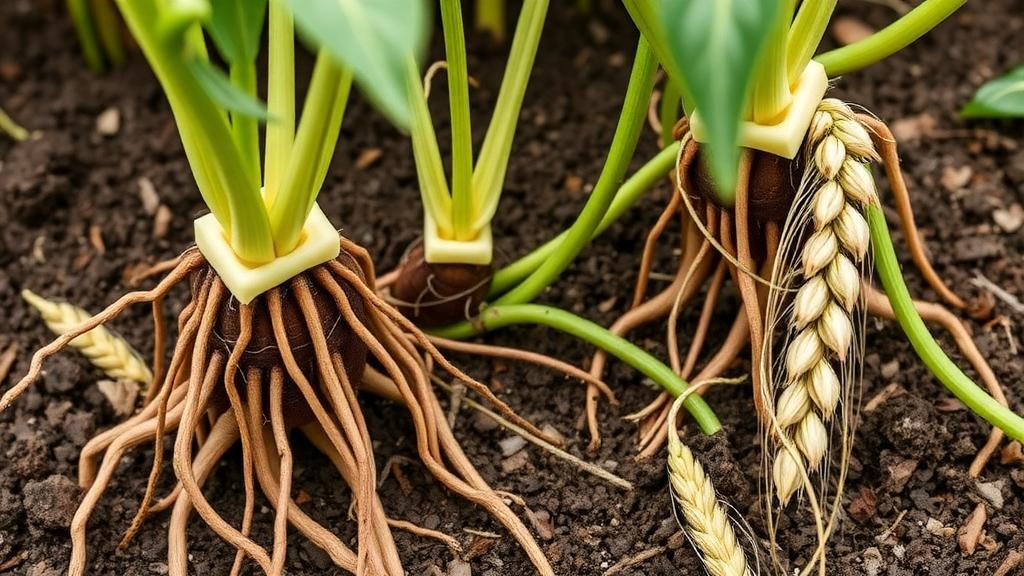
Underground, plants are talking. In the wheat and faba bean fields of southwestern China, researchers have now traced one of these conversations molecule by molecule, showing that a stressed faba bean plant can send chemical distress signals through the soil, prompting its wheat neighbor to flood its own roots with antifungal weapons. The result is a striking example of what scientists call the “call-for-help” strategy, and it may explain why intercropping these two crops so reliably suppresses one of faba bean’s most destructive diseases.
The study, published in the Journal of Agriculture and Food Research, focused on Fusarium oxysporum f. sp. fabae, a soil-borne fungus that causes devastating wilt in faba bean. Farmers in Yunnan Province have long observed that growing wheat alongside faba bean reduces wilt incidence, but the underlying chemistry remained murky. The new work, led by Bijie Hu and colleagues, connects the dots across three levels: the signals released by sick faba bean roots, the defensive compounds those signals induce in wheat, and the lethal effects of those compounds on the pathogen itself.
The team began with hydroponic experiments in which faba bean plants were grown alone or alongside wheat, and then subjected to three kinds of stress: the fungal pathogen itself, cinnamic acid as a stand-in for abiotic stress, and both together. Using untargeted metabolomics of root exudates, they found dramatic shifts in the chemical composition of what stressed faba bean roots released into their surroundings. Under combined stress, more than 770 differential metabolites were detected compared with unstressed monoculture plants, with the vast majority upregulated.
Pathway analysis pointed consistently toward secondary metabolism, including flavonoid biosynthesis and plant hormone signal transduction. When the researchers screened for metabolites that were upregulated across every stress treatment, four candidates stood out: jasmonic acid, salicylic acid, allantoin, and luteolin. Quantitative measurements confirmed that faba bean boosted secretion of these compounds under biotic and abiotic stress alike, and that intercropping pushed the levels even higher. In field plots, intercropping raised jasmonic acid in the root zone by nearly 64 percent, salicylic acid by about 46 percent, and allantoin by roughly 15 percent compared with faba bean grown alone.
These molecules are well-known players in plant stress biology. Jasmonic acid and salicylic acid are classic defense hormones, while allantoin is a nitrogen-rich metabolite linked to oxidative stress responses. The authors interpret their coordinated release as a broadcast distress call, a chemical SOS that neighboring plants can detect and respond to. Analogous systems have been documented elsewhere: chili plants under attack induce benzoxazinoid production in adjacent corn, and barnyard grass releases jasmonic acid that prompts rice to pump out allelopathic compounds.
To test whether wheat actually listens, the team applied jasmonic acid, salicylic acid, and allantoin exogenously to wheat at concentrations matching those found in faba bean exudates, then measured benzoxazinoid levels in wheat leaves and rhizosphere soil. The response was clear. Salicylic acid treatment raised DIMBOA content in wheat leaf tissue by up to 96 percent and MBOA by nearly 60 percent. Jasmonic acid and allantoin produced similarly robust, dose-dependent increases. Crucially, the benzoxazinoids also accumulated in the rhizosphere soil, confirming that wheat not only synthesized the compounds but secreted them into the soil where the pathogen lives.
Benzoxazinoids such as DIMBOA and MBOA are defensive secondary metabolites produced almost exclusively by grasses, the Poaceae family that includes wheat, maize, and their relatives. The next question was what these compounds do to the fungus. In a clever microscopy setup using capillary grooves on glass slides, the researchers observed that FOF spores actively accumulate in the wheat rhizosphere, with numbers rising over 20 minutes of observation. Rather than avoiding wheat, the pathogen is drawn toward it, a positive chemotactic response that previous work suggests is driven in part by the benzoxazinoids themselves.
That attraction sets up what the authors describe as an “attract-and-kill” strategy. In liquid culture, DIMBOA and MBOA reduced FOF mycelial biomass in a concentration-dependent manner, with the strongest suppression at 150 micrograms per milliliter, cutting fungal growth by roughly 38 percent. Fluorescent staining revealed that the compounds also crippled biofilm formation, a key step in fungal establishment, and induced apoptotic vesicles in FOF spores, hallmarks of programmed cell death. The mechanism, the authors suggest, involves reactive oxygen species: benzoxazinoids trigger bursts of intracellular ROS that overwhelm the fungus’s antioxidant defenses, damaging mitochondrial and cytoplasmic function until the cells die.
Perhaps the most surprising finding came from germination tests. Far from being toxic to the crop it protects, the wheat-derived benzoxazinoids actually stimulated faba bean seed germination. DIMBOA treatment increased germination potential, germination index, vigor index, and seedling length, with vigor index gains reaching nearly 900 percent under some conditions, and the effects held even when seeds were simultaneously challenged with the pathogen. The authors speculate that benzoxazinoids may act somewhat like hormones, stimulating cell division and metabolic activity in germinating seeds, though they caution that the precise mechanism remains to be established.
Taken together, the study sketches a complete chemical circuit: a stressed faba bean root releases jasmonic acid, salicylic acid, and allantoin; wheat senses these signals and ramps up benzoxazinoid biosynthesis and secretion; the pathogen, lured by chemotactic cues, gathers at the wheat rhizosphere where the accumulated DIMBOA and MBOA suppress its growth, dismantle its biofilms, and push its cells into programmed death. The authors are careful to note that the links between exudate composition, benzoxazinoid induction, and fungal viability are associations, and that further work is needed to fully establish the causal mechanisms, including quantifying spore apoptosis with flow cytometry. Even so, the findings offer a compelling blueprint for disease-suppressive agriculture, suggesting that the right crop combinations can turn a field into a coordinated chemical defense network, reducing reliance on fungicides while potentially giving seedlings a head start. In an era when crop diversity is increasingly promoted for sustainable intensification, this underground conversation between a legume and a grass shows just how sophisticated plant-plant communication can be, and how much agronomic value may be hiding in the chemistry of the rhizosphere.
Subject of Research: Chemical communication between faba bean and wheat roots that induces benzoxazinoid defenses suppressing Fusarium wilt
Article Title: Root exudate-mediated plant chemical communication induces benzoxazinoid synthesis in wheat and suppresses Fusarium oxysporum f. sp. fabae activity in faba bean
Article References: Hu, B., Li, T., Yang, S., & Dong, Y. (2026). Root exudate-mediated plant chemical communication induces benzoxazinoid synthesis in wheat and suppresses Fusarium oxysporum f. sp. fabae activity in faba bean. Journal of Agriculture and Food Research, 31, Article 103324. https://doi.org/10.1016/j.jafr.2026.103324
Image Credits: AI Generated
DOI: 10.1016/j.jafr.2026.103324
Keywords: intercropping, root exudates, benzoxazinoids, DIMBOA, MBOA, jasmonic acid, salicylic acid, Fusarium oxysporum, faba bean wilt, plant chemical communication, attract-and-kill, rhizosphere
Cite Scienmag News
Alan Morgan. (October 5, 2026). Stressed Faba Bean Roots Call Wheat for Help, Triggering a Chemical Defense That Kills Wilt Fungus. Scienmag. https://scienmag.com/stressed-faba-bean-roots-call-wheat-for-help-triggering-a-chemical-defense-that-kills-wilt-fungus/
Alan Morgan. "Stressed Faba Bean Roots Call Wheat for Help, Triggering a Chemical Defense That Kills Wilt Fungus." Scienmag, 5 October 2026, https://scienmag.com/stressed-faba-bean-roots-call-wheat-for-help-triggering-a-chemical-defense-that-kills-wilt-fungus/. Accessed 5 October 2026.
Alan Morgan. "Stressed Faba Bean Roots Call Wheat for Help, Triggering a Chemical Defense That Kills Wilt Fungus." Scienmag. October 5, 2026. https://scienmag.com/stressed-faba-bean-roots-call-wheat-for-help-triggering-a-chemical-defense-that-kills-wilt-fungus/


