


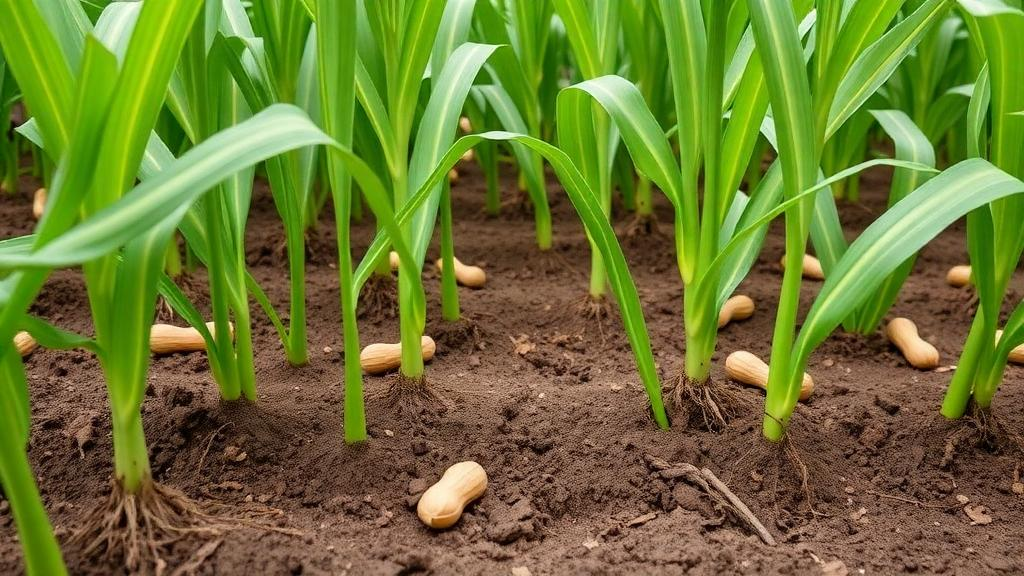
When farmers plant maize and peanut together in the same field, something remarkable happens beneath the soil surface. The two crops do not merely coexist; they enter into a chemical conversation that unlocks nutrients neither could access alone. A new study published in Plant and Soil by Nanxian Xiu, Dongying Zhou, and colleagues at Shenyang Agricultural University has now dissected this underground dialogue at the molecular level, revealing that root exudates—the cocktails of organic acids, amino acids, and other metabolites that roots leak into surrounding soil—are the key agents that allow intercropped maize and peanut to thrive even when potassium is scarce.
Potassium is one of the three macronutrients every crop needs in large quantities, and it plays a decisive role in water regulation, enzyme activation, photosynthesis, and stress tolerance. Yet much of the potassium in agricultural soils is locked away in forms that plant roots cannot absorb. Soil potassium exists along a continuum of availability: there is the readily available fraction dissolved in soil water and held on exchange sites of clay particles, a slower-release pool of non-exchangeable potassium trapped between the layers of clay minerals such as micas and illites, and finally the vast mineral reservoir embedded in the crystal lattices of potassium-bearing minerals like feldspars and micas. When fertilizer supplies run short, plants depend on their ability to coax potassium out of these reluctant pools, and that is precisely where root chemistry becomes decisive.
The research team designed a pot experiment that manipulated three variables simultaneously: potassium supply, planting pattern, and the irrigation of plants with root exudates collected from either maize or peanut. This elegant design allowed the researchers to separate the physical effects of having two species share a rooting volume from the purely chemical effects of the exudates themselves. They grew maize and peanut both alone and intercropped, under adequate and low potassium conditions, and then watered some plants with exudate solutions harvested from the roots of the other species. Across all treatments, the team measured plant dry matter, potassium uptake, the pools of available, non-exchangeable, and mineral potassium in the rhizosphere—the narrow zone of soil directly influenced by roots—along with rhizosphere pH, acid phosphatase activity, and comprehensive metabolomic profiles of the root exudates.
The results were striking in their asymmetry. Intercropping significantly promoted maize growth and nutrient accumulation, but it did not directly promote peanut growth when the two crops shared a pot. Low potassium, as expected, reduced biomass, root development, and potassium uptake in both species. Yet the intercropping treatment and, crucially, the irrigation of peanut with maize-derived root exudates partially alleviated these deficiencies, with the strongest rescue effects observed in peanut under low potassium stress. In other words, maize roots were secreting something that peanut roots could exploit. When peanut plants received maize root exudates, their dry matter and potassium accumulation increased, and the available potassium in their rhizosphere rose as well. The effect was amplified precisely when potassium was most limiting, suggesting that the exudate-mediated mechanism is most valuable under the very conditions where farmers can least afford yield losses.
The reciprocity, however, was not equal. Peanut root exudates had only limited effects on maize, indicating that the facilitation runs predominantly from the cereal to the legume in this pairing. This directional asymmetry fits a broader pattern documented in other cereal-legume intercropping systems, where the deep-rooted, vigorously growing cereal partner acts as a chemical engineer of the shared soil environment while the legume reaps substantial benefits. Previous work by some of the same research groups had shown that maize-peanut intercropping improves nitrogen accumulation in maize by promoting the secretion of flavonoids and enriching beneficial rhizosphere bacteria; the new study extends this framework to potassium, demonstrating that the same interspecific chemistry governs multiple nutrient cycles simultaneously.
To understand what exactly was happening at the metabolite level, the researchers profiled the root exudates using metabolomic techniques and compared the chemical signatures of maize and peanut grown alone versus intercropped, under sufficient versus low potassium. Under low potassium intercropping, both species ramped up the release of organic acids, phenolic acids, and amino acid derivatives. Several of the upregulated organic acids are well-known players in rhizosphere acidification and mineral weathering. Organic acids such as citrate, malate, and oxalate can dissolve potassium from the interlayers of clay minerals and from the surfaces of primary minerals by donating protons and by chelating the metal ions that hold mineral structures together. This dual action—acidification plus complexation—releases potassium ions into the soil solution where roots can finally absorb them.
The correlation analysis provided the most compelling mechanistic evidence. In peanut, six upregulated organic acids were negatively correlated with rhizosphere pH and with the content of non-exchangeable potassium. A negative correlation with pH means that as these acids accumulated, the rhizosphere became more acidic; a negative correlation with non-exchangeable potassium means that as the acids accumulated, this stubborn potassium pool was depleted. Together, the two correlations sketch a coherent causal chain: intercropping and low potassium stress stimulate peanut roots to exude more organic acids, these acids lower the local pH and attack the fixed potassium reserves in clay interlayers, the released potassium replenishes the available pool, and the plant takes it up. The rhizosphere effectively becomes a small-scale chemical reactor, powered by plant metabolism, that converts unavailable soil potassium into plant nutrition.
Perhaps the most practically significant finding is that root exudate irrigation can partially mimic the potassium-enhancing effects of intercropping itself. When peanut plants were simply watered with solutions containing maize root exudates, without any physical contact between the two root systems, they gained dry matter and potassium as if they had been intercropped. This demonstrates that the chemical signals carried in exudates are sufficient to reproduce much of the intercropping benefit, opening the door to a new class of agricultural interventions. Instead of breeding crops or applying more fertilizer, farmers could someday apply exudate-derived biostimulants, or engineer cover crops and companion plants specifically selected for their potassium-mobilizing secretions. Such approaches would be especially valuable in potassium-deficient soils across Asia and Africa, where fertilizer costs are high and where the mineral potassium reserves in soil are abundant but chemically inaccessible.
The study also carries implications for the sustainability of intensive agriculture. Potassium fertilizer is mined from finite deposits concentrated in a handful of countries, and its price volatility has repeatedly shaken global food systems. Teaching crops to mine their own potassium from soil minerals would reduce dependence on external inputs while making use of the enormous reserves already present in most farmland. The maize-peanut system, widely practiced across northern China, now offers a proven template: a cereal whose roots aggressively acidify and weather the rhizosphere paired with a legume that benefits from the liberated nutrients while contributing its own nitrogen-fixing symbioses. The research was supported by the National Natural Science Foundation of China and the China Agricultural Research System, reflecting the strategic importance of intercropping science to Chinese agriculture.
What makes this work resonate beyond agronomy is the picture it paints of plants as active agents shaping their own chemical environments. Roots are not passive straws; they are sophisticated secretory organs that respond to nutrient stress by reprogramming their metabolite output, and in mixed communities, these secretions ripple outward to alter the fortunes of neighboring species. The finding that maize exudates rescue potassium-stressed peanut, while peanut exudates barely help maize, reveals the selective and directional nature of plant-plant facilitation. As metabolomics and rhizosphere chemistry continue to advance, researchers will be able to identify the specific compounds responsible, quantify their effects in field soils, and ultimately design cropping systems in which the underground chemistry of one plant becomes the fertilizer of another. The hidden half of agriculture, it turns out, has been running a sophisticated resource-sharing economy all along; science is only now learning to read its ledger.
Subject of Research: Root exudate-mediated potassium mobilization in maize-peanut intercropping under low potassium stress
Article Title: Effects of root exudates on soil potassium activation and uptake in maize and peanut under low potassium stress in an intercropping system
Article References: Xiu, N., Zhou, D., Zhao, T., Wang, N., Wang, S., Wang, Y., Lv, Z., Zhang, H., Wang, J., Wang, X., Yu, H., & Zhao, X. (2026). Effects of root exudates on soil potassium activation and uptake in maize and peanut under low potassium stress in an intercropping system. Plant and Soil. https://doi.org/10.1007/s11104-026-09122-1
Image Credits: AI Generated
DOI: 10.1007/s11104-026-09122-1
Keywords: intercropping, root exudates, potassium uptake, maize, peanut, rhizosphere pH, organic acids, soil potassium, metabolomics, low potassium stress, non-exchangeable potassium, plant nutrition
Cite Scienmag News
Alan Morgan. (October 5, 2026). Maize Roots Secretly Feed Peanut Potassium in Intercropping Breakthrough. Scienmag. https://scienmag.com/maize-roots-secretly-feed-peanut-potassium-in-intercropping-breakthrough/
Alan Morgan. "Maize Roots Secretly Feed Peanut Potassium in Intercropping Breakthrough." Scienmag, 5 October 2026, https://scienmag.com/maize-roots-secretly-feed-peanut-potassium-in-intercropping-breakthrough/. Accessed 5 October 2026.
Alan Morgan. "Maize Roots Secretly Feed Peanut Potassium in Intercropping Breakthrough." Scienmag. October 5, 2026. https://scienmag.com/maize-roots-secretly-feed-peanut-potassium-in-intercropping-breakthrough/


