


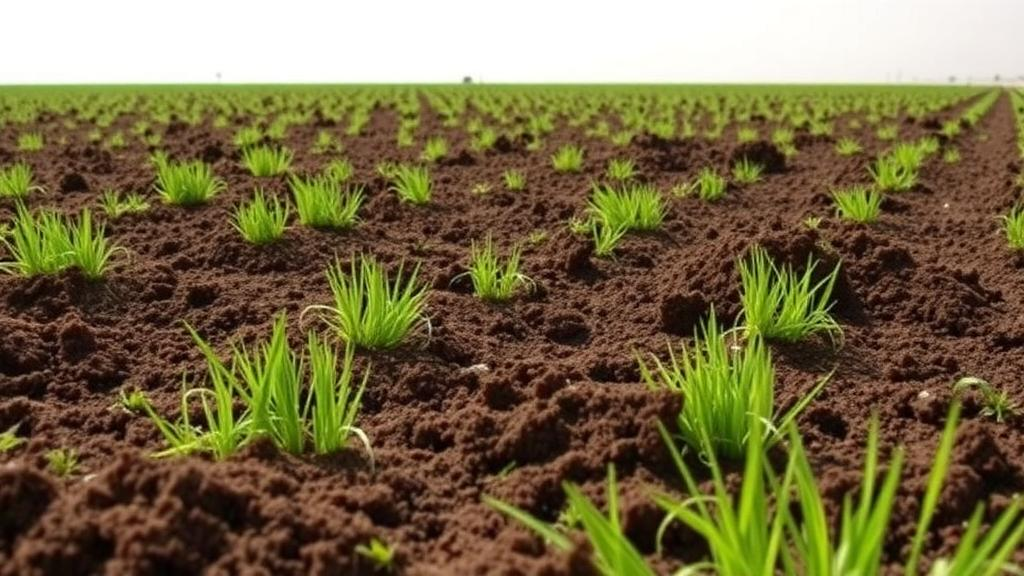
On Egypt’s northwestern Mediterranean coast, farmers face a double bind that defines much of modern agriculture in the Near East and North Africa: the groundwater they must irrigate with is naturally brackish, and the soils they work are steadily accumulating salt. A new field study conducted at Wadi El Raml during the 2023 growing season suggests that one of the most powerful tools against this creeping salinity is not a new crop variety, an expensive soil amendment, or a high-tech sensor network, but something as deceptively simple as how the seed is placed in the ground. Researchers from Egypt’s Desert Research Center and the Egyptian Center of Excellence for Saline Agriculture found that dibbling, a hill-sowing technique in which seeds are placed individually into holes, dramatically outperformed traditional broadcasting and row planting for both pearl millet and sorghum grown under saline conditions.
The numbers are striking. Compared with broadcasting, in which seed is scattered uniformly across the soil surface, dibbling increased fresh forage yield by 46.46 percent in pearl millet and 22.27 percent in sorghum. Under the best treatment combinations, total forage yield reached approximately 170 megagrams per hectare for millet and 130 megagrams per hectare for sorghum. The mean difference between dibbling and broadcasting was highly significant in statistical testing. What makes these gains remarkable is that they were achieved without changing the crop, the fertilizer regime, or the total amount of water applied. The only variable was the spatial arrangement of seeds and, with it, the way water moved through the root zone.
The mechanism behind the effect is rooted in soil physics. When water is applied through a drip system to localized planting holes, as in the dibbling treatment, infiltration is concentrated in discrete wetted bulbs beneath each hill. This concentrated water movement pushes soluble salts downward, below the active rooting depth, rather than allowing them to accumulate near the surface where evaporation is strongest. Broadcasting, by contrast, spreads water and roots thinly across the surface, encouraging capillary rise that draws salt back up into the topsoil between plants. The study measured soil electrical conductivity in the 0 to 30 centimeter layer after the final harvest and found the lowest values under dibbling, roughly 9.91 decisiemens per meter lower than under line and broadcasting methods, following the consistent trend of broadcasting being saltiest, row planting intermediate, and dibbling least saline.
Irrigation level played a supporting but revealing role. The researchers compared two regimes, 100 percent and 110 percent of crop evapotranspiration, calculated using the FAO Penman-Monteith equation with meteorological data from the Marsa Matrouh station and crop-specific coefficients. On its own, irrigation level showed no statistically significant effect on the measured parameters. But the interaction between irrigation and sowing method was significant: the extra 10 percent of water reduced root-zone salinity primarily when combined with dibbling, because the additional volume enhanced percolation of sodium and chloride ions below the root zone and helped displace exchangeable sodium with calcium. This leaching effect also lowered soil pH, with the lowest values, around 7.60 to 7.70, recorded under dibbling with 110 percent irrigation, while broadcasting at 100 percent produced the highest, near 8.0.
The sodium adsorption ratio, a key indicator of sodicity risk that threatens soil structure and permeability, told the same story. The lowest SAR values, approximately 4.0, occurred under dibbling combined with 110 percent irrigation and millet cultivation, while broadcasting produced values as high as 18.0. Even the calcareous nature of the coastal soils, rich in calcium carbonate, responded to management: reductions in active carbonate reached about 8 percent under dibbling, compared with 4 percent under row sowing and 2 percent under broadcasting. These localized rhizosphere changes, likely driven by improved water movement, leaching, and biological activity around densely concentrated roots, hint that careful sowing geometry can gradually reshape the chemistry of degraded soils rather than merely tolerating it.
Water use efficiency added a crucial nuance to the picture. Here the trend reversed with respect to irrigation: the highest efficiency values came at 100 percent of crop evapotranspiration, not 110 percent. Pearl millet under dibbling achieved approximately 0.69 megagrams of dry forage per cubic meter of water, the highest in the study, while sorghum under the same sowing method reached about 0.52 megagrams per cubic meter at 100 percent irrigation, compared with roughly 0.33 under broadcasting. Although the 110 percent treatment slightly increased biomass through enhanced leaching, the extra water diluted overall efficiency. The authors conclude that water productivity depends more on how efficiently water is distributed than on how much is applied, a finding with obvious implications for a region where renewable freshwater supplies have fallen to around 600 cubic meters per person per year in Egypt.
Between the two crops, pearl millet emerged as the clear winner under saline stress. Both species are considered moderately salt tolerant at around 4 decisiemens per meter, but millet maintained productivity at salinity levels exceeding 10 to 12 decisiemens per meter, where sorghum declined significantly. The physiological basis is well understood: millet accumulates osmolytes such as proline and soluble sugars to maintain cellular water balance, preserves a favorable potassium-to-sodium ratio through selective ion uptake, and deploys a dense fibrous root system that can exploit less saline soil layers. Its antioxidant defenses also protect cellular structures from the oxidative damage that salinity provokes. Sorghum performed respectably, particularly under dibbling, but millet’s combination of tolerance and water efficiency makes it the more reliable choice for salt-affected fields.
To synthesize these effects, the team developed a Soil Salinity Vulnerability Index, a weighted composite of electrical conductivity, pH, sodium adsorption ratio, calcium carbonate content, and organic matter, with weights derived through the Analytical Hierarchy Process using pairwise comparisons on a nine-point scale. The index separated the treatments cleanly: broadcasting scored highest, around 12, indicating greatest vulnerability, while dibbling consistently approached zero. This tool matters because it translates scattered soil measurements into a single, comparable vulnerability score that farmers and extension services can use to evaluate management options. It also confirmed that agronomic practice, not crop choice, was the dominant lever: in the multivariate analysis, sowing method was statistically significant with a partial eta squared of 0.99, whereas crop type alone was not.
The study, published in Discover Soil, comes with honest caveats. It spanned a single growing season, from April to July 2023, so multi-year trials are needed to confirm that the salt-leaching benefits of dibbling persist without degrading soil structure over time. Results may also vary across agro-ecological zones with different groundwater chemistry, and future work should test more salt-tolerant genotypes and explore how organic amendments interact with precision sowing. Still, the core message is powerful in its practicality. On roughly one third of Egypt’s agricultural land affected by salinity, where per capita cultivated area has shrunk below 0.1 acres and global food demand climbs toward a projected 9.7 billion people by 2050, the combination of pearl millet, dibbling, and irrigation tuned to 100 percent of crop water requirements offers a low-cost, immediately deployable strategy. It turns a humble planting technique into a biological salt pump, squeezing more forage from every drop of scarce, brackish water while slowly pushing the salt back where it belongs.
Subject of Research: Effects of irrigation levels and sowing methods on forage productivity and soil salinity in salt-affected soils of Northwestern Egypt
Article Title: Effects of irrigation levels and sowing methods on forage productivity and soil salinity in Northwestern Egypt
Article References: Wassif, O. M., Wassif, M., & El-Shaer, H. (2026). Effects of irrigation levels and sowing methods on forage productivity and soil salinity in Northwestern Egypt. Discover Soil, 3(1), Article 114. https://doi.org/10.1007/s44378-026-00266-1
Image Credits: AI Generated
DOI: 10.1007/s44378-026-00266-1
Keywords: soil salinity, dibbling, pearl millet, sorghum, water use efficiency, drip irrigation, Egypt, forage production, sodicity, semi-arid agriculture, salt tolerance, leaching
Cite Scienmag News
Alan Morgan. (October 5, 2026). How a Simple Sowing Trick Boosts Forage Yields on Egypt’s Salty Coastal Farms. Scienmag. https://scienmag.com/how-a-simple-sowing-trick-boosts-forage-yields-on-egypts-salty-coastal-farms/
Alan Morgan. "How a Simple Sowing Trick Boosts Forage Yields on Egypt’s Salty Coastal Farms." Scienmag, 5 October 2026, https://scienmag.com/how-a-simple-sowing-trick-boosts-forage-yields-on-egypts-salty-coastal-farms/. Accessed 5 October 2026.
Alan Morgan. "How a Simple Sowing Trick Boosts Forage Yields on Egypt’s Salty Coastal Farms." Scienmag. October 5, 2026. https://scienmag.com/how-a-simple-sowing-trick-boosts-forage-yields-on-egypts-salty-coastal-farms/


