


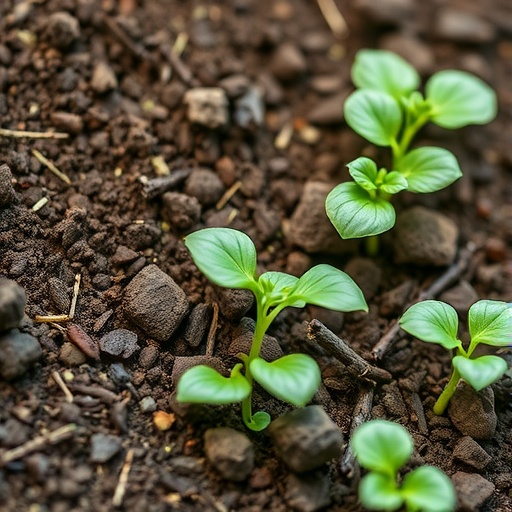
In the ongoing battle against climate change, soil organic carbon (SOC) stands as a critical front, offering one of the most effective natural reservoirs for carbon sequestration. Recently, an innovative study has unveiled crucial insights into how organic amendments can dramatically enhance the stabilization of SOC, leveraging the intricate interplay of iron chemistry and enzymatic activity within the soil matrix. This research, published in Communications Earth & Environment, not only advances our understanding of soil carbon dynamics but also opens new avenues for sustainable agricultural practices and climate mitigation strategies.
This breakthrough centers on what the authors describe as the “iron gate” and “enzyme latch” mechanisms, two complementary pathways that govern the fate of organic carbon in soils amended with organic material. The “iron gate” mechanism refers to the pivotal role of iron minerals in chemically binding organic carbon, thus protecting it from rapid microbial decomposition. Iron oxides, abundant in many soils, have a natural affinity for organic molecules, effectively locking carbon within mineral associations that can persist for decades or even centuries. This process mitigates carbon loss by rendering it less accessible to soil microbes.
Simultaneously, the “enzyme latch” mechanism offers a biological counterpoint to the mineral protection conferred by iron. Soil extracellular enzymes are responsible for breaking down complex organic compounds into simpler constituents that microbes can metabolize. However, in the presence of specific iron-organic complexes, enzyme activity can be significantly inhibited or “latched,” further slowing down the decomposition rate of organic carbon. The research highlights that these enzyme-latch interactions are context-dependent, influenced by soil pH, moisture, and the nature of the organic amendments applied.
The study employed a multi-faceted approach combining advanced spectroscopy, isotopic labeling, and enzyme assays to dissect these mechanisms in soils treated with differing types of organic amendments such as compost, biochar, and manure. The findings revealed that biochar and compost, rich in phenolic compounds and aromatic structures, promote enhanced iron-organic complexation, which in turn exerts a stronger enzyme latch effect. Manure, with its higher nitrogen content and labile organic matter, exhibited a distinct influence—more stimulating microbial activity initially but also contributing to longer-term SOC stabilization through subsequent iron mineral interactions.
One of the major implications of these findings lies in the nuanced understanding they provide of soil amendment strategies. Traditional approaches often focus on simply adding organic carbon to soils without considering the complex chemical and biological environment that dictates carbon stabilization. This study demonstrates that the efficacy of carbon sequestration in soils can be optimized by tailoring amendments to exploit these dual mechanisms. Organic inputs that encourage iron gate formation alongside enzyme activity suppression maximize carbon retention and thus enhance the soil carbon sink potential.
Moreover, the research sheds light on temporal dynamics, indicating that the iron gate and enzyme latch mechanisms do not operate uniformly over time. Initial rapid microbial processing can be slowed as iron-organic complexes develop, leading to a “second phase” of carbon stabilization. This points to the importance of long-term monitoring and management of amended soils, as the benefits in carbon sequestration may accrue and stabilize over months or years rather than immediately after amendment.
The ecological ramifications of fortified SOC pools extend beyond carbon sequestration alone. Higher levels of stabilized organic carbon improve soil structure, enhance nutrient retention, and foster a more resilient microbial community. This translates into better water retention, increased fertility, and ultimately greater agricultural productivity—all critical factors in supporting food security in the face of climate uncertainty.
This evolving understanding also intersects with global soil and climate models, which have historically underestimated the stability and storage capacity of SOC pools. By incorporating the molecular interactions of iron and organic matter as well as the enzyme modulation effects demonstrated in this study, predictions of carbon cycling and greenhouse gas emissions can be significantly refined. This represents a step forward in creating more accurate, actionable climate models that better harness terrestrial ecosystems as carbon sinks.
Furthermore, the study poses new questions about how environmental variables—such as soil moisture regimes, fluctuating redox conditions, and iron mineralogy—interact with the iron gate and enzyme latch mechanisms under real-world field conditions. Climate change itself may alter these parameters, influencing the efficacy of soil carbon stabilization processes in unpredictable ways. Continued investigation is essential to adapt soil management practices to these shifting environmental contexts.
On a practical front, the findings encourage the development of next-generation organic amendments designed with a molecular understanding of iron-mediated carbon stabilization. These “smart amendments” could be engineered to optimize phenolic content, mineral affinity, and enzyme inhibition capabilities, offering farmers potent tools to enhance soil health and carbon sequestration simultaneously. This integrative approach supports both sustainable agriculture and climate mitigation within a single framework.
The interdisciplinary nature of this research brings together soil chemistry, microbiology, mineralogy, and environmental science, highlighting the need for collaborative efforts to unpack the complexity of terrestrial carbon cycles. The synergy between iron mineral phases and microbial enzymes emerges as a fascinating frontier that blurs the lines between the biological and geochemical domains, revealing how life and minerals cooperate to regulate Earth’s critical carbon reservoirs.
Importantly, these insights resonate with global soil conservation initiatives, including those embedded within international frameworks like the “4 per 1000” initiative, which aims to increase SOC stocks worldwide through improved land stewardship. By providing a mechanistic foundation for how amendments influence long-lasting carbon stabilization, this study equips policymakers and land managers with scientifically robust tools to design interventions that maximize carbon capture.
Despite these advances, the authors acknowledge several challenges in translating laboratory findings into field-scale applications. Soil heterogeneity, climatic variability, and land-use practices create a complex backdrop against which the iron gate and enzyme latch mechanisms operate. Addressing these challenges necessitates large-scale trials, long-term experiments, and the incorporation of diverse soil types across climatic zones to validate and generalize the processes identified.
In conclusion, the elucidation of iron gate and enzyme latch mechanisms marks a paradigm shift in soil carbon research, positioning iron-organic interactions and enzyme modulation at the core of SOC stabilization processes. This knowledge not only deepens our scientific understanding but also paves the way for innovative soil management practices that bolster carbon sequestration, mitigate climate change, and promote sustainable land use. As we navigate an era marked by environmental uncertainty, unlocking the secrets of soil’s silent carbon guardians may hold the key to a more resilient and climate-smart future.
Cite Scienmag News
Alan Morgan. (April 15, 2026). Organic Amendments Boost Soil Carbon via Iron, Enzymes. Scienmag. https://scienmag.com/organic-amendments-boost-soil-carbon-via-iron-enzymes/
Alan Morgan. "Organic Amendments Boost Soil Carbon via Iron, Enzymes." Scienmag, 15 April 2026, https://scienmag.com/organic-amendments-boost-soil-carbon-via-iron-enzymes/. Accessed 3 September 2026.
Alan Morgan. "Organic Amendments Boost Soil Carbon via Iron, Enzymes." Scienmag. April 15, 2026. https://scienmag.com/organic-amendments-boost-soil-carbon-via-iron-enzymes/


