


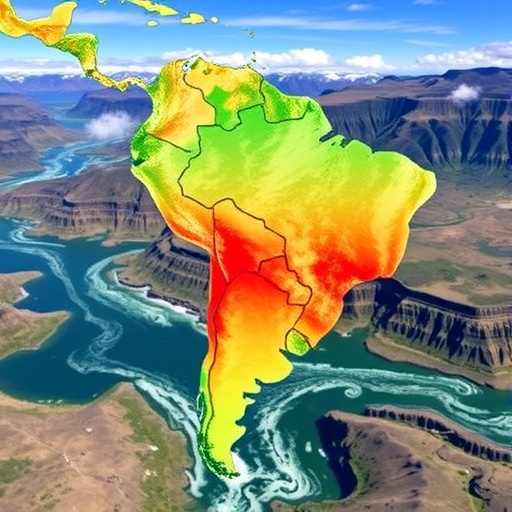
In a groundbreaking study that challenges conventional wisdom in climate science, researchers M. Zarei and G. Destouni have unveiled a complex narrative about South America’s water cycle over the three decades from 1980 to 2010. Their work, recently published in Communications Earth & Environment, reveals that while extreme hydrological events—such as floods and droughts—have indeed intensified, this escalation has occurred without a corresponding intensification of the overall water cycle. This principle-defying finding invites a profound reconsideration of how climate variability interacts with the continent’s vast and diverse hydrological dynamics.
Traditionally, intensification of a water cycle implies increased precipitation, evaporation, and runoff, which in turn are linked to more extreme weather patterns. However, the study’s meticulous analysis, based on extensive hydrological data spanning thirty years, demonstrates a dissociation between the magnitude of hydrological extremes and the average state of the water cycle itself. South America, a region marked by intricate climatic zones—from the Amazon rainforest to the Andes mountains—presents an exceptional natural laboratory to assess these nuanced hydrological behaviors.
The research hinges on comprehensive observational datasets and sophisticated hydrological modeling that reinterpret historical water flow and precipitation trends across the continent. By delving into river discharge records, precipitation gauges, and evaporative flux calculations, Zarei and Destouni identified a significant rise in the frequency and severity of extreme water-related events without any measurable increase in the mean intensity of the water cycle components. This paradox suggests that there are underlying climatic mechanisms at play beyond the previously understood straightforward scaling of extremes with average hydrological fluxes.
One of the compelling outcomes of this analysis is the recognition of spatial heterogeneity in water cycle changes. While some regions experienced more frequent flooding episodes, others confronted prolonged droughts, both phenomena occurring independently of large-scale intensifications in precipitation or evaporation. This heterogeneous distribution indicates that regional atmospheric circulation patterns and land-atmosphere interactions may drive the amplification of extremes rather than a uniform intensification of the hydrological cycle.
Central to the study is the identification of environmental and climatic drivers that modulate water extremes. Fluctuations in ocean-atmosphere systems like the El Niño-Southern Oscillation (ENSO) and variations in atmospheric moisture transport pathways likely enhance the variability of freshwater availability. These oscillations could cause pronounced wet or dry spells, thereby escalating the extremity of events without altering the mean water cycle intensity. The intricate feedbacks between these oceanic phenomena and terrestrial hydrology underscore the complexity of attributing extremes solely to climate change-induced water cycle intensification.
Moreover, landscape factors such as land use changes, deforestation, and urban expansion emerge as non-negligible elements influencing hydrological extremes. The study notes that anthropogenic alterations, especially prominent in parts of the Amazon Basin and southern South America, modify surface runoff, soil moisture retention, and evapotranspiration rates. Such perturbations can increase vulnerability to droughts and floods by altering the local hydrodynamic responses independently of atmospheric moisture changes.
From a technical standpoint, the research employed cutting-edge statistical techniques to discern trends amidst noisy hydrological data, overcoming challenges of data gaps and measurement inconsistencies. Nonlinear trend analysis and extreme value theory applications allowed the authors to isolate extremes from gradual mean shifts, providing a clearer picture of how extreme events evolve temporally and spatially. These methods afford a crucial advancement over simpler linear trend assessments that could mask heterogeneous extreme behaviors.
Importantly, these findings have significant implications for climate change impact assessments and water resource management strategies in South America. The uncoupling of extremes from water cycle intensification complicates predictive modeling because it signals that conventional climate models might underestimate the probability and magnitude of future extreme hydrological events. Adaptive management frameworks must contend with increased uncertainty and regional variability, calling for refined models that incorporate atmospheric teleconnections and land-surface processes more accurately.
The study also foregrounds the necessity for enhanced hydrological monitoring networks across South America. Improved spatial resolution in data collection, especially in under-monitored regions of the Amazon and the Andean highlands, could sharpen understanding of regional extreme patterns and their drivers. Integrating remote sensing data with ground-based observations can facilitate this endeavor, permitting near real-time assessments of evolving hydrological extremes.
In a broader climatological context, the research speaks to emerging discussions about climate extremes under a warming world. It serves as a reminder that changes in extremes are not always straightforward extensions of average climate trends, complicating vulnerability assessments and mitigation planning. The authors’ work urges the scientific community to develop more nuanced theories and models that capture the multifaceted nature of hydrological variability.
From the perspective of societal impact, the increasing frequency of floods and droughts documented in the study pose profound challenges to South American communities, agriculture, biodiversity, and infrastructure. Understanding that these extremes can intensify without a parallel increase in average water cycle metrics is critical to designing resilient infrastructure and developing policies tailored to localized risks rather than continental averages.
The juxtaposition of enhanced extremes against a backdrop of stable average water cycle intensity also points to the potential role of nonlinear climate dynamics and threshold effects. Small perturbations might propagate disproportionately through regional climate systems, producing abrupt, extreme hydrological responses. These nonlinear responses necessitate greater emphasis on early warning systems and disaster preparedness in vulnerable regions, underscoring the practical relevance of the study.
Furthermore, the research contributes to the scientific narrative on how regional climates respond unevenly to global climate forcing. Whereas global warming is expected to intensify hydrological cycles worldwide, South America’s case reveals a more complex reality, where atmospheric circulation changes and land-surface feedbacks might decouple extremes from mean cycle intensification. This highlights the limitation of broad-brush climate projections and the importance of downscaling studies to inform regional adaptive strategies.
The expected ongoing shifts in oceanic and atmospheric patterns associated with climate change could exacerbate the identified trends, potentially increasing the occurrence of extreme events without necessarily amplifying the overall water cycle intensity. Such evolving dynamics will require continuous monitoring and updating of climate risk analyses to safeguard ecosystems and human livelihoods in this climatically sensitive region.
In summary, Zarei and Destouni’s research reveals a paradox that challenges established paradigms of hydrological extremes tied linearly to average water cycle intensity. Their rigorous approach illuminates the complexity of South America’s climate-hydrology interplay, emphasizing the role of atmospheric oscillations, regional variability, and human-induced land changes in shaping the continent’s increasing vulnerability to hydrological extremes. This study not only advances scientific understanding but also points to crucial pathways for future climate adaptation policies and research directions focused on resilience building in the face of unpredictable and amplified water-related hazards.
Cite Scienmag News
Violet Maxwell. (May 25, 2026). South America’s Water Cycle: Enhanced Extremes Unchanged. Scienmag. https://scienmag.com/south-americas-water-cycle-enhanced-extremes-unchanged/
Violet Maxwell. "South America’s Water Cycle: Enhanced Extremes Unchanged." Scienmag, 25 May 2026, https://scienmag.com/south-americas-water-cycle-enhanced-extremes-unchanged/. Accessed 3 September 2026.
Violet Maxwell. "South America’s Water Cycle: Enhanced Extremes Unchanged." Scienmag. May 25, 2026. https://scienmag.com/south-americas-water-cycle-enhanced-extremes-unchanged/


