

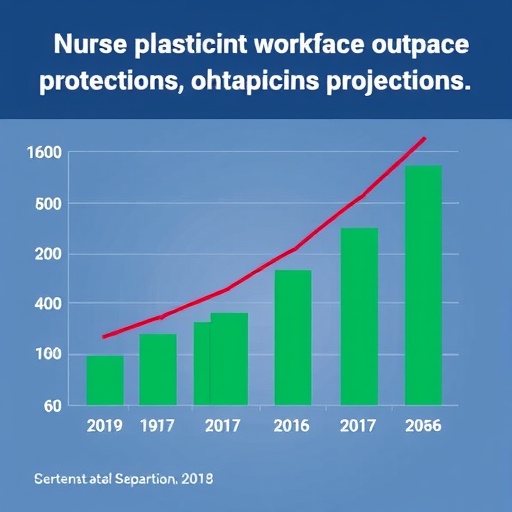
A seismic shift is reshaping the American healthcare workforce, and it is not coming from the direction most experts anticipated. While the number of physicians inches upward at a glacial pace, nurse practitioners are surging into the field at a rate that has stunned even seasoned workforce analysts. A new study from Columbia University School of Nursing, published in Health Affairs, reveals that between 2016 and 2023, the nurse practitioner workforce expanded by an average of 10 percent each year, leaving the physician growth rate of just 1.1 percent in the dust. Physician associates, another group of advanced practice clinicians, grew at 8.6 percent annually over the same period. The numbers rewrite the story of who will be providing the nation’s primary and specialty care in the coming decade.
The research team, led by assistant professor Monica O’Reilly-Jacob, did not simply extrapolate from recent trends to produce these projections. Instead, they reached into a deeper statistical toolbox and deployed the Cohort Supply Model, a method that parses 40 years of census data to disentangle two separate forces: the propensity of people born in a given year to enter a profession, and the likelihood that individuals in that profession will work at different life stages, such as during child-rearing years or as they approach retirement. By treating each year’s data independently, the model prevents early assumptions from compounding into wildly inaccurate long-range forecasts. This approach stands in stark contrast to the Health Resources and Services Administration’s projections, which the authors suggest may be underestimating the rapid transformation underway.
Cohort-based modeling is particularly valuable for capturing the dynamics of a workforce that is predominantly female, the authors note. The ebb and flow of labor force participation shaped by life-cycle work patterns—temporary reductions, later re-entries, and shifts in career intensity—has historically confounded linear projection methods. Here, the model picks up a powerful accelerant: registered nurses leaving the bedside grind for graduate degrees that promise predictable schedules and greater clinical autonomy. Graduate nursing programs have responded with a proliferation of online and distance-learning options, a flexibility that physician associate programs, still largely campus-bound, have not matched. This difference in educational delivery helps explain why nurse practitioner growth is outpacing even that of physician associates.
If the current trajectory holds, by 2030 the annual growth rates will be 1.1 percent for physicians, 11 percent for nurse practitioners, and 5.6 percent for physician associates. In absolute terms, the clinic of the near future will look nothing like the physician-dominated model of the past. The study frames this as a timely convergence: an aging U.S. population is generating demand for chronic disease management, mental health services, and routine primary care that the physician workforce alone cannot supply. Nurse practitioners and physician associates are already the safety net in many rural and underserved urban communities, and their rapid expansion is poised to fill specific chasms, including a severe shortage of psychiatric providers.
Yet the raw numbers only tell part of the story. The authors caution that the surge does not automatically translate into equitable distribution. Without deliberate regulatory and payment reforms, the new workforce could cluster in well-resourced areas and specialties, bypassing the very populations that need them most. State-level scope-of-practice laws still hamstring nurse practitioners in some regions, requiring physician supervision that does not align with their training or with the reality of modern team-based care. Federal payment policies in Medicare and Medicaid similarly lag, often reimbursing nurse practitioners and physician associates at lower rates for the same services.
The paper’s projection methodology offers a caution against policy inertia. Because the Cohort Supply Model does not force a single average trend into the future but instead allows generation-specific work patterns to surface, it reveals how the pandemic-era disruptions to training pipelines have created a temporary plateau in some professions while an educational boom in nursing has fed an unexpected pipeline surge. The independent treatment of entry and exit rates also means that the model can be updated as new census data arrive, offering a living forecast rather than a static prediction.
Unpacking what is happening on the ground, the researchers point to the fraught working conditions that many registered nurses endured during COVID-19. Burnout, moral injury, and the physical toll of bedside care have driven a substantial number of RNs toward advanced degrees, not merely for higher pay but for careers that allow them to set their own schedules and exercise full clinical judgment. This exodus from the RN pool into the NP pipeline is, paradoxically, creating a shortage at the bedside while building a surplus of primary care and specialty providers for the future. The trend, the authors imply, may be a permanent realignment rather than a temporary correction.
The study’s conclusions are both an invitation and a warning. The authors argue that regulations and payment policies must be retooled to leverage this growing workforce effectively, enabling nurse practitioners and physician associates to deliver high-quality, cost-effective care at the top of their licenses. Ongoing monitoring of supply and demand, and of whether expanding capacity reaches high-need communities, will be essential. As the nurse practitioner workforce continues its double-digit ascent, the question is no longer whether these clinicians will become a central pillar of American healthcare, but whether the system is ready to receive them.
Subject of Research: Workforce projections for physicians, nurse practitioners, and physician associates
Article Title: Workforce Projections For Physicians, Nurse Practitioners, And Physician Associates
News Publication Date: July 7, 2026
Web References: https://www.healthaffairs.org/doi/10.1377/hlthaff.2025.01747 ; https://www.nursing.columbia.edu/
References: 10.1377/hlthaff.2025.01747
Image Credits: Not provided
Keywords: Nurse practitioners, Physician associates, Physicians, Healthcare workforce, Workforce projections, Cohort Supply Model, Health Affairs, Nursing, Primary care, Health policy


