

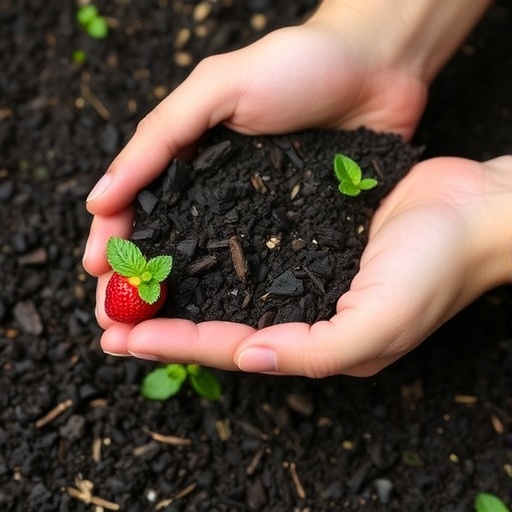
Farmers battling soil-borne diseases have long faced a cruel paradox: the very treatments that kill devastating pathogens often lay waste to the beneficial microbes that keep soil alive. Now, a team of researchers in China has shown that something as simple as carefully charred plant stalks can break that cycle, selectively annihilating the bacterium behind bacterial wilt while simultaneously coaxing a richer, more resilient microbial community back from the brink. The secret weapon is not the charcoal itself, but an arsenal of ephemeral, highly reactive molecules it unleashes—reactive oxygen species, or ROS.
The study, published in the journal Biochar, focused on Ralstonia solanacearum, a globally destructive soil-borne pathogen that causes bacterial wilt in tomatoes, tobacco, potatoes, and many other crops. The bacterium sneaks into roots, clogs water-conducting vessels, and can survive in soil for years, making it a nightmare for growers. Conventional soil fumigants and disinfectants tend to scorch the earth—or at least the microbial earth—leaving behind a biological vacuum that can be recolonized by the same opportunists. What the group wanted to know was whether biochar, a porous carbon material produced by heating biomass in low oxygen, could be tuned to target R. solanacearum without triggering microbial ecocide.
The researchers, led by Hanzhong Jia, prepared biochars from four types of straw—tobacco, rice, wheat, and maize—at pyrolysis temperatures from 300 to 700 degrees Celsius, then tested their antibacterial punch in the lab. Tobacco stem biochar was the standout performer. At lower temperatures of 300 to 400 degrees Celsius, it inhibited the pathogen by 92.91 percent to 99.60 percent; at 500 to 700 degrees Celsius, the inhibition hit a perfect 100 percent. But what really grabbed the team’s attention was not just the lethality, but the mechanism. Unlike simple physical occlusion or pH alteration, the killing power came overwhelmingly from reactive oxygen species.
Reactive oxygen species are chemically restless molecules—hydroxyl radicals, superoxide radicals, singlet oxygen, hydrogen peroxide—that rip electrons from cell membranes, proteins, and DNA, essentially burning pathogens from the inside. The biochar’s ROS profile shifted dramatically with pyrolysis temperature. Low-temperature chars churned out radical-type ROS such as hydroxyl and superoxide radicals, while high-temperature chars leaned on non-radical species, particularly singlet oxygen and hydrogen peroxide. To prove those fleeting molecules were the true weapon, the team ran quenching experiments, using chemical scavengers to mop up specific ROS. When the scavengers neutralized the radicals and non-radicals, the biochar’s antibacterial effect collapsed, confirming that ROS were the principal agents of destruction.
The real-world implications crystallized in a hydroponic tomato seedling trial. Seedlings infected with R. solanacearum wilted severely, as expected. Those treated with tobacco stem biochar, however, showed no disease symptoms at all—their growth was indistinguishable from healthy controls. Crucially, when ROS were chemically quenched in the treatment, the protective shield vanished, and the plants sickened again. This direct cause-and-effect chain—biochar, ROS, pathogen death, plant health—moved the finding far beyond correlation into a clear mechanistic narrative.
Just as important as what the biochar killed is what it nurtured. When the team examined the rhizosphere microbiome in both artificial and naturally diseased soils, they found that tobacco stem biochar did not leave a microbial desert. Instead, bacterial richness surged; the Chao1 index, a measure of community richness, jumped by up to 951 points, while microbial network complexity exploded with hundreds of new connections between species. Beneficial genera such as Rhizobium, Paracoccus, Cellvibrio, Fluviicola, and Pseudomonas flourished, while several pathogen-aligned groups shrank. The resulting community was not just larger but more tightly woven—a hallmark of stable, disease-suppressive soils.
“Our results show that biochar is not only a passive soil amendment,” Jia said. “By controlling the raw material and pyrolysis temperature, we can tune the reactive chemistry of biochar and use it to suppress pathogens while supporting a healthier microbial community.” The remark encapsulates a paradigm shift away from viewing biochar as a simple carbon sink or water sponge and toward seeing it as a programmable chemical interface that can actively manage soil biology.
The practical upshot for agriculture is that not all biochars are created equal. A grower cannot simply toss any charcoal into a field and expect disease suppression; the feedstock and charring conditions dictate whether you get a potent antimicrobial tool or an inert pile of carbon. The study implies that purpose-built biochars, generated at specific temperature windows—say 500 to 700 degrees Celsius for tobacco stems—could become a new class of microbiome-friendly crop protectants, reducing dependence on broad-spectrum soil sterilants. As climate pressures and soil degradation intensify, the ability to steer the soil microbiome with precision rather than brute force may prove as transformative as any synthetic pesticide once promised to be.
Article Title: Biochar modulates soil microbial communities via reactive oxygen species derived from its constituents
News Publication Date: 29-Jun-2026
Web References: 10.1007/s42773-026-00637-5
References: Liu, M., Shen, S., Qiao, H. et al. Biochar modulates soil microbial communities via reactive oxygen species derived from its constituents. Biochar 8, 122 (2026).
Image Credits: Meng Liu, Siqi Shen, Haiyang Qiao, Huiqiang Yang, Yaru Zhu, Yawei Zhou & Hanzhong Jia
Keywords: Biochar, Reactive oxygen species, Ralstonia solanacearum, Soil microbiome, Bacterial wilt, Pyrolysis temperature, Microbial ecology, Sustainable agriculture, Rhizosphere, Disease suppression


