

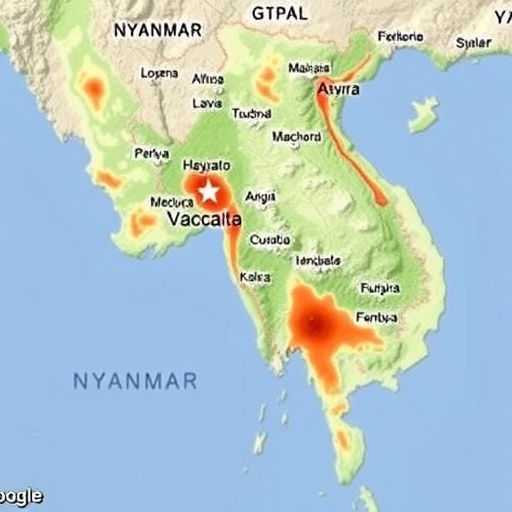
On 28 March 2025, a magnitude 7.7 earthquake ripped through central Myanmar, with an epicenter close to the city of Mandalay. The disaster killed thousands, injured more than 11,000, and levelled homes, bridges, and ancient pagodas. It was the most powerful earthquake to strike the country in over a century, and now a detailed forensic analysis of how the ground moved, published in Geodesy and Geodynamics, reveals why it proved so catastrophically destructive. The study exposes a rare combination of extreme surface rupture behaviour and a high-speed fracture front that travelled faster than the seismic waves it generated.
Using satellite-based interferometric synthetic aperture radar (InSAR) and pixel offset tracking, a research team led by Shuai Wang at the China University of Mining and Technology constructed a centimetre-scale map of the co-seismic deformation field. Their results show that the earthquake ruptured a roughly 500-kilometre-long segment of the Sagaing Fault, a notorious right-lateral strike-slip boundary that slices through Myanmar from north to south. Such a long rupture length was one of the first red flags: for context, the 2023 Turkey earthquake sequence produced a total surface rupture of around 400 kilometres combined across two events, and even the great 1906 San Francisco earthquake ruptured about 470 kilometres. A 500-kilometre break is exceptional.
The slip model derived from these observations showed that almost all the fault movement was horizontal, as expected for a strike-slip event, and that the greatest slip occurred at remarkably shallow depths. Most of the displacement was concentrated within the top 12 kilometres of the crust, and the surface directly above the fault shifted by as much as 4.6 metres. In many large earthquakes, geophysicists observe a phenomenon called the shallow slip deficit, where the amount of movement recorded at the surface is systematically less than that inferred at depth, possibly because near-surface sediments absorb or distribute the strain aseismically. The Myanmar earthquake, however, defied this pattern. The team found no appreciable shallow slip deficit, meaning the fault rupture fully propagated to the surface with almost undiminished intensity, directly shredding everything in its path.
This finding alone would make the event scientifically notable, but the team uncovered an even rarer characteristic: the rupture transitioned into a supershear phase. A supershear earthquake occurs when the advancing crack tip outruns the shear wave speed of the surrounding rock. In practical terms, imagine a seismic Mach cone, analogous to a sonic boom, that piles up wave energy ahead of the rupture tip. Supershear events are exceptionally hazardous because the condensed wave front can amplify ground shaking well beyond what a conventional sub-Rayleigh rupture would produce. The researchers marshalled three independent lines of evidence for this. First, the high-speed rupture segment coincided with a striking absence of aftershocks, a signature consistent with a smooth, unhindered fracture that does not leave behind many locked asperities. Second, the earthquake radiated unusually low moment-scaled energy compared to other quakes of similar magnitude, indicating that a disproportionate amount of energy went into fracturing fresh rock rather than into generating long-period seismic waves. Third, the geometry of the Sagaing Fault along the supershear segment is remarkably straight and structurally simple, without major bends or step-overs that would typically arrest a fast-moving rupture. Smooth, mature fault planes are precisely where supershear transitions are expected to occur.
What pushed the Sagaing Fault into such an extreme mode? The study suggests that this particular stretch of the fault had been accumulating tectonic stress for a very long time. By performing a seismic moment budget analysis and geodetic slip deficit modelling, Wang and colleagues estimated that the segments that ruptured in 2025 have a recurrence interval for magnitude 7 or greater earthquakes of about 104 to 131 years. Because no large historical earthquake had been documented on this exact section in the modern instrumental era, the fault was likely late in its seismic cycle and primed to release all its stored elastic strain in one violent, unimpeded cascade.
The results carry immediate implications for seismic hazard assessment across Southeast Asia. The Sagaing Fault runs directly through the economic heartland of Myanmar and passes near Yangon, a megacity of over 5 million people. That the 2025 rupture propagated with supershear speed and zero shallow slip deficit underscores that when this fault system fails, it can fail with an almost engineering-level efficiency at transferring deep tectonic motion to the surface. Hazard models that assume a modest reduction in surface slip for similar strike-slip settings may therefore underestimate the true destructive potential.
Equally important, the study demonstrates the power of modern space geodesy to dissect a large earthquake within days. The combination of InSAR, which measures line-of-sight ground deformation with millimetric precision, and pixel offset tracking, which can capture large horizontal displacements even in densely vegetated regions, allowed the team to recover the full three-dimensional surface displacement field with unprecedented detail. Such rapid mapping capabilities are becoming a standard tool for the international earthquake response community, informing everything from damage assessment to the targeting of field reconnaissance teams.
Beyond the immediate tragedy, the 2025 Myanmar earthquake serves as a stark natural laboratory for what happens when a mature, fast-moving plate boundary unzips in one go. It joins a very short list of well-documented supershear strike-slip events—including the 2001 Kunlun earthquake in Tibet, the 2002 Denali earthquake in Alaska, and the 2018 Palu earthquake in Indonesia—and provides the clearest evidence yet that shallow slip deficit can vanish entirely under the right conditions. For seismologists, the event is a sobering reminder that the most dangerous faults are not always the ones with the biggest cumulative slip, but the ones that are straight, locked, and loaded.
Subject of Research: Earthquake rupture dynamics and surface deformation of the 28 March 2025 Mw 7.7 Myanmar earthquake
Article Title: The 28 March 2025 MW7.7 Myanmar earthquake revealed by InSAR and POT observations: A supershear event with no shallow slip deficit
News Publication Date: [Not provided in source material]
Web References: 10.1016/j.geog.2025.09.008
References: Not available
Image Credits: Shuai Wang
Keywords: Earth sciences, Geophysics, Plate tectonics, Earthquake, Supershear, Sagaing Fault, InSAR, Shallow slip deficit


