

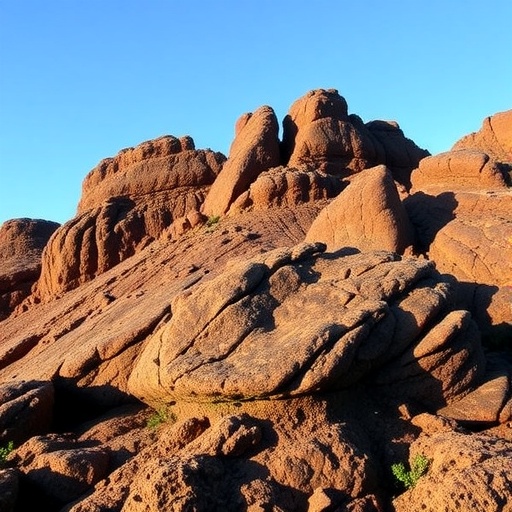
A revolutionary analysis of 3.1-billion-year-old volcanic rocks from the Australian outback is dismantling long-held assumptions about our planet’s infancy, revealing that the primordial Earth was far wetter and more dynamically complex than previously imagined. The study, which probes the volatile content of ancient magmas, provides startling evidence that the geological engines driving modern-style plate tectonics—complete with water-rich volcanic arcs—were already operational deep in the Archean Eon. This discovery does not merely add a footnote to geological textbooks; it fundamentally rewrites the timeline of Earth’s transition from a hellish, molten ball to a habitable world with continents, oceans, and a sophisticated geochemical cycle.
The central paradox for geologists studying the early Earth has always been water. The planet’s infancy was a time of higher internal heat production from radioactive decay, which should have generated thick, buoyant, and intensely dry crust incapable of the downward thrust required for modern subduction. Yet, the new research, spearheaded by a team from prominent institutions, demonstrates that the mantle source feeding these ancient volcanoes was astonishingly hydrated, containing water concentrations on par with those found in modern subduction zones like the Pacific Ring of Fire. The team utilized a cutting-edge geochemical proxy, measuring the ratio of thorium to lanthanum in pristine zircon crystals, to unlock a hygrometer of the deep past. This proxy acts as a molecular fossil of magmatic water content, and the signature it revealed was unequivocal: the Archaean mantle was not a desiccated relic but a vigorous, water-saturated cauldron.
To understand the profound implications, one must first grasp the role of water in the solid Earth. Water is not merely a surface feature; it is a primary tectonic lubricant. When water is incorporated into the crystal lattice of minerals deep within a subduction zone, it dramatically lowers the melting point of the mantle rock, catalyzing the production of silica-rich, explosive magmas that build the continents. It also weakens the rigid lithosphere, allowing it to bend and sink, driving the plate tectonic conveyor belt. Finding a modern arc-like hydration signature in 3.1-billion-year-old rocks implies that this entire cascade of processes—deep volatile recycling, fluid-fluxed melting, and the consequent generation of chemically evolved crust—was already mature. This hydration fingerprint was not a subtle trace; the data indicate that the mantle source contained up to 4 weight percent of water, a value that sits squarely in the middle of the range for contemporary arc basalts.
The field evidence for this discovery was excavated from the ancient cratonic nucleus of Australia, a region that preserves a mostly intact fragment of the Earth’s primordial crust. Here, the researchers focused on a suite of volcanic rocks known as komatiites and basaltic flows, which represent high-temperature melts that originated deep in the mantle. For decades, these rocks were interpreted as the products of a dry, anhydrous mantle plume, a vertical column of superheated material rising from the core-mantle boundary. The new thorium-lanthanum data, however, tells a contradictory story. The distinctive geochemical fingerprint matches a flux melting signature, a process by which fluids released from a descending slab of oceanic crust percolate into the overlying mantle wedge, triggering melting. This is the same chemical prosody that writes the story of modern arcs like the Aleutians or the Andes.
This revelation thrusts the “drip” hypothesis into the spotlight. In the hotter Archean mantle, conventional flat-slab subduction might have been mechanically difficult. Instead, many geodynamicists propose that the dense, lower portion of a thick, hydrated oceanic plateau could have become gravitationally unstable, peeling away and dripping back into the mantle. This “drip” would carry water and other volatiles to great depths, acting as a proto-subduction conveyer. The hydrated mantle source detected by the team is a direct chemical consequence of such a process. It provides a compelling mechanism for how an early Earth, perhaps lacking globe-spanning rigid plates, could still have developed localized zones of deep water recycling, creating the chemical factories necessary to build the first stable continents rising above the waves.
The implications for the origins of life and planetary habitability are immense. The establishment of a deep water cycle this early means that oceans were not transient, superficial features but were actively being mixed into the planetary interior and degassed back out through volcanoes. This chemical convection acted as a planetary thermostat, sequestering and releasing carbon dioxide over geological timescales and stabilizing the climate long before the rise of oxygen. A wet mantle is also more efficient at generating continental crust, providing the stable, buoyant platforms on which life would eventually emerge and thrive. The study effectively closes the gap between the geological and biological evolution of our planet, suggesting that the environmental scaffolding for life’s earliest experiments was assembled far earlier than the standard model allows.
While the data is robust, it ignites a fierce debate about the style of early tectonics. Critics argue that high water content could also be achieved through alternative mechanisms, such as a globally deeper ocean floor that was inherently more hydrated, or through a stagnant-lid regime where the base of a thick crust occasionally foundered. However, the specific elemental ratios found in the zircon crystals are chemically difficult to produce without a process that mimics the focused, fluid-fluxed melting of a subduction zone. The research team anticipates this contention, suggesting that while the surface expression of tectonics may have looked different—perhaps a mosaic of microplates and drips—the underlying chemical engine of volatiles cycling from a hydrated surface to a deep mantle source was already operational.
Ultimately, this analysis of a 3.1-billion-year-old rock is a testament to the power of advanced analytical geochemistry to travel back in time. By interrogating the memory locked within a single crystal of zircon, scientists have peered into the deep water cycle of an Earth that was just a billion years old. The findings do not just tweak the timeline of plate tectonics; they unify the story of Earth’s two great systems: the one that moves rock and the one that moves water. The planet’s journey to habitability was not a slow, dry awakening, but a wet and explosive adolescence, with the deep engines of volcanism and the vast oceans conspiring in a global geochemical dance that had already been choreographed into the familiar rhythms of a modern Earth.
Subject of Research: The water content in the mantle source of 3.1-billion-year-old volcanic rocks and its implications for the initiation of plate tectonics and Earth’s deep water cycle.
Article Title: Modern arc-like water content in the source of 3.1-billion-year-old volcanic rocks.
Article References: Vandenburg, E.D., Nebel, O., Smithies, R.H. et al. Modern arc-like water content in the source of 3.1-billion-year-old volcanic rocks. Nat Commun 17, 5630 (2026). https://doi.org/10.1038/s41467-026-74653-1
Image Credits: AI Generated
DOI: https://doi.org/10.1038/s41467-026-74653-1
Keywords: Archean Eon, Plate Tectonics, Deep Water Cycle, Crustal Evolution, Mantle Geochemistry, Zircon, Volatiles, Subduction, Early Earth, Habitability


