

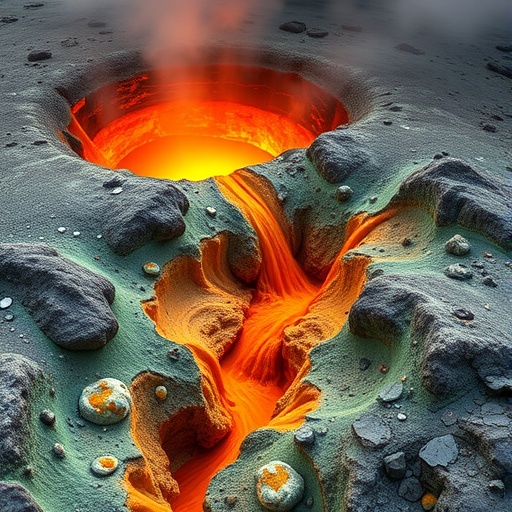
A long-standing geological puzzle may have finally been cracked, and the answer could reshape how we hunt for some of the most valuable metal deposits on Earth. Iron oxide-apatite (IOA) deposits, often called Kiruna-type after the famous Swedish orebody, are enigmatic giants of the mineral world. They host billions of tons of high-grade iron ore enriched with phosphorus, rare earth elements, and other critical metals, yet a convincing explanation for their formation has remained elusive for over a century. Now, a new study published in Nature Communications reveals that these deposits are born when hot, ascending magmas swallow a very particular menu item: ancient layers of evaporitic sulfate rock.
The research, led by Stefan Peters and colleagues, wields a powerful combination of sulfur isotope geochemistry and petrological modeling to trace the fingerprints of that primordial meal. By analyzing sulfur signatures in apatite from the iconic Kiruna and Grängesberg deposits in Sweden, the team uncovered a distinct isotopic composition that could not be explained by magmatic sulfur alone. Instead, the data pointed unmistakably to a massive input from evaporitic sulfates, the kind left behind when ancient seas evaporated and deposited gypsum and anhydrite. This is not a trivial seasoning; it is a trigger that fundamentally alters the physical and chemical evolution of the magma.
When a mantle-derived silicate melt rises through the crust and encounters a thick sequence of sulfate-rich evaporites, it assimilates that material on a grand scale. The sulfate is reduced to sulfide or oxidized sulfur species, a process that dramatically shifts the magma’s oxidation state. This sudden injection of sulfate pushes the melt into a critical chemical window where its capacity to dissolve iron and phosphorus collapses. Iron oxides, primarily magnetite and hematite, begin to crystallize en masse directly from the magma, while calcium phosphate precipitates as apatite. In effect, the assimilation event acts like a chemical switch that flips the magma from a metal-transporting medium into a metal-dumping factory.
The evidence hinges on multiple sulfur isotope ratios measured in individual apatite crystals. The team found minor isotopic anomalies indicative of mass-independent fractionation of sulfur, a hallmark of sulfate that once cycled through the Archean or Paleoproterozoic atmosphere. Such signals are absent in typical mantle sulfur but are preserved in ancient evaporite layers. The isotopic data were then integrated with thermodynamic phase-equilibria calculations, which demonstrated that adding even a few weight percent of sulfate to a silicate melt can trigger liquid immiscibility or force the direct crystallization of iron oxides and apatite without the need for external fluids. This dry, purely magmatic pathway elegantly explains the massive depletion of silica and the characteristic iron-phosphorus enrichment seen in IOA systems.
One of the most exciting implications of this model is its predictive power for mineral exploration. If the trigger for a Kiruna-type deposit is the assimilation of basin-scale evaporite formations, then the search space for new resources shrinks dramatically. Geologists can now prioritize magmatic arcs and rifted continental margins where mantle-derived melts must traverse thick sequences of evaporitic strata. The study suggests that many of the world’s largest IOA provinces, from Chile’s Cretaceous iron belt to the Bafq district of Iran, may owe their fertility to similar encounters with buried sulfate-rich rocks, a hypothesis that can be tested through targeted isotopic surveys.
The findings also illuminate a deeper planetary process. They show that surface conditions—the evaporation of oceans and the deposition of sulfate minerals—can reach down into the crust and influence magmatic ore formation hundreds of millions of years later. The recycling of surface-derived sulfur into the deep crust via assimilation creates a direct link between climate-driven sedimentation and the concentration of critical metals. It is a vivid reminder that Earth’s mineral wealth is not merely a product of internal heat and pressure, but a complex interplay between the hydrosphere, atmosphere, and lithosphere.
The team further warns that this mechanism may have been more common in the early Earth, when sulfate-rich evaporites first became widespread following the Great Oxidation Event. The isotopic anomalies they documented are consistent with a Paleoproterozoic sulfur source, aligning the genesis of the Swedish deposits with a time when the planet’s surface chemistry was undergoing radical transformation. This temporal link could explain why certain epochs in Earth’s history are disproportionately endowed with giant IOA-style orebodies.
In a broader sense, the study transforms our understanding of how so-called “melt-fluid” boundary processes operate. While previous models invoked late-stage hydrothermal fluids or immiscible iron-rich melts to explain IOA deposits, the evaporite assimilation hypothesis unifies field observations, experimental constraints, and isotopic evidence into a coherent narrative. It demonstrates that the key ingredient for some of the world’s most important iron resources is not exotic mantle chemistry, but a fortuitous intersection of magmatism with ancient salt flats. As the clean energy transition drives surging demand for iron, phosphorus, and rare earth elements needed for electric motors and batteries, this new genetic framework could not be timelier. It turns out that the recipe for a billion-ton iron orebody begins with a hot melt simply eating its way through yesterday’s evaporated sea.
Subject of Research: Formation of iron oxide-apatite deposits triggered by magmatic assimilation of evaporitic sulfate
Article Title: Formation of iron oxide-apatite deposits triggered by magmatic assimilation of evaporitic sulfate
Article References:
Peters, S.T.M., Feng, D., Troll, V.R. et al. Formation of iron oxide-apatite deposits triggered by magmatic assimilation of evaporitic sulfate.
Nat Commun 17, 5930 (2026). https://doi.org/10.1038/s41467-026-75189-0
Image Credits: AI Generated
DOI: 10.1038/s41467-026-75189-0
Keywords: iron oxide-apatite deposits, magmatic assimilation, evaporitic sulfate, sulfur isotopes, Kiruna-type ores, apatite, ore genesis, critical metals


