

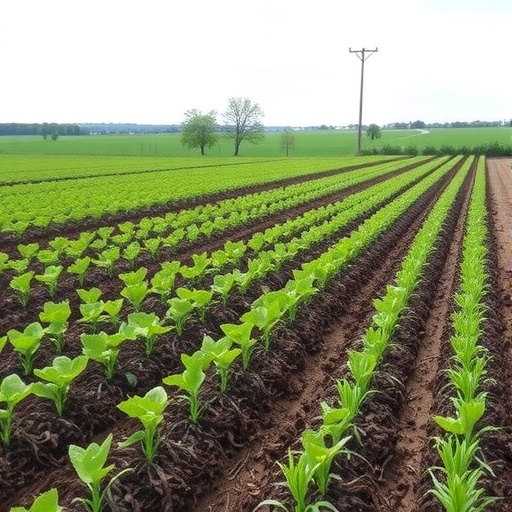
The relentless adaptability of weeds is pushing farmers into a corner, and this summer’s wet weather across the southeastern United States has only intensified the crisis. Frequent rains in June prevented timely herbicide applications, allowing aggressive species like Palmer amaranth and goosegrass to balloon past the ideal treatment window. Now, researchers from the University of Tennessee Institute of Agriculture are sounding the alarm: even the most trusted chemical tools are losing their edge, and growers need a radically updated playbook to protect their yields. The sobering findings will be presented in full during the 34th Milan No-Till Field Day on July 23 at the AgResearch and Education Center in Milan, Tennessee.
Palmer amaranth (Amaranthus palmeri), a notoriously fast-growing weed capable of producing hundreds of thousands of seeds per plant, has long been the villain of row crop agriculture. For years, postemergence control relied on Liberty (glufosinate), dicamba, or a tankmix of both. But field scouting across multiple West Tennessee counties this season has revealed something deeply worrisome: plants just two to three inches tall—well within the label-recommended size for treatment—are surviving Liberty applications. This emerging tolerance suggests that the weed is evolving physiological mechanisms, possibly through enhanced metabolic detoxification or reduced target-site sensitivity, to withstand doses that would have been lethal just a few seasons ago.
Larry Steckel, a row crop weed specialist at UTIA, explains that the loss of reliable postemergence options is particularly devastating this late in the growing season, when rescue treatments are the only remaining defense. For escapes that survive Liberty or dicamba, Steckel recommends shifting to hooded or post-directed applications. These methods physically shield the crop while directing a spray of Liberty combined with a residual partner such as Direx (diuron), Caparol (prometryn), Valor (flumioxazin), Zidua (pyroxasulfone), or Dual Magnum (S-metolachlor). The synergy of a contact herbicide with a soil-residual component helps suppress regrowth and prevents a second flush of germination.
Sally Reed, a graduate research assistant in the UT Herbert College of Agriculture, emphasizes that even these tactics are being tested by Palmer amaranth’s resilience. In some fields, only a drastic rescue treatment using Gramoxone (paraquat) in a hooded rig, tankmixed with diuron, Caparol, or Valor, can eliminate plants that have already survived an initial application. Paraquat is a potent photosystem I inhibitor that generates reactive oxygen species, rapidly desiccating green tissue on contact. Its use, however, demands extreme caution and specialized equipment, underscoring how the industry is being forced toward older, more hazardous chemistry as modern tools falter.
The crisis is not confined to broadleaf weeds. Glyphosate-resistant goosegrass (Eleusine indica), a prolific grassy weed, is spreading steadily across Tennessee. Its resistance mechanism often involves a point mutation in the EPSPS gene, preventing glyphosate from binding effectively. This biotype thrives in no-till systems, where its late-season emergence can dodge preplant herbicides. Meanwhile, graduate researcher Hayden Love will share new data on Italian ryegrass (Lolium multiflorum), a winter annual that has become a choking problem in Tennessee’s no-till operations. Multiple resistance to glyphosate, ALS inhibitors, and in some cases ACCase inhibitors has turned this grass into a year-round management puzzle that demands intricate combination of fall-applied residuals, spring burndowns, and crop rotation.
The Milan No-Till Field Day has been a crucible for conservation agriculture since 1981, pioneering the shift away from conventional tillage to protect soil structure, reduce erosion, and improve water infiltration. But the very success of no-till systems—where minimal soil disturbance leaves weed seeds concentrated at the surface—has accelerated selection pressure for resistance. This year’s event has shifted all agricultural presentations to sheds near the lake, where Steckel and his team will deliver an unvarnished hour-long technical tour titled “Herbicide-Resistant Weed Management.” Attendees will walk away with concrete herbicide combination matrices and application timing thresholds validated by UTIA field trials.
Beyond the specifics of chemistry, the overarching message is one of diversification. The era of relying on a single mode of action is over. Steckel’s group advocates for an integrated approach that layers cultural practices—cover cropping, narrow row spacing, and strategic tillage—with chemical rotations that stack multiple effective sites of action in every pass. Even then, the researchers caution that the pace of evolution is quickening. Laboratory assays of survivors now routinely test for cross-resistance patterns, and early warning signs are emerging for PPO inhibitor tolerance in some Palmer amaranth populations, a development that would erase another critical line of defense.
The event, which runs from 8 a.m. to 1 p.m. CDT and is free to all, offers Certified Crop Adviser and pesticide recertification credits. Its location at 3 Ledbetter Gate Road positions it in the heart of a region where the outcomes of this weed management crisis will be measured in bushels. As Steckel puts it, the wet June was a stress test nobody wanted, but it has sharply illuminated the gaps in current control programs. The research shared on July 23 may well determine whether farmers can keep these evolutionary adversaries at bay—or whether the weeds will continue rewriting the rules of engagement.
Subject of Research: Herbicide-resistant weed management in no-till row crop production
Article Title: Tennessee Researchers Confront Emerging Herbicide Resistance as Weeds Outmaneuver Last-Line Defenses
News Publication Date: July 2025 (press release associated with the 34th Milan No-Till Field Day)
Web References: milannotill.tennessee.edu ; utia.tennessee.edu
References: Not provided in source material
Image Credits: Photo courtesy UTIA
Keywords: Herbicides, Pesticides, Agriculture, Pest Control, Sustainable Agriculture, Weeds, Palmer Amaranth, Goosegrass, Italian Ryegrass, Herbicide Resistance


