

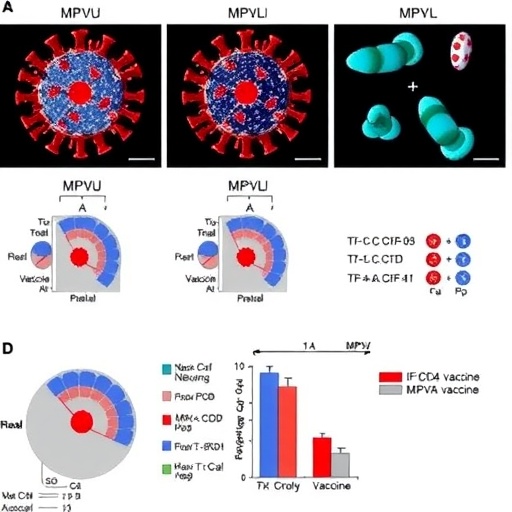
A new study has illuminated a critical dimension of the immune response to monkeypox virus (MPXV), revealing that a single surface protein, H3L, triggers a remarkably broad and cross-reactive arsenal of CD4 T helper cells in both people who have recovered from mpox and those immunized with the modified vaccinia Ankara (MVA) vaccine. The work, conducted by researchers in Germany and published in npj Viruses, offers a detailed map of the cellular immunity that underpins protection, highlighting conserved viral targets that could shape the next generation of orthopoxvirus vaccines.
The H3L protein is a structural component of the MPXV envelope that plays a vital role in viral entry. It belongs to a family of proteins that bind to heparan sulfate on the surface of host cells, anchoring the virus before fusion. Because H3L sits exposed on the mature virion, it is an attractive candidate for antibody-mediated neutralization, but its ability to engage the T-cell arm of the immune system has until now remained poorly characterized. Understanding CD4 T-cell responses is especially important because these lymphocytes orchestrate antibody production, mobilize cytotoxic CD8 T cells, and secrete antiviral cytokines that can limit viral spread before clinical symptoms escalate.
To dissect these responses, the researchers drew blood from mpox patients during the acute phase of infection and from healthy individuals who had received the MVA-BN vaccine, the same third-generation smallpox vaccine deployed globally during the 2022 mpox outbreak. They stimulated peripheral blood mononuclear cells with overlapping peptide pools spanning the entire H3L sequence, then used a combination of intracellular cytokine staining and activation-induced marker assays to detect and quantify antigen-specific CD4 T cells. The result was unambiguous: H3L is a dominant target of the CD4 T-cell response in both natural infection and vaccination. Responding cells produced a mix of Th1 cytokines such as interferon-gamma, tumor necrosis factor, and interleukin-2, often co-expressing multiple effector molecules, a polyfunctional profile strongly associated with protective antiviral immunity.
Delving deeper, the team performed high-resolution epitope mapping using smaller peptide subpools and then individual peptides, identifying multiple distinct CD4 T-cell epitopes scattered across the H3L sequence. This broad epitopic landscape is a crucial finding. By pinning down the exact peptide sequences recognized by T cells, the researchers showed that the response is not focused on one or two immunodominant regions but is instead directed against a wide array of determinants, a pattern that reduces the chance that the virus can escape recognition through mutation. Several of the most frequently recognized epitopes were presented by common human leukocyte antigen (HLA) class II molecules, such as HLA-DR, suggesting that a large fraction of the genetically diverse human population could generate similar T-cell memory.
Crucially, the CD4 T-cell responses induced by MVA vaccination closely mirrored those seen after natural mpox infection. MVA is a highly attenuated vaccinia virus that cannot replicate in human cells, yet it retains many genes orthologous to those of MPXV, including the H3L homolog. Because MVA delivers intact viral proteins to the host cell’s antigen-presenting machinery, it is adept at priming T-cell responses. The new data confirm that the MVA vaccine establishes H3L-specific memory CD4 T cells that are phenotypically and functionally comparable to those generated by live viral infection, providing mechanistic insight into the well-documented clinical efficacy of MVA-BN against mpox.
One of the most compelling aspects of the study is the demonstration of cross-reactivity. The researchers tested whether T cells raised against MPXV H3L could recognize the corresponding H3L protein from vaccinia virus, the ancestral orthopoxvirus used in first- and second-generation smallpox vaccines. They found extensive cross-recognition, with T cells responding to peptides from both viruses. This immunological memory bridge explains, at the cellular level, why historical smallpox vaccination provided decades of cross-protection against monkeypox and why MVA, derived from vaccinia, remains effective. It also implies that T-cell-based immunity could act as a pan-orthopoxvirus shield, a feature that is particularly relevant as zoonotic poxviruses continue to emerge.
From a vaccine design perspective, the identification of conserved, broadly recognized T-cell epitopes in H3L opens the possibility of developing protein-based or mRNA subunit vaccines that do not rely on live viral vectors. Incorporating H3L, or specific epitope strings from it, into next-generation vaccines could simplify manufacturing, improve safety in immunocompromised populations for whom replicating vaccines are contraindicated, and allow rapid adaptation to new viral variants. The study also highlights the value of measuring T-cell responses alongside neutralizing antibody titers when assessing vaccine immunogenicity, especially since T-cell memory often persists longer than circulating antibodies and may be more resilient against viral evolution.
Beyond vaccine development, the work has immediate implications for public health surveillance. As mpox continues to circulate in endemic regions and re-emerges in previously unaffected populations, monitoring T-cell immunity at the population level could help predict susceptibility. A decline in cross-reactive T-cell memory among younger generations that never received smallpox vaccination likely contributed to the speed of the 2022 outbreak. By establishing robust, peptide-based T-cell assays against H3L, the researchers provide tools to measure this critical immune parameter in epidemiological surveys.
In essence, the study transforms H3L from a known structural protein into a well-characterized T-cell immunogen. It maps the breadth and functional quality of CD4 T-cell responses with single-epitope precision and shows that MVA vaccination faithfully recapitulates the T-cell memory seen after natural infection. As the global community grapples with the long-term management of mpox and the broader threat of orthopoxviruses, this detailed blueprint of cellular immunity will guide the rational design of safer, broader-spectrum countermeasures, ensuring that our immunological defenses remain one step ahead of viral emergence.
Subject of Research: CD4 T cell responses to the MPXV H3L envelope protein in mpox patients and MVA vaccine recipients, including epitope mapping, cytokine profiling, and cross-reactivity with vaccinia virus.
Article Title: MPXV H3L elicits broadly directed CD4 T cell responses in mpox patients and MVA vaccinees.
Article References:
da Fonseca Araújo, D., Schultheiß, C., Cords, L. et al. MPXV H3L elicits broadly directed CD4 T cell responses in mpox patients and MVA vaccinees. npj Viruses 4, 31 (2026). https://doi.org/10.1038/s44298-026-00205-5
Image Credits: AI Generated
DOI: https://doi.org/10.1038/s44298-026-00205-5
Keywords: monkeypox virus, H3L protein, CD4 T cells, MVA vaccine, T-cell epitopes, cross-reactivity, orthopoxvirus, immunodominance, HLA class II, vaccine design.


