


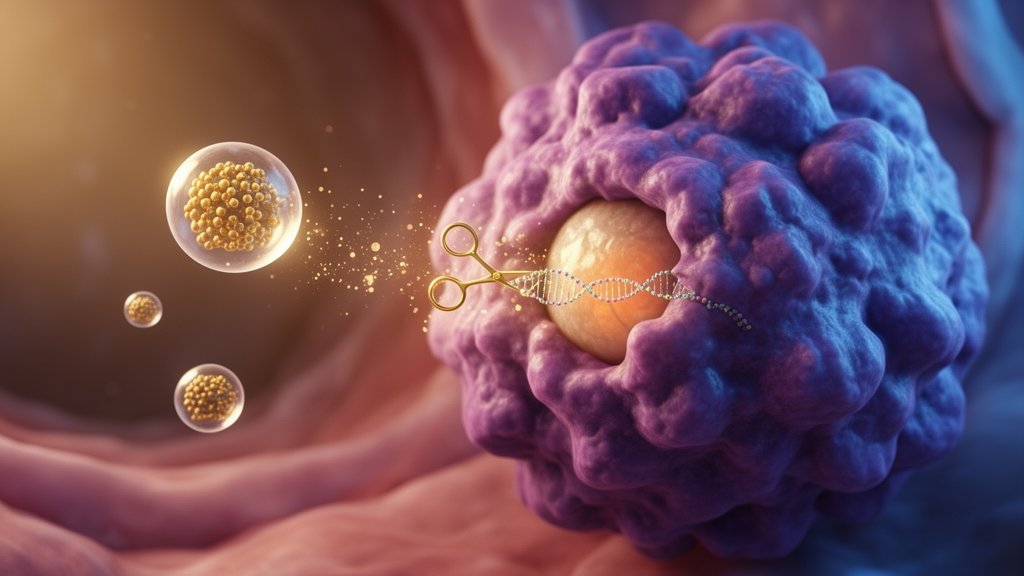
Infant neuroblastoma is one of the most clinically paradoxical cancers in medicine. Diagnosed during the first year of life, it spans a spectrum from localized tumors that can shrink or vanish entirely without treatment to aggressive metastatic disease that resists even the most intensive multimodal therapy. A recent SIOPEN analysis of 750 infants reported a 10-year overall survival of approximately 91 percent, yet for the high-risk subset, particularly MYCN-amplified disease, long-term survival has historically hovered near 50 percent. Now, a review published in Molecular Biology Reports examines whether CRISPR/Cas9 gene editing, ferried into tumor cells by engineered nanoparticles, could one day rewrite the genetic instructions driving the deadliest forms of this infant cancer.
The review, led by Samruddhi Kaknale and Varnitha Manikantan of Symbiosis Medical College for Women in Pune, India, together with collaborators at Symbiosis School of Biological Sciences, Karunya Institute of Technology and Sciences, and Manipal Institute of Technology Bengaluru, systematically maps the pathobiology of infant neuroblastoma, the mechanics of CRISPR/Cas9 targeting, and the nanocarrier platforms that might deliver the editing machinery safely in vivo. The authors are careful to frame the work as an investigational hypothesis rather than an established clinical application, noting that direct evidence in infant neuroblastoma remains limited and that most findings come from general neuroblastoma models, non-cancer models, or adult cancers that should not be interpreted as proof of efficacy in infants.
At the heart of the therapeutic concept lie two molecular hallmarks: MYCN amplification and activating ALK mutations. MYCN is a potent transcription factor that drives proliferation, suppresses apoptosis, and propels tumor progression, and its amplification is an established adverse prognostic feature associated with advanced stage, rapid growth, and poor outcome. ALK mutations, meanwhile, produce constitutive kinase activity that fuels oncogenic signaling. Because these alterations define the biology of high-risk disease, they represent the most attractive targets for precision gene editing, offering a shift from broad cytotoxic chemotherapy toward highly selective molecular intervention.
The CRISPR/Cas9 system itself is elegantly simple in principle. It consists of the Cas9 nuclease and a single guide RNA, a synthetic chimeric RNA containing a scaffold for Cas9 binding and a 20-nucleotide spacer complementary to the target DNA. For the commonly used Streptococcus pyogenes Cas9, target recognition requires a 5′-NGG-3′ protospacer-adjacent motif. Once directed to its genomic address, Cas9 induces a targeted double-strand break that the cell repairs through endogenous mechanisms. The predominant pathway, non-homologous end joining, is error-prone and typically generates small insertions or deletions that frameshift and inactivate the target gene, a powerful strategy for knocking out oncogenes such as MYCN or ALK. The less frequent homology-directed repair pathway uses a homologous DNA template and can, in principle, correct specific point mutations, such as activating ALK variants, with meticulous precision.
Recent advances have refined this toolkit further. Base editors harness a catalytically impaired Cas9 fused to a deaminase to convert single nucleotides directly, for example C to T or A to G, without double-strand breaks. Prime editors combine nCas9 with reverse transcriptase and a prime editing guide RNA to direct templated insertions, deletions, and all twelve possible base-to-base conversions, offering search-and-replace capabilities that reduce the risk of indels and chromosomal rearrangements. The review notes that direct evidence for base or prime editing in neuroblastoma remains limited, marking these approaches as avenues for future investigation rather than validated options.
Preclinical evidence, however, is already compelling in cell lines and animal models. High-throughput CRISPR screens have identified genetic dependencies in neuroblastoma, including a reliance on the PRC2 components EZH2, EED, and SUZ12 in MYCN-amplified models. Direct knockout of MYCN and ALK in various neuroblastoma cell lines has produced significant reductions in cell proliferation, inhibition of tumor growth in vitro and in vivo, and induction of apoptosis. CRISPR interference targeting the MYCN promoter has effectively repressed MYCN expression and suppressed neuroblastoma cell growth, while knockout of uPAR, a gene linked to cellular invasion, has inhibited invasive phenotypes, suggesting the technology can also blunt metastasis by targeting genes involved in tumor cell motility.
Yet the review is unflinching about the obstacles. Delivering Cas9 and its guide RNA into a sufficient percentage of tumor cells in vivo remains the central challenge, complicated by the large size, negative charge, immunogenicity, and degradation susceptibility of CRISPR cargoes. The Cas9 protein, derived from bacteria, can elicit innate and adaptive immune responses that clear edited cells or render subsequent treatments unproductive, and preexisting adaptive immunity to Cas9 proteins has been identified in humans. Off-target editing persists despite improvements in guide RNA design and high-fidelity Cas9 variants, and achieving uniform editing efficiency across a heterogeneous solid tumor microenvironment, with poor penetration and variable cellular uptake, is extraordinarily difficult. For infants, whose expected lifespans stretch across decades, persistent Cas9 activity, potential germline exposure, chromosomal rearrangements, large deletions, structural variants, and long-term effects in normal tissues demand careful assessment and lifelong follow-up before any clinical translation.
Nanoparticle delivery systems emerge as the leading candidates to surmount these barriers. Lipid nanoparticles, the most clinically advanced platform and the technology behind successful mRNA vaccines, typically comprise ionizable lipids, helper lipids like cholesterol and phospholipids, and PEGylated lipids. Ionizable lipids are positively charged at acidic pH but neutral at physiological pH, facilitating nucleic acid complexing and endosomal escape after cellular uptake, while PEGylated lipids preserve systemic circulation by preventing rapid elimination by the reticuloendothelial system. Delivery of Cas9 mRNA with sgRNA allows transient protein expression, minimizing off-target effects and immune activation associated with prolonged Cas9 activity, whereas pre-formed Cas9 ribonucleoproteins offer reduced immunogenicity and faster editing onset but are more complicated to encapsulate due to their size.
Polymeric and inorganic nanocarriers expand the design space. Biodegradable polymers such as PLGA, PEG, chitosan, and dendrimers can encapsulate CRISPR components with adjustable degradation and sustained release, and PLGA’s capacity to safeguard sensitive payloads makes it widely used for surface functionalisation aimed at neuroblastoma cell targeting. Gold nanoparticles are biocompatible and easily functionalized for direct conjugation with Cas9 and sgRNA, with photothermal applications, while magnetic nanoparticles enable magnetic targeting and MRI tracking, and mesoporous silica nanoparticles provide high loading, controlled release, and rigid protection of CRISPR cargo. For the minority of patients with CNS involvement or relapse, blood-brain barrier penetration strategies, including receptor-mediated transcytosis via ligands binding the transferrin, insulin, or low-density lipoprotein receptors, cell-penetrating peptides like TAT and R8, and focused ultrasound combined with microbubbles to transiently and locally disrupt the barrier, are being explored, though the review cautions that enhanced permeability does not necessarily indicate efficient nanoparticle delivery to the brain and may increase the risk of unintended CNS exposure and neurotoxicity.
The authors conclude that robust preclinical validation in relevant in vitro and in vivo models, including organoids, patient-derived xenografts, and orthotopic systems that precisely mimic the human disease, is essential for determining efficacy, characterizing biodistribution, evaluating off-target effects, and establishing a preliminary safety profile. Ethical and regulatory considerations add further complexity, as infants lack capacity for informed consent, requiring parents or legal guardians to decide in the child’s best interests amid the potentially irreversible nature of genomic modification. Future work should prioritize more selective nanoparticles, gene-editing tools with high precision and minimal off-target effects, and internationally harmonised regulatory frameworks for paediatric applications. With sustained interdisciplinary collaboration, the convergence of nanoparticle delivery and CRISPR/Cas9 precision may ultimately enable safer and more effective therapies for infants with neuroblastoma, though the review emphasizes that current evidence remains predominantly preclinical and is not yet sufficient to establish the optimal nanoparticle or CRISPR technique for infant neuroblastoma.
Subject of Research: Nanoparticle-enabled CRISPR/Cas9 gene editing as a potential therapy for infant neuroblastoma
Article Title: Precision gene editing in infant neuroblastoma: a review of nanoparticle: enabled CRISPR/Cas9 therapies
Article References: Kaknale, S., Ranjan, A., Enoch, I. V. M. V., Vyas, A., & Manikantan, V. (2026). Precision gene editing in infant neuroblastoma: a review of nanoparticle: enabled CRISPR/Cas9 therapies. Molecular Biology Reports, 53(1), Article 1725. https://doi.org/10.1007/s11033-026-12916-2
Image Credits: AI Generated
DOI: 10.1007/s11033-026-12916-2
Keywords: infant neuroblastoma, CRISPR/Cas9, nanoparticles, lipid nanoparticles, gene therapy, MYCN, ALK, drug delivery, paediatric oncology, base editing, prime editing, preclinical models
Cite Scienmag News
Juliet Wilcox. (October 17, 2026). Nanoparticles may carry CRISPR gene editing into infant neuroblastoma. Scienmag. https://scienmag.com/nanoparticles-may-carry-crispr-gene-editing-into-infant-neuroblastoma/
Juliet Wilcox. "Nanoparticles may carry CRISPR gene editing into infant neuroblastoma." Scienmag, 17 October 2026, https://scienmag.com/nanoparticles-may-carry-crispr-gene-editing-into-infant-neuroblastoma/. Accessed 17 October 2026.
Juliet Wilcox. "Nanoparticles may carry CRISPR gene editing into infant neuroblastoma." Scienmag. October 17, 2026. https://scienmag.com/nanoparticles-may-carry-crispr-gene-editing-into-infant-neuroblastoma/


