


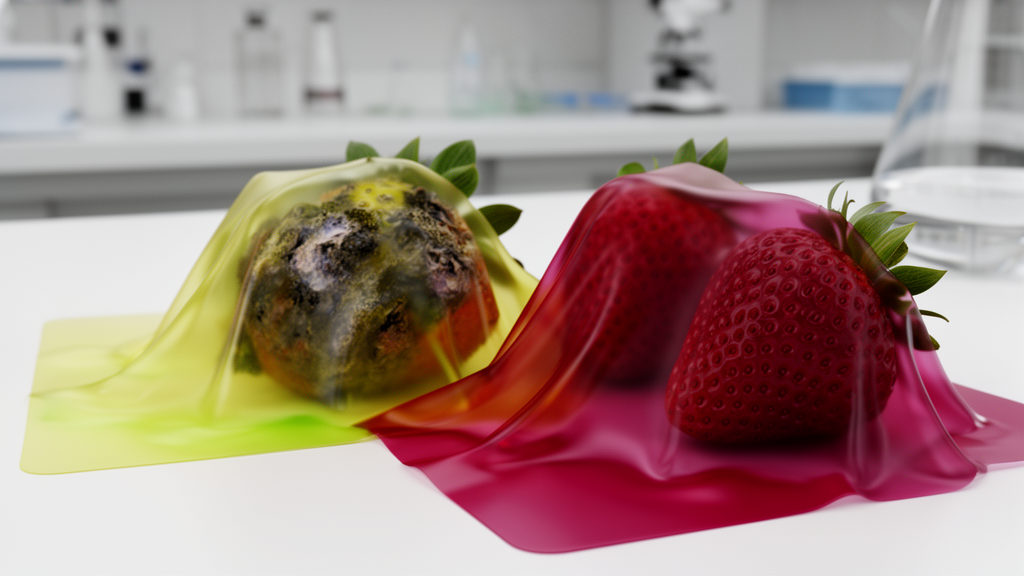
Imagine peeling back the lid on a pack of mushrooms and knowing at a glance whether they are still safe to eat — not from a printed date, not from a sniff test, but from the packaging itself changing color before your eyes. That is the promise of a new biodegradable freshness-indicating film developed by researchers at Banaras Hindu University in Varanasi, India. The team, led by Chinmay Patil, Suman Bharti, and Arvind Kumar, blended two renewable polysaccharides — kappa-carrageenan from red seaweed and hydroxypropyl methylcellulose, a cellulose derivative — and infused the matrix with anthocyanin pigments extracted from roselle, the deep crimson calyces of Hibiscus sabdariffa. The result is a thin film that doubles as a real-time spoilage alarm, turning from red to black as the food inside deteriorates.
The chemistry behind the color change is elegantly simple. Anthocyanins are the natural pigments that give berries, red cabbage, and hibiscus their vivid hues, and their molecular structure shifts reversibly as pH changes. When food spoils, microbes break down proteins and release volatile amines such as ammonia and trimethylamine, which raise the pH in the package headspace. As the environment becomes more alkaline, the anthocyanin molecules undergo structural transformations that shift their absorbed light from the red end of the spectrum toward blue-green, which the human eye reads as a dramatic darkening. This halochromic behavior makes anthocyanins ideal visual indicators for spoilage, particularly in protein-rich foods where volatile basic nitrogen compounds accumulate rapidly.
Roselle anthocyanins bring a distinct compositional profile to the party. Unlike the berry-derived pigments used in most previous indicator films, roselle is dominated by delphinidin- and cyanidin-based derivatives, which carry higher intrinsic acidity and stronger antioxidant capacity. The researchers suspected these properties could enhance both the pH responsiveness and the bioactivity of the polymer matrix — a hypothesis their experiments largely confirmed. The extraction process itself was straightforward: shade-dried roselle powder was mixed with 80 percent ethanol acidified to pH 2.0, heated at 50 degrees Celsius for an hour, filtered, concentrated under reduced pressure in the dark to prevent photodegradation, and dried into a semi-solid concentrate stored in amber bottles under refrigeration.
Film fabrication followed a solvent-casting route that kept conditions gentle enough to preserve the delicate pigments. Kappa-carrageenan and HPMC were dissolved in a 4:1 weight ratio in distilled water at 80 degrees Celsius, cooled to 50 degrees, and then combined with roselle anthocyanin at concentrations ranging from 0 to 2 percent of the dry polymer weight, with sorbitol as a constant plasticizer. After homogenization and degassing, 30-milliliter aliquots were cast onto Petri dishes and dried at 30 degrees for 24 hours. The resulting films, designated RA0 through RA2, ranged in thickness from 0.047 to 0.076 millimeters — thin enough for practical packaging yet robust enough for characterization.
Mechanical testing revealed a clear trade-off between pigment loading and structural integrity. Tensile strength plummeted from 43.5 megapascals in the control film to just 11.5 megapascals at 2 percent anthocyanin, while elongation at break fell from 18.2 percent to 6.06 percent. The explanation lies in the molecular architecture: anthocyanins carry multiple hydroxyl groups that form hydrogen bonds with the carrageenan and cellulose chains, but at elevated concentrations they disrupt the tight packing of polymer chains, weakening intermolecular cohesion and creating structural heterogeneity that compromises stress distribution. The films become stiffer and more brittle as the pigment crowds the network, restricting chain mobility and limiting plastic deformation before rupture.
Yet the same interactions that weakened the films strengthened their barrier performance. Water solubility dropped from 80.06 percent in the control to 70.27 percent at the highest loading, and the swelling ratio fell from 6.55 to 1.85. By occupying free hydrophilic groups and promoting partial crosslinking within the network, the anthocyanins reduced the availability of sites where water molecules could bind and penetrate. This moisture resistance is a significant advantage for packaging humid foods, where excessive water uptake can dissolve or degrade the film. The films also resisted oil permeation completely in a 24-hour test, thanks to the hydrophilic polysaccharide matrix rejecting non-polar oil molecules, and they retained structural integrity across a pH range from 2 to 12, with only minor disintegration at the most alkaline extremes where ionization of hydroxyl and sulfate groups weakens hydrogen bonding.
Antioxidant activity climbed steeply with pigment concentration, reaching 80.63 percent DPPH radical scavenging at 2 percent loading — a dramatic contrast to the zero activity of the unpigmented control. The phenolic hydroxyl groups on the anthocyanin molecules donate hydrogen atoms to neutralize free radicals, adding an active protective function to the packaging beyond mere indication. Fourier-transform infrared spectroscopy confirmed that the anthocyanins integrated into the matrix without disrupting the primary polymer backbone: the sulfate ester bands characteristic of kappa-carrageenan remained visible in all formulations, while new absorptions associated with aromatic C=C stretching and carbonyl groups verified the pigment’s presence. Thermogravimetric analysis showed the familiar multi-step degradation of polysaccharide films — moisture loss below 200 degrees, plasticizer decomposition between 200 and 300 degrees, and backbone scission up to 450 degrees — with thermal stability essentially maintained despite the bioactive loading.
Biodegradability was assessed through soil burial tests, where the films lost weight continuously over 21 days as soil microbes and enzymes hydrolyzed the hydrophilic polysaccharide matrix. The degradation pattern suggests near-complete breakdown within roughly two months, consistent with other carrageenan-based films that achieve 70 to 100 percent weight loss in 20 to 30 days. This rapid compostability stands in stark contrast to petroleum-based plastics, which persist in the environment for centuries, and underscores the environmental rationale behind the entire approach.
The real proof came from the freshness trial. Button mushrooms, chosen for their high respiration rate and rapid spoilage at room temperature, were packaged with the optimized 2 percent anthocyanin film and stored at 25 degrees Celsius. For the first 8 hours, the mushrooms stayed firm and fresh, and the film held its red color. By 16 hours, transpiration moisture had built up in the package but no off-odors had developed. Between 19 and 24 hours, the mushrooms began to discolor and emit faint odors, and the film started darkening. Beyond 28 hours, strong spoilage odors coincided with the film’s complete red-to-black transition, and by 32 to 36 hours the mushrooms were fully deteriorated — mirrored exactly by the black indicator. The color shift reflects the anthocyanins responding to volatile amines released by spoilage microbes, which raise the local pH and trigger the structural transformation of the pigment molecules.
What makes this work stand out in the crowded field of intelligent packaging is the attention to anthocyanin source as a design variable. Most previous studies have relied on berry pigments, but the roselle derivatives’ higher acidity and antioxidant capacity appear to influence polymer compatibility and functional performance in ways that berry sources do not. The trade-offs are real — mechanical strength suffers at high loadings — but the researchers argue that lower and moderate anthocyanin levels maintain acceptable integrity while prioritizing responsiveness and visual indication. With food waste representing one of the largest inefficiencies in the global supply chain, and with consumers increasingly demanding both sustainability and transparency, a compostable film that doubles as a spoilage alarm offers a compelling glimpse of where packaging is headed: not a passive barrier, but an active, communicating interface between food and the people who eat it.
Subject of Research: pH-responsive κ-carrageenan/HPMC biodegradable films incorporated with roselle anthocyanin for freshness indication
Article Title: pH-responsive κ-carrageenan/HPMC biodegradable films incorporated with roselle anthocyanin for freshness indication
Article References: Patil, C., Bharti, S., & Kumar, A. (2026). pH-responsive κ-carrageenan/HPMC biodegradable films incorporated with roselle anthocyanin for freshness indication. Frontiers in Industrial Microbiology, 4, Article 1784813. https://doi.org/10.3389/finmi.2026.1784813
Image Credits: AI Generated
DOI: 10.3389/finmi.2026.1784813
Keywords: pH-responsive, carrageenan, HPMC, biodegradable, films, incorporated, roselle, anthocyanin, freshness, indication, scientific research
Cite Scienmag News
Drew Townsend. (October 17, 2026). pH-responsive κ-carrageenan/HPMC biodegradable films incorporated with roselle anthocyanin for freshness indication. Scienmag. https://scienmag.com/ph-responsive-%ce%ba-carrageenan-hpmc-biodegradable-films-incorporated-with-roselle-anthocyanin-for-freshness-indication/
Drew Townsend. "pH-responsive κ-carrageenan/HPMC biodegradable films incorporated with roselle anthocyanin for freshness indication." Scienmag, 17 October 2026, https://scienmag.com/ph-responsive-%ce%ba-carrageenan-hpmc-biodegradable-films-incorporated-with-roselle-anthocyanin-for-freshness-indication/. Accessed 17 October 2026.
Drew Townsend. "pH-responsive κ-carrageenan/HPMC biodegradable films incorporated with roselle anthocyanin for freshness indication." Scienmag. October 17, 2026. https://scienmag.com/ph-responsive-%ce%ba-carrageenan-hpmc-biodegradable-films-incorporated-with-roselle-anthocyanin-for-freshness-indication/


