


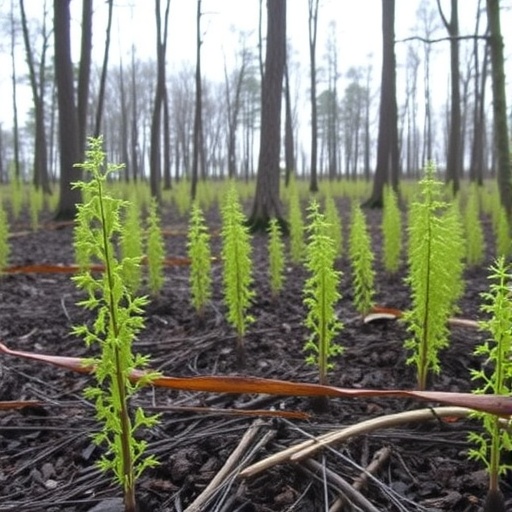
In the quiet understory of Michigan’s Manistee National Forest, a team of researchers from Michigan State University has been meticulously observing the forest’s future for nearly three decades. What they study may not be as grandiose as towering trunks or vast canopies, but these small seedlings, less than a year old, hold profound clues about how the forest will evolve amid a rapidly changing climate. Led by forestry professor Richard Kobe, this ongoing monitoring effort focuses on the delicate beginnings of tree life—seedling recruitment—and its intricate relationship with environmental variables across space and time.
The research unfolds each summer, as the team traverses the same 12 sites scattered over a 370-square-mile stretch of northern Michigan forest. Their annual task involves identifying and counting a staggering number of seedlings—almost 189,000 individual saplings have been cataloged so far. These measurements are more than mere tallies; they represent snapshots of survival, adaptation, and transformation in the face of warming temperatures, altered precipitation patterns, and shifting resource availability. The team records critical microenvironmental factors at each site: air temperature, soil moisture, soil fertility, and the amount of light penetrating the canopy. Together, these variables create resource gradients influencing which species can establish and persist in this dynamic ecosystem.
The life stage of a seedling is notoriously perilous. As Bailey McNichol, a postdoctoral scholar in forestry and ecology at MSU, explains, seedlings possess shallow roots rendering them particularly vulnerable to drought stress and temperature variability. They also endure intense biotic pressures, including diseases and herbivory from deer. Surviving the germination gauntlet means overcoming a short but crucial window during which the plant must establish itself in unforgiving forest floor conditions. Only a fraction of seedlings transition to saplings, let alone mature trees; understanding this bottleneck is essential for predicting forest composition decades into the future.
This long-term observational study employs a rigorous transect methodology. Seasonal sampling across multiple years and locations produces unprecedented temporal and spatial datasets allowing researchers to correlate seedling abundances with environmental drivers. The fine-scale resolution helps unravel how resource gradients influence recruitment not only of individual species but also the broader community dynamics shaping northern hardwood forests. Among the species tracked are ecologically and economically significant hardwoods such as sugar maple, red maple, American beech, white ash, and various oaks.
One compelling finding emerging from the data indicates that forest regenerative patterns are responding to recent climate trends. Since the 1950s, the Great Lakes region has experienced a notable rise in average temperatures of approximately 2.3°F, with projections suggesting an increase as high as 11°F by century’s end. These changes, combined with varying precipitation regimes, appear to be selecting for certain species better adapted to warmer, wetter conditions. For example, species like white oak, red oak, black cherry, ironwood, and red maple maintain robust seedling recruitment across the studied sites, suggesting their potential to dominate future forest canopies.
Conversely, traditional hardwood stalwarts such as sugar maple, American beech, white ash, basswood, and black oak are exhibiting declines in seedling presence. This trend raises alarms about the stability and composition of northern hardwood forests, given these species’ extensive roles in forest ecology and timber industries. The study underscores that climate-induced shifts in forest regeneration are not uniform; microhabitat factors, including canopy cover, modulate seedling microclimates. Dense overstory layers buffer seedlings from climatic extremes, creating cooler, moister conditions essential for vulnerable species’ recruitment.
However, climatic suitability alone does not guarantee seedling survival into maturity. Forest ecosystems also face mounting pressures from diseases, invasive pests, and herbivory hotspots, particularly deer browse, which can decimate seedling cohorts before they transition to saplings. These biotic stressors interact with abiotic variables, potentially amplifying recruitment bottlenecks. The researchers emphasize the necessity of longitudinal studies extending beyond the first year of seedling emergence to fully unravel survival trajectories and factors influencing long-term forest regeneration.
The implications of this research resound beyond academic interest. Michigan’s forests underpin a complex socio-economic fabric, providing ecosystem services such as carbon sequestration, water filtration, erosion control, and recreational opportunities, besides supporting a robust forestry sector employing tens of thousands and contributing billions in economic output. Understanding and anticipating how forest compositions will respond under climatic pressures is crucial for management practices aimed at fostering resilient ecosystems.
Looking forward, the investigative team aims to refine their models of forest dynamics by incorporating seedling to sapling survival rates, extending their observations into the vital juvenile growth stages. Such efforts will enhance predictive capabilities regarding the spatial-temporal distribution of tree species under diverse climate scenarios. This approach will inform adaptive forest management strategies targeting species conservation, timber production sustainability, and mitigation of climate change impacts.
The meticulous work of McNichol and Kobe’s team exemplifies the power of sustained ecological monitoring. Their study, recently published in Global Change Biology Communications, contributes to a growing body of knowledge highlighting how complex interactions between climate, resource availability, and biotic pressures shape the future of northern hardwood forests. As the region’s seedlings quietly bear witness to a changing world beneath the canopy, this research underscores a fundamental truth: the forest of tomorrow depends on the fragile, often overlooked beginnings beneath our feet.
News Publication Date: April 9, 2026
Web References:
https://onlinelibrary.wiley.com/doi/10.1002/gcb4.70017
References:
McNichol, B. H., & Kobe, R. K. (2026). Variation in Climate Shapes Seedling Recruitment Along Resource Gradients in a Northern Hardwood Forest. Global Change Biology Communications. DOI: 10.1002/gcb4.70017
Cite Scienmag News
Russell Cooper. (May 26, 2026). Michigan’s Future Forests: 190,000 Baby Trees Counted Over 25 Years Reveal Key Insights. Scienmag. https://scienmag.com/michigans-future-forests-190000-baby-trees-counted-over-25-years-reveal-key-insights/
Russell Cooper. "Michigan’s Future Forests: 190,000 Baby Trees Counted Over 25 Years Reveal Key Insights." Scienmag, 26 May 2026, https://scienmag.com/michigans-future-forests-190000-baby-trees-counted-over-25-years-reveal-key-insights/. Accessed 4 September 2026.
Russell Cooper. "Michigan’s Future Forests: 190,000 Baby Trees Counted Over 25 Years Reveal Key Insights." Scienmag. May 26, 2026. https://scienmag.com/michigans-future-forests-190000-baby-trees-counted-over-25-years-reveal-key-insights/


