


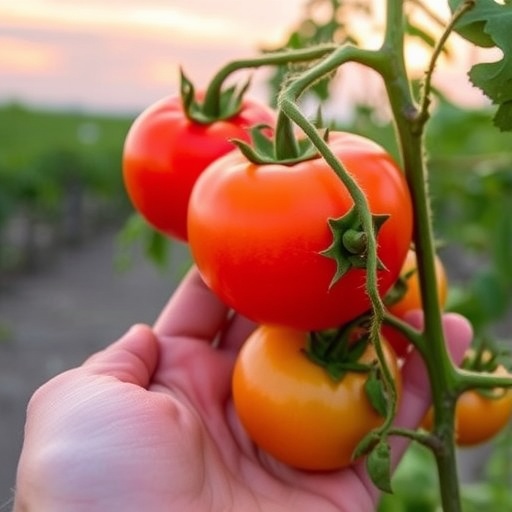
What if the key to drought-resistant crops is not simply how much water a plant uses, but when it chooses to use it? New research on tomato plants suggests that a hidden daily rhythm in the microscopic pores of leaves may help breeders develop varieties capable of producing strong yields while conserving water under increasingly harsh climate conditions.
The study, led by Dr. Sanbon Chaka Gosa and Prof. Menachem Moshelion at the Faculty of Agriculture of the Hebrew University of Jerusalem, identifies the timing of stomatal activity as a potentially important marker of drought resilience. Stomata are tiny adjustable pores, usually concentrated on the undersides of leaves, that regulate the exchange of gases between a plant and the atmosphere. They allow carbon dioxide to enter for photosynthesis, but their opening also permits water vapor to escape through transpiration. This creates a constant balancing act: plants must open their stomata enough to capture carbon dioxide and grow, while closing them sufficiently to prevent dangerous dehydration.
The research, published in Plant Science, examined how genetically diverse tomato lines managed water throughout the day and responded to periods of drought and recovery. Rather than relying on isolated measurements taken at a single time, the scientists continuously monitored whole-plant water use in controlled greenhouse experiments and compared those results with years of field-performance data. This approach allowed them to observe the plants as dynamic systems, revealing changes in water consumption and stomatal behavior that conventional snapshots can easily miss.
The most successful tomato plants displayed a distinct surge in stomatal activity during the early morning. Their stomata opened when sunlight was already strong enough to support vigorous photosynthesis, but before temperatures and atmospheric dryness reached levels that would cause excessive water loss. The researchers describe this interval as a physiological “golden hour.” During this period, plants appeared to capture carbon efficiently while limiting the amount of water released into the air, creating a more favorable trade-off between growth and conservation.
That timing matters because the atmosphere changes dramatically over the course of a day. In the morning, temperatures are often lower and humidity is relatively high, reducing the pressure that draws water from leaves. As the day progresses, heat and dry air increase the evaporative demand on the plant. If stomata remain widely open during the hottest part of the day, a plant may lose water rapidly without gaining a proportional benefit in carbon fixation. The tomato lines that performed best appeared to take advantage of the early period of favorable conditions, then adjust their water use as environmental stress intensified.
The findings challenge the assumption that drought resistance can be predicted primarily from a plant’s anatomy. The high-performing lines tended to have more stomata on the underside of their leaves, a feature that might appear to increase the risk of water loss. Yet stomatal number alone did not explain which plants survived drought most effectively. The crucial distinction was how those pores behaved: when they opened, how widely they opened, how quickly they responded to changing conditions, and how efficiently the plant recovered after water became available again.
The study also produced a result that may seem counterintuitive. Tomato plants that used more water under favorable conditions were often among those that recovered most successfully after drought. Rather than indicating poor water management, higher water use during periods of abundance may have supported greater biomass accumulation, stronger growth, and improved capacity to rebound from stress. The researchers found that the strongest lines maintained high biomass and water-use efficiency while also recovering more rapidly after dehydration. Their performance suggests that drought resilience is not always equivalent to minimizing water use at every moment.
“Plants don’t simply save water during drought, they manage it strategically,” Prof. Moshelion said. “Understanding these dynamic patterns gives breeders entirely new traits to target when developing crops that can thrive under increasingly unpredictable climate conditions.” This perspective could influence how drought tolerance is evaluated in breeding programs. Instead of selecting plants only by measuring final yield after a dry period, breeders could monitor daily water-use patterns and identify plants that coordinate photosynthesis, transpiration, and recovery more effectively.
Dr. Gosa said the work demonstrates why continuous measurements can provide a clearer picture of plant resilience than observations taken at a single moment. “Our work shows that a plant’s daily rhythm matters,” she said. “By measuring how plants respond continuously rather than at a single moment, we can identify resilient varieties much earlier and with far greater precision.” The researchers believe that the same strategy could be extended beyond tomatoes to other crops facing hotter temperatures, irregular rainfall, and longer droughts. As agriculture confronts climate change, the ability to recognize and breed for biological timing may become as important as selecting for yield, root development, or leaf structure.
The implications reach beyond the laboratory. Tomatoes are a major food crop, and their productivity can decline sharply when drought disrupts photosynthesis, causes premature leaf aging, or limits the plant’s ability to recover during fruit development. A breeding strategy based on stomatal dynamics could help produce varieties that make better use of short periods of favorable weather, reduce unnecessary water loss during heat, and resume growth more effectively after irrigation or rainfall returns. The research does not suggest that a single “golden hour” will solve agricultural water scarcity, but it reveals a measurable physiological trait that could make future crops more adaptable. In a warming world where farmers must produce more food with less predictable water supplies, the daily schedule of a plant’s microscopic pores may prove to be an unexpectedly powerful tool.
Web References: https://doi.org/10.1016/j.plantsci.2026.113170
References: Plant Science, DOI: 10.1016/j.plantsci.2026.113170
Cite Scienmag News
Alan Morgan. (August 17, 2026). Tomato golden-hour research may help crops withstand heatwaves and drought. Scienmag. https://scienmag.com/tomato-golden-hour-research-may-help-crops-withstand-heatwaves-and-drought/
Alan Morgan. "Tomato golden-hour research may help crops withstand heatwaves and drought." Scienmag, 17 August 2026, https://scienmag.com/tomato-golden-hour-research-may-help-crops-withstand-heatwaves-and-drought/. Accessed 3 September 2026.
Alan Morgan. "Tomato golden-hour research may help crops withstand heatwaves and drought." Scienmag. August 17, 2026. https://scienmag.com/tomato-golden-hour-research-may-help-crops-withstand-heatwaves-and-drought/


