


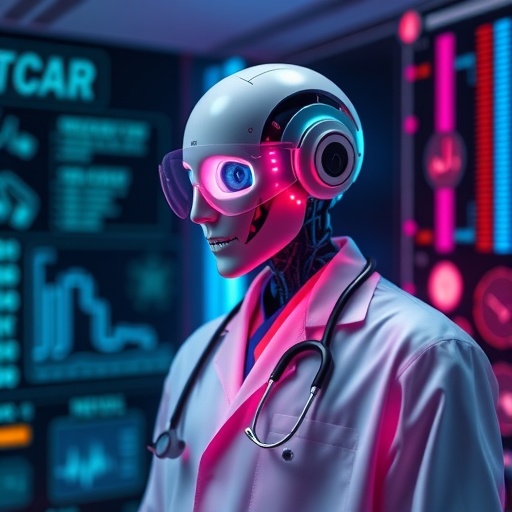
Artificial intelligence is moving from the research laboratory into examination rooms, hospitals and home-care platforms, raising a question that could redefine modern medicine: should patients primarily be treated by physicians, by intelligent machines, or by a combination of both? A new Perspective in JAMA, authored by Ezekiel J. Emanuel, MD, PhD, examines the advantages and disadvantages of physician-led medical care compared with care provided by artificial intelligence. Rather than presenting AI as a simple replacement for doctors, the article addresses a more complicated possibility: that medical care may become a contest between human judgment and computational systems—or a partnership in which each performs the tasks it can handle best.
The appeal of AI in medicine is rooted in its ability to process information at a scale no individual clinician can match. Modern health care generates enormous quantities of data, including electronic health records, laboratory measurements, medication histories, medical images, genetic sequences, wearable-device signals and clinical notes. Machine-learning systems can analyze these data rapidly, identify statistical patterns and generate predictions about diagnosis, prognosis or treatment response. In imaging, neural networks can be trained to recognize subtle features associated with cancer, retinal disease or neurological injury. In clinical documentation, large language models can summarize records, draft notes and extract relevant information from thousands of pages. These capabilities could reduce delays and help clinicians detect signals that might otherwise be overlooked.
AI systems may also make medical expertise more continuously available. A physician can examine only a limited number of patients at a time, while software can operate around the clock and support millions of interactions simultaneously. Automated tools could answer routine questions, monitor chronic conditions, remind patients about medications and identify changes that warrant professional attention. For people living in regions with few doctors, algorithmic systems might provide preliminary guidance or help local health workers interpret complex cases. In principle, AI could also reduce costs by automating repetitive administrative work, allowing physicians to spend more time on diagnosis, communication and treatment decisions. The technology’s greatest value may therefore come not from replacing clinical encounters but from extending the reach of scarce medical expertise.
Yet speed and scale do not guarantee safe or appropriate care. AI models learn from existing data, and those data reflect the strengths, weaknesses and inequities of the health systems that produced them. If a training dataset contains fewer examples from particular racial, ethnic, socioeconomic or geographic groups, an algorithm may perform less accurately for those patients. A model developed in one hospital may fail when deployed in another because patient populations, equipment, documentation practices and disease prevalence differ. This problem, known as distribution shift, can cause performance to deteriorate when real-world conditions depart from the environment in which the system was trained. Continuous monitoring, external validation and recalibration are therefore essential, but they are technically demanding and often neglected after deployment.
AI also introduces distinctive forms of error. A language model can produce fluent but false statements, a phenomenon commonly called hallucination. A diagnostic algorithm may be highly accurate on average while making dangerous mistakes in unusual cases. Some systems provide a probability without explaining the biological or clinical reasoning behind it, making it difficult for a physician or patient to challenge the recommendation. Other models can be influenced by irrelevant details, such as differences in image quality or wording in a clinical note. Automation bias adds another risk: people may accept a computer-generated recommendation simply because it appears objective or technologically sophisticated. In medicine, an incorrect answer delivered with confidence can be more hazardous than an acknowledged uncertainty.
Physician-led care has limitations of its own. Doctors vary in knowledge, experience, attention and susceptibility to cognitive biases. Fatigue, time pressure and excessive workloads can contribute to diagnostic mistakes, delayed follow-up and communication failures. Human clinicians may also rely too heavily on familiar patterns, overlook rare conditions or recommend treatments inconsistently. Medical care can be expensive and difficult to access, particularly for patients who live far from hospitals or lack insurance. Physicians cannot memorize every new study, guideline or drug interaction, and no doctor can independently review all the information available in a complex patient record. These constraints explain why AI tools are attractive even to clinicians who remain cautious about autonomous medical decision-making.
The central distinction is not simply between human intelligence and artificial intelligence, but between different kinds of judgment. Physicians can interpret a patient’s goals, fears, family circumstances and tolerance for risk in ways that remain difficult to encode mathematically. They can notice when a patient’s words, behavior or silence suggests distress, confusion or mistrust. They can negotiate competing values, explain uncertainty and accept responsibility for a recommendation. These interpersonal and ethical dimensions are not peripheral to medicine; they influence whether patients understand a diagnosis, follow a treatment plan and feel respected. AI can imitate empathy through language, but imitation does not necessarily equal comprehension, moral responsibility or a genuine therapeutic relationship.
A safer model may be collaborative care in which algorithms perform narrowly defined tasks while physicians retain meaningful oversight. In such a system, AI might screen images, identify medication interactions, compare a patient’s data with relevant evidence or alert clinicians to a deteriorating condition. The physician would evaluate the output in context, discuss options with the patient and decide whether the recommendation is appropriate. This arrangement, however, requires more than placing a software tool inside a hospital. Clinicians must be trained to understand model limitations, interpret confidence scores and recognize when an algorithm is operating outside its validated range. Health systems also need clear rules for documenting AI involvement, investigating errors and determining responsibility when automated advice contributes to harm.
The expansion of AI care raises broader questions about accountability, privacy and the future medical workforce. Training powerful models requires access to sensitive health information, creating risks if data are collected without meaningful consent or protected inadequately. Commercial systems may be difficult to audit if their developers treat model architecture or training data as proprietary. Patients may not know whether they are communicating with a person or a machine, or how their information will be used to improve the system. At the same time, widespread automation could change the skills expected of physicians, shifting emphasis from memorization toward verification, communication, systems thinking and ethical reasoning. The Perspective in JAMA presents this debate as a choice with no effortless answer: AI may improve accuracy, access and efficiency, but medicine’s human obligations cannot be reduced to prediction alone. The future of care will depend on whether technological power is placed under effective clinical, ethical and public oversight.
Web References: https://doi.org/10.1001/jama.2026.15380
References: Emanuel EJ. Perspective on physician-led medical care versus artificial intelligence–provided medical care. JAMA. doi:10.1001/jama.2026.15380.
Keywords
Artificial intelligence; AI in medicine; physician-led care; health care; clinical decision-making; machine learning; medical ethics; diagnostic accuracy; patient safety; health equity.
Cite Scienmag News
Ophelia Keating. (August 17, 2026). Could Autonomous AI Outperform AI-Assisted Physicians in Delivering the Best Medical Care? Scienmag. https://scienmag.com/could-autonomous-ai-outperform-ai-assisted-physicians-in-delivering-the-best-medical-care/
Ophelia Keating. "Could Autonomous AI Outperform AI-Assisted Physicians in Delivering the Best Medical Care?" Scienmag, 17 August 2026, https://scienmag.com/could-autonomous-ai-outperform-ai-assisted-physicians-in-delivering-the-best-medical-care/. Accessed 3 September 2026.
Ophelia Keating. "Could Autonomous AI Outperform AI-Assisted Physicians in Delivering the Best Medical Care?" Scienmag. August 17, 2026. https://scienmag.com/could-autonomous-ai-outperform-ai-assisted-physicians-in-delivering-the-best-medical-care/


