


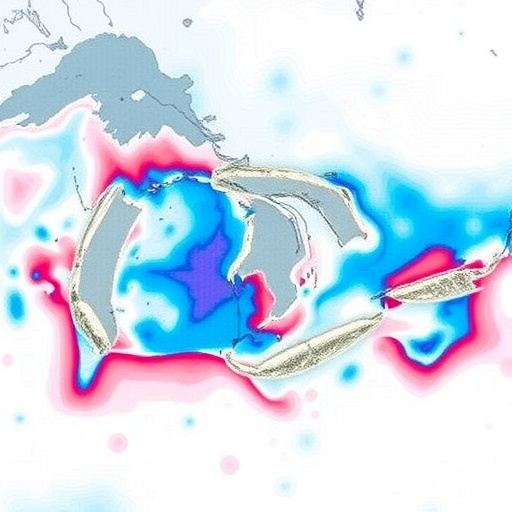
A century of reconstructed ice data from the Laurentian Great Lakes is challenging the familiar story of inexorably shrinking winter ice. New research led by the Cooperative Institute for Great Lakes Research at the University of Michigan suggests that average annual ice cover may enter a temporary pause—or even increase moderately over the coming decade—as natural climate cycles move the region from a long-term trough toward a potential crest. The finding does not signal a recovery from climate change. Instead, it reveals how strongly slow-moving natural variability can temporarily mask the effects of continued global warming, producing sudden and sometimes bewildering changes in the frozen surface of Lakes Superior, Michigan, Huron, Erie and Ontario.
The study, published in Communications Earth & Environment, reconstructs annual average ice cover across the Great Lakes back to 1898. Before the satellite era, which began providing systematic observations in the 1970s, researchers had no consistent, lake-wide measurements of ice. To fill that gap, the team developed a statistical model linking historical air temperatures to observed ice cover during the modern period. They then used the century-long temperature record to estimate—or hindcast—the amount of ice present during earlier winters. Newspaper reports, ship captains’ logs and other historical accounts provided an independent way to test whether the model’s results matched descriptions of exceptionally icy or nearly ice-free seasons.
The resulting record resembles neither a simple straight-line decline nor a stable cycle. Ice cover fell during roughly the first four decades of the 20th century, then increased for almost 40 years before beginning another sustained decline in the late 1970s. That pattern is crucial because it places the recent reduction in a much longer context. The Great Lakes are currently near a low point in a broad, slow oscillation, the researchers report, and conditions could shift toward more extensive ice even while the underlying climate continues to warm. If the historical pattern repeats, annual average ice cover could begin rising within the next decade, although the size and duration of any increase remain uncertain.
The researchers attribute this broad wave in part to natural climate variability that influences atmospheric circulation, air temperatures and winter weather across the Great Lakes region. Large-scale climate patterns can persist for years or decades, altering the frequency of cold-air outbreaks, the timing of freeze-up and thaw, and the storms that distribute heat and moisture over the lakes. Because ice responds rapidly to changes in temperature and wind, these natural fluctuations can generate a powerful signal in the ice record. A warmer climate does not eliminate that signal; it changes the baseline on which it operates. The result can be a temporary increase in ice cover superimposed on a much longer warming trend.
That distinction is central to interpreting the study. “It is important that we do not interpret these changes as climate recovery, but rather a temporary respite from the background warming that has continued over the last 125 years,” the authors wrote. Greenhouse-gas-driven warming is still reducing the long-term potential for winter ice, particularly during mild years and in the southern lakes. A natural upswing could therefore produce more ice than recent winters without restoring the conditions common in earlier generations. Over time, the warming baseline may continue to erode the average amount of ice, even as the natural cycle creates a short-lived rebound.
The study also highlights a paradox that may make future winters harder, not easier, to predict. As temperatures rise, the difference between one winter and the next can become enormous. David Cannon, a senior author and assistant research scientist with CIGLR, pointed to a striking example: during the past half-century, the highest and lowest ice years in the record occurred back to back. Such abrupt contrasts can arise when the lakes hover near the temperature threshold at which water freezes. Small changes in atmospheric conditions can then determine whether ice expands rapidly, breaks apart during a storm or fails to form at all. Climate warming may therefore reduce the long-term average while increasing the practical uncertainty surrounding individual winters.
That uncertainty matters across the Great Lakes basin, where ice is not merely a scenic feature. Winter ice influences commercial shipping, coastal hazards, fishing, tourism and local events built around frozen bays and channels. Ice cover can restrict or redirect vessels, protect shorelines from wave energy, alter evaporation and affect lake-effect snowfall. Communities also rely on predictable ice conditions for activities ranging from snowmobiling and ice fishing to races and festivals. In 2024, poor ice conditions forced Ashland’s “Book Across the Bay” 10K ski and snowshoe event on Chequamegon Bay to move closer to shore for safety. Similar disruptions may become more common when long-term warming collides with large year-to-year swings.
The project began through the Great Lakes Summer Fellows Program, a partnership involving CIGLR and the National Oceanic and Atmospheric Administration’s Great Lakes Environmental Research Laboratory. Elleanna Viere, who worked on the analysis as an undergraduate at Northland College, was motivated by personal observations of changing ice on Lake Superior. She had watched the ice bridge to nearby islands form later in the season and heard residents describe the lake ice as increasingly unpredictable. Her work with Cannon and colleagues transformed those observations into a quantitative historical investigation, combining satellite-era ice measurements, air-temperature records and documentary evidence from before modern remote sensing.
The model currently focuses on annual average ice cover, but the researchers say the same approach could eventually be used to reconstruct other properties, including ice thickness, the geographic distribution of ice and the timing of freeze-up and breakup. Those details would provide a sharper picture of how climate variability affects individual lakes and communities. The team also emphasizes that maintaining direct observations is essential. Satellite records, buoy measurements, shoreline observations and historical archives allow future scientists to evaluate models and detect changes that a single short dataset could miss. A long record is especially valuable in a system where extraordinary winters can occur only a year apart.
The Great Lakes are therefore entering a future defined by two forces at once: persistent human-caused warming and powerful natural fluctuations capable of briefly reversing the recent direction of ice cover. The new century-long reconstruction shows why both must be considered. A decade of heavier ice would not disprove climate change, just as a nearly ice-free winter would not reveal the entire long-term trajectory. Instead, the record shows a more complicated and more consequential reality—one in which average conditions can shift slowly, extremes can arrive suddenly, and reliable observations are indispensable for shipping operators, businesses, ecosystems and residents preparing for the next frozen—or unexpectedly open—Great Lakes winter.
News Publication Date: 28-Jul-2026
Web References: https://ciglr.seas.umich.edu/ ; https://ciglr.seas.umich.edu/david-cannon/ ; https://nmu.edu/eegs/elleanna-viere
References: Cannon et al., Communications Earth & Environment (2026), DOI: 10.1038/s43247-026-03866-5
Cite Scienmag News
Russell Cooper. (August 17, 2026). Great Lakes Ice Cover Declines, but Temporary Relief May Be Coming. Scienmag. https://scienmag.com/great-lakes-ice-cover-declines-but-temporary-relief-may-be-coming/
Russell Cooper. "Great Lakes Ice Cover Declines, but Temporary Relief May Be Coming." Scienmag, 17 August 2026, https://scienmag.com/great-lakes-ice-cover-declines-but-temporary-relief-may-be-coming/. Accessed 3 September 2026.
Russell Cooper. "Great Lakes Ice Cover Declines, but Temporary Relief May Be Coming." Scienmag. August 17, 2026. https://scienmag.com/great-lakes-ice-cover-declines-but-temporary-relief-may-be-coming/


