


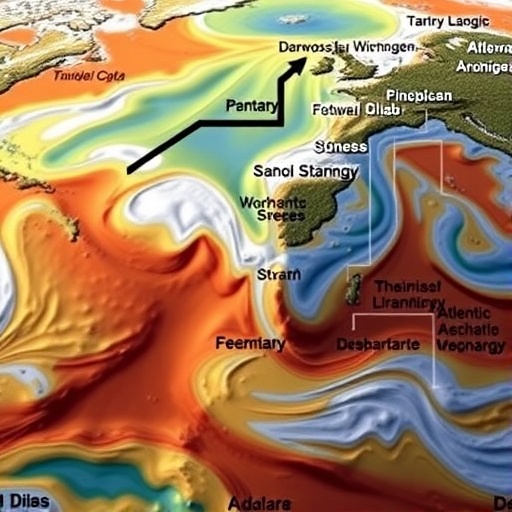
CORVALLIS, Ore. — The Atlantic Ocean’s great conveyor belt may be doing far more than transporting heat around the planet. New research suggests that the Atlantic Meridional Overturning Circulation, or AMOC, functions as a planetary “heat valve,” controlling how much energy the global ocean stores and how much escapes into the atmosphere. When the circulation weakens, the planet does not simply redistribute heat from the Northern Hemisphere to the Southern Hemisphere, as scientists have long believed. Instead, the global ocean absorbs additional heat, increasing the total energy stored by the Earth system.
The finding, published in Nature Geoscience, offers a new explanation for one of the most abrupt climate phenomena in Earth’s history. It also carries a striking implication for the future: although a weakening AMOC would cool the North Atlantic and nearby regions, it would contribute to greater overall planetary warming. “The AMOC works like a heat valve that controls the energy budget of the planet,” said Christo Buizert, a paleoclimatologist at Oregon State University and lead author of the study.
The AMOC is a vast network of currents that moves warm, salty surface water northward from the tropics and returns colder, denser water toward the deep ocean. In the North Atlantic, surface water releases heat into the atmosphere. As it cools, its density increases, causing it to sink and helping drive the deep branch of the circulation. This process, known as deep-ocean convection, links the atmosphere, the ocean surface and the abyssal ocean in a system that transports heat across thousands of kilometers.
Under strong AMOC conditions, heat absorbed from sunlight in the tropical ocean is carried northward efficiently. There, the energy can escape from the ocean into the atmosphere, especially during winter, when cold air promotes intense heat loss. The process effectively opens the planet’s heat valve. The ocean gives up more of its stored energy, and the global ocean and planet as a whole lose heat, even though the North Atlantic becomes an important source of atmospheric warmth.
When the AMOC weakens, that heat transfer is interrupted. The new study indicates that the surface of the North Atlantic can cool dramatically while the deeper ocean continues to warm. Rather than disappearing or being shifted cleanly into the Southern Hemisphere, heat remains trapped within the ocean interior. The result is a net increase in global ocean heat content. “It’s as if the whole ocean acts as a giant bucket of heat,” Buizert said. “The AMOC acts as a spigot that controls how much of that heat can flow out.”
This mechanism helps reinterpret abrupt climate shifts known as Dansgaard-Oeschger events. These events occurred repeatedly during the Ice Ages, which extended from roughly 2.7 million years ago until about 11,700 years ago. During some of these episodes, the North Atlantic region experienced sudden and severe cooling, with temperatures changing on timescales far shorter than those associated with ordinary long-term climate cycles. Europe, Greenland and parts of what is now the northeastern United States could be plunged into conditions dramatically colder than today.
For decades, the leading explanation for these events was the “thermal bipolar seesaw.” According to that view, a weakened AMOC reduced northward heat transport, causing the Northern Hemisphere to cool while the Southern Hemisphere warmed as heat was redirected southward. The new modeling analysis challenges the idea that the events were primarily a simple exchange between hemispheres. Instead, the researchers find that weakened circulation changed the efficiency with which the planet could release heat into space.
The researchers developed a framework based on simulations of abrupt AMOC changes in three different climate models. They tracked the movement of heat through the ocean, the exchange of energy between the ocean and atmosphere, and the total energy budget of the planet. Across the simulations, the same broad pattern emerged: a strong AMOC allowed more ocean heat to reach the North Atlantic surface and escape, while a weak AMOC insulated the deeper ocean and increased global heat storage. The effect was substantial. The researchers estimate that AMOC weakening during the last Ice Age produced an amount of warming comparable to the effect of adding 25 parts per million of carbon dioxide to the atmosphere today—roughly equivalent to a decade of modern human emissions.
The discovery is especially relevant because climate models generally project that human-caused warming will weaken the AMOC. Melting ice, increased precipitation and changes in ocean temperature can reduce the salinity and density of North Atlantic surface waters, making them less likely to sink. A weaker overturning circulation would probably cool the North Atlantic, Greenland and surrounding land areas, creating a regional climate contrast that could obscure the broader planetary effect. Yet the new research indicates that the global ocean could gain additional heat at the same time, intensifying warming across the Earth system.
The study also provides a more hopeful, though carefully limited, conclusion. The researchers found that a warmer climate may make the AMOC more stable against the kind of abrupt tipping events seen during the Ice Ages. Although continued warming could weaken the circulation, the AMOC might not necessarily collapse irreversibly. It could decline and later recover, depending on how the climate system responds. That possibility does not remove the risks associated with AMOC weakening, which could alter rainfall, storms, sea level and regional temperatures around the world. It does, however, suggest that the dramatic tipping-point behavior observed in glacial climates may not be directly repeated in a warmer future. Because ancient climate events are not perfect analogues for modern climate change, the researchers emphasize that more work is needed to determine how the AMOC will evolve and how its changes will affect weather and climate globally.
Web References: Oregon State University research announcement; https://www.nature.com/articles/s41561-026-02070-6
References: Nature Geoscience, DOI: 10.1038/s41561-026-02070-6
Cite Scienmag News
Russell Cooper. (August 17, 2026). Weakening Atlantic currents could accelerate global warming, study suggests. Scienmag. https://scienmag.com/weakening-atlantic-currents-could-accelerate-global-warming-study-suggests/
Russell Cooper. "Weakening Atlantic currents could accelerate global warming, study suggests." Scienmag, 17 August 2026, https://scienmag.com/weakening-atlantic-currents-could-accelerate-global-warming-study-suggests/. Accessed 5 September 2026.
Russell Cooper. "Weakening Atlantic currents could accelerate global warming, study suggests." Scienmag. August 17, 2026. https://scienmag.com/weakening-atlantic-currents-could-accelerate-global-warming-study-suggests/


