


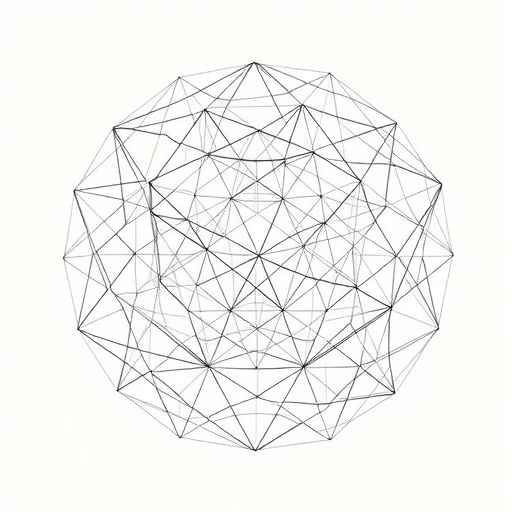
In a development that has quietly electrified the general relativity community, a theoretical physicist at the California Institute of Technology has unveiled a complete, all-orders formulation of one of the oldest problems in gravitational physics: how freely falling particles separate from one another as they move through curved spacetime. The new work, published in the journal General Relativity and Gravitation, replaces nearly a century of incremental, often laborious calculations with an elegant machinery drawn from the differential geometry of the tangent bundle, and it delivers exact equations for what is known as finite geodesic deviation in the form of infinite sums whose coefficients turn out to be products of ordinary binomial coefficients.
The question of how gravity acts on the relative motion of bodies is, at its heart, the question of what tidal forces really are. When an astronaut floats weightlessly inside an orbiting spacecraft, both the astronaut and the craft follow geodesics, the straightest possible paths through spacetime. Yet if two such free-floating objects are separated by some distance, they will gradually drift apart or drift together, because the gravitational field is not perfectly uniform. Einstein’s theory encodes this effect in the curvature of spacetime itself, and the classical equation governing this drift, the geodesic deviation equation, was formalized in the 1920s and 1930s through the pioneering work of Tullio Levi-Civita and John Lighton Synge. In its familiar, textbook form, the equation states that the relative acceleration between two neighboring freely falling particles is proportional to the Riemann curvature tensor contracted with the separation vector between them. It is a linear equation, and it is exact only in the limit where the separation between the particles is infinitesimally small.
The catch, and the reason the new paper matters, is that real physical situations almost never involve infinitesimal separations. A star torn apart by a black hole, a gravitational wave stretching the arms of a detector by kilometers, or a small body orbiting close to a compact remnant all involve separations large enough that the linear equation breaks down. Correcting for this requires extending the geodesic deviation equation to higher and higher orders in the separation vector, with each new order introducing increasingly complicated combinations of the Riemann tensor and its covariant derivatives. For decades, mathematicians and relativists have pushed this expansion outward using a formalism known as Synge calculus, named after its inventor, which expresses the geometry between two points of spacetime through objects called bitensors. The calculations become ferociously intricate very quickly, and until recently the practical frontier of such expansions sat at fourth order in the separation.
Joon-Hwi Kim of the Walter Burke Institute for Theoretical Physics at Caltech, the sole author of the new study, has sidestepped the bitensor machinery entirely. Instead of working with quantities that compare two distinct spacetime points, Kim reformulates the problem on the tangent bundle, the geometric space that attaches to every point of spacetime a full set of tangent directions. Within this framework, he constructs a covariant calculus of differential forms that generates, in a single unified operation, all the higher-order corrections to geodesic deviation at once. The approach is what relativists call an “in-in” formalism, meaning that every quantity describing the relative motion is defined along the worldline of the observer, avoiding the awkward two-point bookkeeping that has historically plagued the subject.
The technical heart of the method lies in a vector field defined on the tangent bundle whose integral flow translates one point of spacetime to another in a fully covariant way. Acting with the associated covariant Lie derivative on curvature-related differential forms produces a sequence of objects that Kim calls Jacobi propagators, which encode how a separation vector is transported along the falling particle’s trajectory. These propagators are built from a hierarchy of tensors, labeled Q2, Q3, Q4 and so forth, each constructed by contracting powers of the separation vector into successive covariant derivatives of the Riemann tensor. The second-order tensor Q2, for instance, is simply the Riemann tensor with the separation vector inserted once, reproducing the standard tidal force. Higher Q-tensors chain together longer and longer strings of curvature and its derivatives, and their products organize themselves into structures that Kim visualizes, in a genuinely playful touch, as molecular diagrams resembling carbon chains, complete with a chemically flavored notation he calls the organic chemistry of covariant Lie derivative calculus.
From these ingredients, the formalism yields two central results. The first is the exact Lagrangian governing the finite geodesic deviation, written as a standard kinetic energy term plus an infinite series of interaction terms, each built from the Q-tensors contracted with the relative velocity and separation of the falling particle. The second is the generalized geodesic deviation equation itself, obtained by varying that Lagrangian and inverting a matrix of Jacobi propagators through a geometric series expansion. Remarkably, the coefficients appearing throughout these infinite sums are products of binomial coefficients, the same humble integers familiar from Pascal’s triangle, hinting at a hidden combinatorial simplicity beneath the intimidating tensor expressions. The paper provides explicit formulas all the way to tenth order in the separation, and Kim has verified the results computationally using the xAct tensor algebra package within Mathematica, with ancillary computer files confirming each expansion order by direct calculation.
A particularly sensitive test of the new formalism is its agreement with earlier work. The fifth-order Lagrangian derived by Kim matches, term for term, the fourth-order deviation equation previously obtained by Justin Vines in 2015 through the traditional covariant bitensor approach, and the lower-order expansions agree exactly with the established results in the literature. The one discrepancy Kim identifies, involving a handful of coefficients in Vines’ published fourth-order equation, is attributed in the paper to typographical errors, since the consistency of the Lagrangian with the resulting equations of motion resolves the mismatch decisively. Such cross-checks are essential in a field where a single sign error can propagate invisibly through pages of tensor algebra.
Beyond the immediate satisfaction of a solved problem, the all-orders geodesic deviation equation has potential reach across gravitational physics. High-order deviation equations underpin analyses of gravitational wave observables that persist after the wave has passed, the modeling of extreme mass-ratio inspirals in which a small object spirals into a supermassive black hole, and the relativistic epicycle descriptions of orbital motion around Kerr black holes. They also enter the effective field theory approach to post-Newtonian gravity, the framework used to compute the motion of binary systems for gravitational wave astronomy. A formalism that makes higher-order calculations systematic rather than heroic could therefore accelerate work in all of these areas.
The paper also demonstrates that the same tangent bundle machinery extends beyond gravity to nonabelian gauge theories, the mathematical language of the strong and electroweak interactions. In that setting, the formalism reproduces the behavior of Wilson lines, the path-ordered exponentials that describe how gauge charges are parallel-transported through a field, and recovers identities connecting gauge connections at different spacetime points in the style of the Fock-Schwinger gauge. This parallel between tidal gravity and gauge theory will resonate with researchers exploring the deep structural analogies between the two, including the double-copy relations that have reshaped scattering amplitude research in recent years. Kim’s formalism even suggests a route to deriving the Wong equations governing the motion of color-charged particles as seen by an arbitrary observer.
The work was supported by the United States Department of Energy and the Walter Burke Institute for Theoretical Physics, and it arrives as gravitational wave observatories continue to probe the strong-field regime where higher-order curvature effects are not merely academic refinements but measurable realities. Nearly a century after Levi-Civita first wrote down the notion of geodesic separation, the mathematics of falling apart has finally been extended, all the way to infinity.
Cite Scienmag News
Grant Pearson. (September 5, 2026). Tangent bundle method computes geodesic deviation to every order. Scienmag. https://scienmag.com/tangent-bundle-method-computes-geodesic-deviation-to-every-order/
Grant Pearson. "Tangent bundle method computes geodesic deviation to every order." Scienmag, 5 September 2026, https://scienmag.com/tangent-bundle-method-computes-geodesic-deviation-to-every-order/. Accessed 5 September 2026.
Grant Pearson. "Tangent bundle method computes geodesic deviation to every order." Scienmag. September 5, 2026. https://scienmag.com/tangent-bundle-method-computes-geodesic-deviation-to-every-order/


