


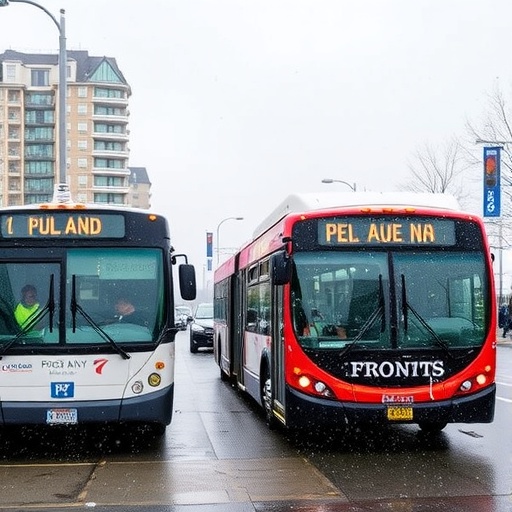
What makes a person step onto a bus on a bitterly cold morning, or decide instead to wait out a downpour at home? It is a question that transit agencies rarely ask with precision, and one that most ridership models ignore entirely. Yet a new study from the University of Colorado Denver suggests that the answers could reshape how cities design, price, and shelter their public transportation systems—particularly as climate change pushes weather extremes into ever more unfamiliar territory.
The research, published in the journal Environmental Research, is among the most granular examinations to date of how atmospheric conditions influence the daily decisions of public transit users. Rather than relying on monthly totals or broad seasonal averages, the team analyzed hourly bus ridership across the Denver metropolitan area from June 2022 through September 2023, capturing nearly 44.3 million individual rider experiences at 7,283 stops operated by the Regional Transportation District, the agency that serves Denver and its surrounding communities. Layered atop this ridership record was an equally detailed stream of environmental data: measurements of heat stress, cold stress, precipitation, wildfire smoke, and ground-level ozone, much of it derived from satellites supported by NASA’s Research Opportunities in Space and Earth Science program.
The scale of the dataset matters. Ridership studies are often constrained by coarse temporal resolution, which can obscure the fact that weather effects unfold over hours, not days. By working at hourly intervals, the researchers could distinguish between a rider who postpones a trip because of a passing storm and one who abandons it altogether—two behaviors that look identical in a daily average but demand very different policy responses. “The true lived human experience is that you have to deal with taking the bus on a bad air pollution day, or when it’s hot or cold. Your life responsibilities still exist,” said Elizabeth Dzwonczyk, who joined the project as a doctoral student at CU Denver and is now an assistant professor at the United States Military Academy. “For that reason, it is really helpful that we were able to combine all of these elements and perspectives.”
A central methodological choice set the study apart from much of the existing literature. Instead of relying solely on air temperature, the team employed the Universal Thermal Climate Index, or UTCI—a composite metric that integrates temperature, humidity, wind speed, and solar radiation into a single measure of how conditions actually feel to the human body. The distinction is more than academic. A 90-degree day with low humidity, light wind, and cloud cover imposes far less physiological stress on a person waiting at a bus stop than an 85-degree day with high humidity and relentless sun. By modeling the felt experience rather than the thermometer reading, the researchers captured something closer to the calculation a rider makes while standing on a curb deciding whether the wait is tolerable.
The results were strikingly asymmetric across weather types. Cold emerged as the condition with the strongest and most persistent association with reduced ridership. The effect began within hours of deteriorating conditions and continued to accumulate throughout the day, suggesting that cold does not merely delay trips—it suppresses them. Rain also discouraged bus use, but its influence was concentrated in the first several hours of a storm, a pattern the researchers interpret as evidence of trip-shifting rather than trip abandonment. Riders appear to push their errands and commutes later in the day rather than cancel them entirely, a nuance invisible to any analysis built on daily aggregates.
Heat produced the study’s most unexpected finding. On very hot days, overall ridership declined as the day wore on—consistent with the intuitive expectation that extreme heat deters travel. But in the immediate term, when temperatures spiked, ridership actually increased. “On hot days, we expected to see less ridership, but it was more nuanced than that,” said Priyanka deSouza, lead author of the study and an assistant professor in CU Denver’s Department of Urban and Regional Planning. “Over the course of very hot days, overall ridership is less. But when it’s really hot, you actually see initial, immediate increase in the number of people who ride the bus.”
The short-term heat surge was most pronounced at stops lacking shelters, and the researchers offer a plausible, if tentative, explanation: some people who would otherwise walk or cycle may switch to the bus precisely because it offers air conditioning during punishing heat. The bus becomes not just transportation but climate refuge. The study did not track individual riders or survey their motivations—it observed only the aggregate relationship between weather and boarding counts—so the authors are careful to frame this mechanism as one hypothesis among several. Still, the pattern carries an uncomfortable implication: as heat waves intensify, demand for transit may concentrate precisely at the infrastructure least equipped to protect the people waiting for it.
Perhaps the most consequential discovery concerns what happens when the fare disappears. Denver’s Zero Fare for Better Air program, which waived transit fees during August 2022 and again in July and August 2023 as part of a state air quality initiative, handed the researchers a natural experiment. During those fare-free windows, they generally found weaker evidence that adverse weather discouraged bus use—and, remarkably, hot conditions were sometimes associated with a short-term increase in ridership. The interpretation is straightforward economics layered on top of environmental behavior: when the marginal cost of a trip falls to zero, the psychological barrier to an inconvenient journey shrinks, and riders appear more willing to tolerate discomfort to reach their destination. The researchers caution that because the program operated only in summer, it cannot illuminate whether free fares would similarly buffer riders against the sharp winter declines the study documented.
Equally notable is what the study did not find. Wildfire smoke and ozone alerts—hazards that have grown more frequent and severe across the American West—showed only modest influence on ridership, at least compared with cold and rain. This is a troubling disconnect from a public health standpoint. Smoke and ozone are precisely the conditions under which health authorities recommend limiting outdoor exertion and time spent waiting outside, yet riders appear to keep boarding buses largely as they would on any other day. The finding underscores that riders often have little choice: the bus is not optional for many households, and advisory language about avoiding outdoor exposure offers cold comfort to someone whose commute requires standing at an uncovered stop beside a busy road.
That asymmetry between hazard and behavior points toward the study’s policy core. Shelter, the researchers found, materially changed how riders responded to heat—yet shelter distribution across the RTD system is not planned around need. Instead, bus shelters are financed and installed at the municipal level, meaning their presence reflects local budgets and political priorities rather than a systematic assessment of where riders are most exposed to the elements. The result is a patchwork in which the most vulnerable riders may also be the least protected. The research team identified several interventions that the data support: real-time alerts and service adjustments during adverse weather, fare strategies that reduce weather-related barriers to transit use, and the construction of shaded, thermally protective shelters at high-exposure stops.
The interdisciplinary breadth of the work is itself part of the story. The team combined environmental science and satellite remote sensing with urban planning, geography, cartography, sociology, statistics, and transportation studies. Peter Anthamatten, an associate professor in CU Denver’s Department of Geography and Environmental Sciences, argues that this breadth is not optional for problems of this kind. “Whenever you start to study a place, you must look broadly,” he said. “Bringing those perspectives together helps us move from understanding one piece of a problem to producing information that can inform public policy and improve people’s lives.” The collaboration also included Carrie Makarewicz and doctoral student Ebru Altintas from urban and regional planning; Adam M. Lippert from sociology; Peter C. Ibsen of the U.S. Geological Survey; Carl Green Jr. of RTD; TC Chakraborty of Pacific Northwest National Laboratory; and Melissa R. McHale of the University of British Columbia.
For transit agencies confronting a future of hotter summers, fiercer storms, and thicker smoke, the study offers a reframing: weather resilience is not merely a scheduling question or a fare-pricing question, but an infrastructure and equity question. The rider standing at an unsheltered stop in a heat wave is making a cost-benefit calculation in real time—and the evidence from Denver suggests that cities can influence the terms of that calculation, one shelter and one fare policy at a time.
Cite Scienmag News
Russell Cooper. (September 4, 2026). Weather drives bus ridership, but fares and shelters shift the balance. Scienmag. https://scienmag.com/weather-drives-bus-ridership-but-fares-and-shelters-shift-the-balance/
Russell Cooper. "Weather drives bus ridership, but fares and shelters shift the balance." Scienmag, 4 September 2026, https://scienmag.com/weather-drives-bus-ridership-but-fares-and-shelters-shift-the-balance/. Accessed 4 September 2026.
Russell Cooper. "Weather drives bus ridership, but fares and shelters shift the balance." Scienmag. September 4, 2026. https://scienmag.com/weather-drives-bus-ridership-but-fares-and-shelters-shift-the-balance/


