

Tuesday, October 20, 2026
Science
No Result
View All Result
  • Login
  • HOME
  • SCIENCE NEWS
  • CONTACT US
  • HOME
  • SCIENCE NEWS
  • CONTACT US
No Result
View All Result
Scienmag
No Result
View All Result
Home Science News Cancer

MG53 degrades AMPKα and suppresses bladder cancer in preclinical models

October 20, 2026
in Cancer
Nathaniel Bowman
By Nathaniel Bowman Scienmag Editorial Profile - Precision Oncology
Reading Time: 2 mins read
0
MG53 degrades AMPKα and suppresses bladder cancer in preclinical models

MG53 degrades AMPKα and suppresses bladder cancer in preclinical models

65
SHARES
587
VIEWS
Share on FacebookShare on Twitter
ADVERTISEMENT

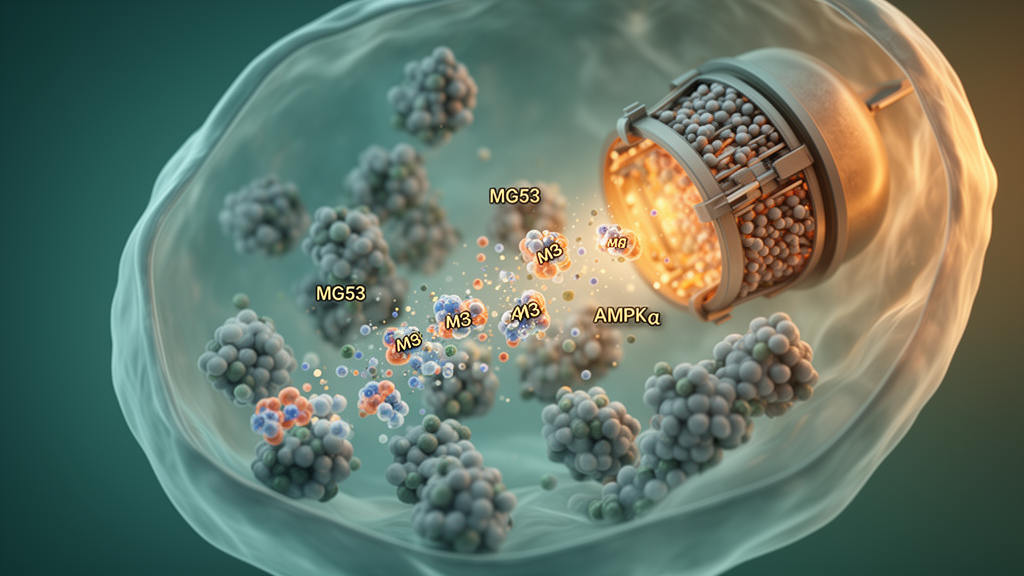
A preclinical study reports that MG53, also known as TRIM72, suppressed bladder cancer progression by promoting the ubiquitination and proteasomal degradation of AMPKα. Researchers found that MG53 expression was lower in bladder cancer tissues than in adjacent normal tissues, while AMPKα levels showed an inverse relationship with MG53. The findings came from tissue and cell studies, including xenograft models, and do not establish a clinical benefit from increasing MG53 in people.

The investigation examined the expression and function of MG53 in bladder cancer. MG53 is a member of the tripartite motif family of E3 ubiquitin ligases, which regulate metabolic homeostasis and tumor-associated signaling. In bladder cancer cells, the team assessed proliferation, invasion, glycolytic metabolism, intracellular reactive oxygen species, or ROS, and apoptosis.

Co-immunoprecipitation and ubiquitination assays were used to investigate the interaction between MG53 and AMPKα. Overexpression of MG53 reduced cell proliferation, invasion, and glycolytic metabolism in bladder cancer cells. It was also accompanied by increased intracellular ROS accumulation and a higher apoptotic rate.

The cells showed increased levels of cleaved caspase-3 and a higher Bax-to-Bcl-2 ratio, while the decrease in glycolytic metabolism was consistent with attenuation of the Warburg effect. These measurements link MG53 overexpression with reduced proliferative and invasive behavior, altered metabolism, and increased cell death in the experimental systems. The reported results do not establish the order in which all of these changes occurred or whether each one directly caused another.

Biochemical experiments identified AMPKα as a molecular target of MG53. Co-immunoprecipitation indicated that MG53 and AMPKα interacted, while ubiquitination assays showed that MG53 promoted AMPKα ubiquitination. The authors further demonstrated that MG53 drove AMPKα toward proteasomal degradation.

Together, the experiments support a mechanism in which elevated MG53 reduces AMPKα abundance, attenuates glycolytic metabolism, and suppresses bladder cancer-cell proliferation and invasion. The evidence comes from molecular assays and bladder cancer-cell experiments; the supplied study summary does not provide the full range of experimental controls or the complete sequence of downstream events. Findings from xenograft models extended the cell results to an in vivo setting.

In those animal models, MG53 overexpression inhibited tumor growth, supporting a suppressive role for the protein in the experimental bladder cancer system. The work identifies MG53 as a candidate therapeutic target, but the researchers explicitly stated that its translational value remains to be established in future preclinical and clinical studies. Accordingly, the results provide a mechanistic and preclinical basis for further investigation of MG53-mediated AMPKα degradation, rather than evidence that MG53-directed treatment is ready for clinical use.

Subject of Research: Preclinical study of MG53-mediated AMPKα degradation in bladder cancer.

Article Title: MG53 suppresses the progression of bladder cancer through E3 ubiquitin ligase-mediated degradation of AMPKα

Article References: He, X., Zhang, H., Zhang, Y., Wu, J., Wang, T., Liu, Y., Jin, K., Tang, W., Ye, Q., & Wang, Q. (2026). MG53 suppresses the progression of bladder cancer through E3 ubiquitin ligase-mediated degradation of AMPKα. Medical Oncology, 43(11), Article 337. https://doi.org/10.1007/s12032-026-03448-7

Image Credits: AI Generated

DOI: 10.1007/s12032-026-03448-7

Keywords: MG53, TRIM72, bladder cancer, AMPKα, E3 ubiquitin ligase, protein degradation, glycolytic metabolism, reactive oxygen species, apoptosis, xenograft models, suppresses, progression

Cite Scienmag News

Nathaniel Bowman. (October 20, 2026). MG53 degrades AMPKα and suppresses bladder cancer in preclinical models. Scienmag. https://scienmag.com/mg53-degrades-ampk%ce%b1-and-suppresses-bladder-cancer-in-preclinical-models/


Nathaniel Bowman. "MG53 degrades AMPKα and suppresses bladder cancer in preclinical models." Scienmag, 20 October 2026, https://scienmag.com/mg53-degrades-ampk%ce%b1-and-suppresses-bladder-cancer-in-preclinical-models/. Accessed 20 October 2026.

Nathaniel Bowman. "MG53 degrades AMPKα and suppresses bladder cancer in preclinical models." Scienmag. October 20, 2026. https://scienmag.com/mg53-degrades-ampk%ce%b1-and-suppresses-bladder-cancer-in-preclinical-models/

Tags: AMPKαAMPKα degradation in cancerapoptosisbladder cancerbladder cancer progressionE3 ubiquitin ligaseE3 ubiquitin ligases in tumor suppressionglycolytic metabolismmetabolic regulation in bladder cancerMG53MG53 TRIM72 ubiquitinationpreclinical bladder cancer studiesprogressionprotein degradationreactive oxygen speciesROS and apoptosis in cancer cellssuppressesTRIM72tumor cell invasion and proliferationubiquitination assays in cancer researchWarburg effect attenuationxenograft bladder cancer modelsxenograft models
Share26Tweet16
Previous Post

Research report: Modeling the distribution of coprophagous beetle species in the Western Swiss Alps

Next Post

Sterile Packaging Damage Linked to Workloads, Material, and Set Size

Related Posts

Phase I NK510-PD-1 combination shows preliminary safety in nine lung cancer patients
Cancer

Phase I NK510-PD-1 combination shows preliminary safety in nine lung cancer patients

October 20, 2026
Piper betle leaf oil shows cell cytotoxicity and antioxidant activity in vitro
Cancer

Piper betle leaf oil shows cell cytotoxicity and antioxidant activity in vitro

October 20, 2026
Lumbar lordosis shows clearest age association in Turkish pediatric radiograph study
Cancer

Lumbar lordosis shows clearest age association in Turkish pediatric radiograph study

October 20, 2026
WSU researchers discover way to ‘crank up’ the body’s antiviral defenses
Cancer

WSU researchers discover way to ‘crank up’ the body’s antiviral defenses

October 20, 2026
Half of head and neck cancer survivors report clinically relevant fatigue
Cancer

Half of head and neck cancer survivors report clinically relevant fatigue

October 20, 2026
Commentary frames tumor microenvironment as a driver of metastasis and resistance
Cancer

Commentary frames tumor microenvironment as a driver of metastasis and resistance

October 20, 2026
Next Post
Sterile Packaging Damage Linked to Workloads, Material, and Set Size

Sterile Packaging Damage Linked to Workloads, Material, and Set Size

  • Mothers who receive childcare support from maternal grandparents show more optimized

    Mothers who receive childcare support from maternal grandparents show more parental warmth, finds NTU Singapore study

    27656 shares
    Share 11059 Tweet 6912
  • University of Seville Breaks 120-Year-Old Mystery, Revises a Key Einstein Concept

    1061 shares
    Share 424 Tweet 265
  • Bee body mass, pathogens and local climate influence heat tolerance

    682 shares
    Share 273 Tweet 171
  • Researchers record first-ever images and data of a shark experiencing a boat strike

    546 shares
    Share 218 Tweet 137
  • Groundbreaking Clinical Trial Reveals Lubiprostone Enhances Kidney Function

    531 shares
    Share 212 Tweet 133
Science

Embark on a thrilling journey of discovery with Scienmag.com—your ultimate source for cutting-edge breakthroughs. Immerse yourself in a world where curiosity knows no limits and tomorrow’s possibilities become today’s reality!

RECENT NEWS

  • Protein–polysaccharide co-assembly stabilizes epicatechin nanoparticles in laboratory study
  • Sterile Packaging Damage Linked to Workloads, Material, and Set Size
  • MG53 degrades AMPKα and suppresses bladder cancer in preclinical models
  • Research report: Modeling the distribution of coprophagous beetle species in the Western Swiss Alps

Categories

  • Agriculture
  • Anthropology
  • Archaeology
  • Athmospheric
  • Biology
  • Biotechnology
  • Blog
  • Bussines
  • Cancer
  • Chemistry
  • Climate
  • Earth Science
  • Editorial Policy
  • Marine
  • Mathematics
  • Medicine
  • Pediatry
  • Policy
  • Psychology & Psychiatry
  • Science Education
  • Science News
  • Social Science
  • Space
  • Technology and Engineering

Subscribe to Blog via Email

Enter your email address to subscribe to this blog and receive notifications of new posts by email.

Join 5,150 other subscribers

© 2025 Scienmag - Science Magazine

Welcome Back!

Login to your account below

Forgotten Password?

Retrieve your password

Please enter your username or email address to reset your password.

Log In
No Result
View All Result
  • HOME
  • SCIENCE NEWS
  • CONTACT US

© 2025 Scienmag - Science Magazine

Discover more from Science

Subscribe now to keep reading and get access to the full archive.

Continue reading