


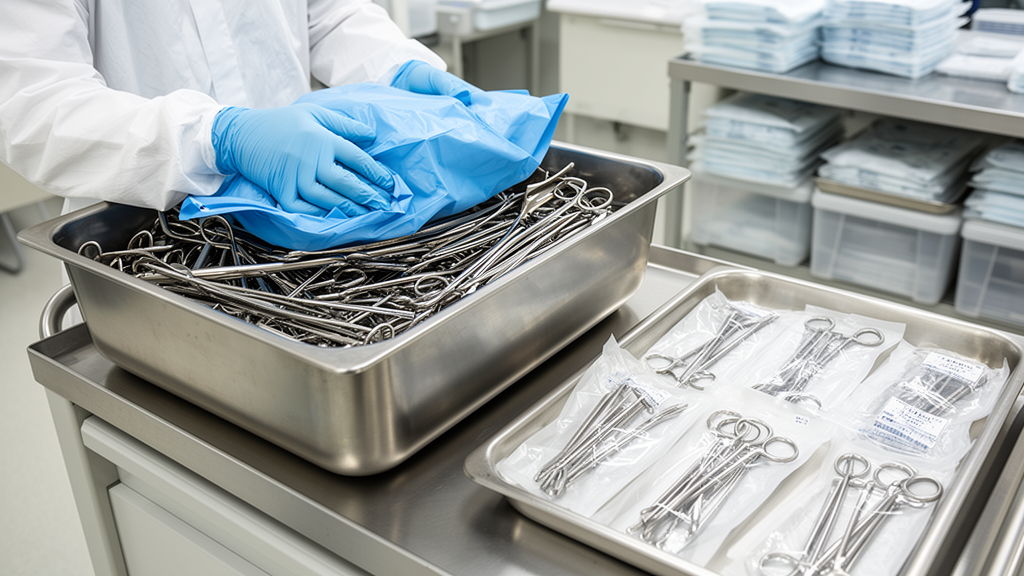
A single-center retrospective case-control study found that non-woven wrapping material, workloads exceeding 500 packs per day, loan medical instruments, larger instrument sets, and a higher number of instruments per set were independently associated with greater odds of physical damage to sterile packaging. Double-layer wrapping was associated with substantially lower odds, while a risk prediction model distinguished damaged from undamaged sets with an area under the receiver operating characteristic curve (AUC) of 0.882.
The study, conducted in a central sterile supply department, included 140 instrument sets with packaging damage and 420 without damage, yielding a 1:3 case-control design. Investigators collected information on packagers and instrument-set characteristics. They used binary logistic regression to identify factors independently associated with packaging damage and assessed the model’s discrimination by calculating AUC. The reported model performance was good, with a 95% confidence interval of 0.847 to 0.918.
Non-woven packaging material had the largest reported association with damage, with an odds ratio of 22.612. Processing more than 500 packs per day was linked to higher odds, with an odds ratio of 5.738, and loan medical instruments were associated with increased odds, with an odds ratio of 5.527. Larger sets had an odds ratio of 2.609, indicating an association between greater set size and damage. Each additional instrument in a set was associated with slightly higher odds, corresponding to an odds ratio of 1.022.
Double-layer wrapping was the only factor reported as protective. Its odds ratio of 0.040 means that sets using this wrapping method had substantially lower odds of packaging damage than the comparison group. The findings identify wrapping configuration as a potentially important variable in models used to recognize high-risk instrument sets, although the study does not establish that double-layer wrapping or any other identified factor directly caused the observed differences.
Because the research was retrospective, observational, and conducted at one center, its estimates show associations rather than causal effects. The results are most directly applicable to instrument sets processed in central sterile supply departments with operating conditions similar to those studied. The model’s AUC indicates that it performed well in distinguishing damaged and undamaged sets in the study population, but the source evidence does not establish whether performance would remain similar in other institutions, under different workflows, or after changes in packaging practices.
Subject of Research: Risk factors and prediction of sterile packaging damage in central sterile supply departments
Article Title: Risk factors for sterile packaging damage in Central sterile supply departments: a retrospective case-control study
Article References: Xiang, S., Liu, J., Zheng, S., & Chen, H. (2026). Risk factors for sterile packaging damage in Central sterile supply departments: a retrospective case-control study. BMC Health Services Research. https://doi.org/10.1186/s12913-026-15870-8
Image Credits: AI Generated
DOI: 10.1186/s12913-026-15870-8
Keywords: sterile packaging, packaging damage, central sterile supply, case-control study, non-woven material, double-layer wrapping, loan instruments, instrument set size, workload, risk prediction, Risk, factors
Cite Scienmag News
Ophelia Keating. (October 20, 2026). Sterile Packaging Damage Linked to Workloads, Material, and Set Size. Scienmag. https://scienmag.com/sterile-packaging-damage-linked-to-workloads-material-and-set-size/
Ophelia Keating. "Sterile Packaging Damage Linked to Workloads, Material, and Set Size." Scienmag, 20 October 2026, https://scienmag.com/sterile-packaging-damage-linked-to-workloads-material-and-set-size/. Accessed 20 October 2026.
Ophelia Keating. "Sterile Packaging Damage Linked to Workloads, Material, and Set Size." Scienmag. October 20, 2026. https://scienmag.com/sterile-packaging-damage-linked-to-workloads-material-and-set-size/


