


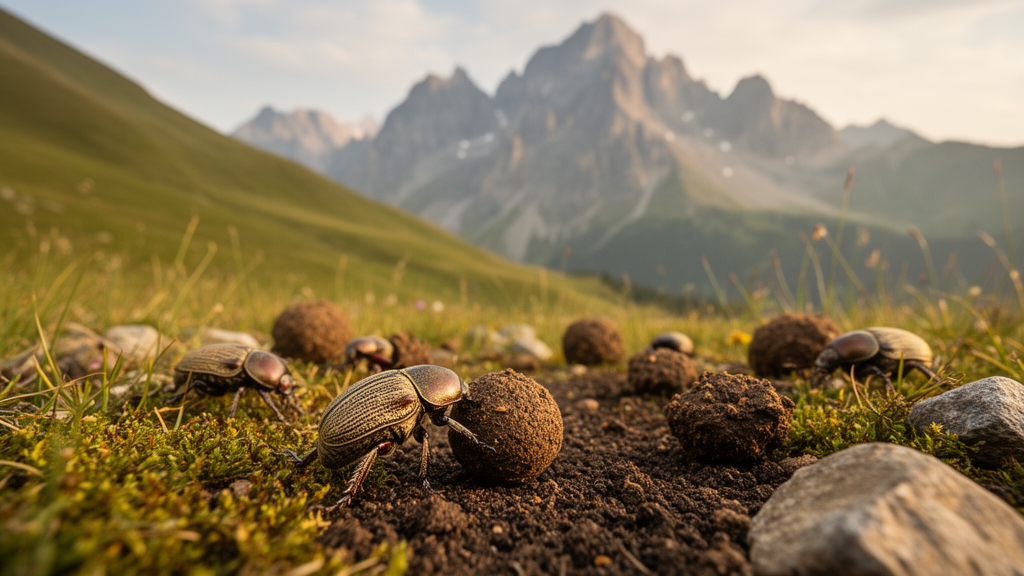
A stratified survey of 132 open habitats in the alpine region of Vaud, Switzerland, recorded 1,120 occurrences representing 47 species of coprophagous beetles, and species-distribution models estimated environmental suitability across the Western Swiss Alps. The models showed substantial differences in predictive performance among species: beetles with narrower altitudinal ranges were more accurately predicted than widespread species. Stacked suitability maps also indicated lower modelled diversity toward higher elevations, with the modeled pattern differing among beetles with different nesting strategies.
This was a correlative spatial analysis rather than a long-term survey of population change. Coprophagous beetles feed on mammal dung and contribute to its decomposition by consuming excrement and, in many species, burying it. Some species lay their eggs directly in dung, while paracoprids dig wells, tunnels or chambers, stock them with dung and place their eggs inside.
Hydrophilidae have dung-feeding adults but predatory larvae that chase fly larvae from dung patches. Although their ecological roles and European distributions have been studied, the fine-scale distribution and environmental requirements of individual coprophagous species in temperate mountains remain understudied. Researchers sampled the alpine region of Canton Vaud from 31 May to 12 September 2020.
The wider region extends from Vevey to Bex and Rougemont and spans 372 to 3,051 metres above sea level, but the study focused on habitats at 1,000 metres and above, where livestock-grazed pastures and alpine grasslands occurred. The 132 sampling plots each had a radius of 20 metres and were placed in open habitats, excluding forests and built-up areas. Ten strata were defined using altitude bands of 300 metres from 1,000 to 2,500 metres and two levels of annual solar radiation.
The number of random plots in each stratum was proportional to its size, while sampling across the elevation gradient during the same season was intended to reduce phenological bias. At each plot, researchers spent 20 minutes manually searching dung with a small shovel to recover as many beetles as possible. Specimens were identified with a binocular microscope and specialist identification keys.
The field inventory contained 48 species before Amidorus immaturus and Amidorus obscurus were pooled because the two had not consistently been distinguished in Swiss-scale records. The final statistical analysis therefore covered 47 species: 21 Aphodiinae, eight Scarabaeinae, four Geotrupidae and 14 Hydrophilidae. The team supplemented its observations with 26,602 records from Swiss museums and private collections held in the info fauna-CSCF database.
For the national-scale models, duplicated records and imprecise historical museum entries with geographic accuracy below 250 metres were removed, leaving 5,359 precise occurrences, or 20.15 percent of the original total. Regional models used the stratified field data, whereas Swiss models combined those observations with national records and background points. The Swiss models used climatic and land-use predictors summarized within 250-metre focal windows.
Regional models added fine-scale information, including annual solar radiation, soil pH and soil carbon-isotope composition. Elevation was excluded as a predictor because the researchers treated it as an indirect variable represented by factors such as temperature, and they checked that correlations among predictors remained below 0.7. Because many species had relatively few observations, the analysis used ensembles of small models, an approach designed to reduce overfitting for data-poor species.
Each ensemble combined many bivariate generalized linear models and generalized additive models, with the individual models weighted according to discrimination performance. The models used a binomial response with a logit link, and 100 runs were conducted with 70 percent of the data assigned to calibration and 30 percent to validation. Separate ensembles represented the two statistical techniques, after which they were combined into a final ensemble.
Model quality was assessed with the maximized True Skill Statistic, or maxTSS, and predictions were converted into presence-and-absence maps using the suitability threshold associated with the best score. National-scale models could be fitted for 46 of the 47 species; Planolinoides borealis had too few Swiss records. Their median maxTSS values ranged from 0.27 for Anoplotrupes stercorosus to 0.93 for Ammoecius brevis.
At the regional scale, 23 species met the minimum requirement of 15 observations, and their median maxTSS values ranged from 0.40 for Acrossus rufipes to 0.85 for Parammoecius gibbus. In both modelling scales, the proportion of rock and bare soil was among the most influential predictors. The authors cautioned that rock cover correlates with elevation and may also represent landscape heterogeneity, so its apparent importance cannot necessarily be interpreted as a direct effect.
Altitudinal range was significantly associated with median maxTSS, with more narrowly distributed species receiving stronger predictions; the reported GLM result was a p-value of 1.78 × 10⁻¹⁰ and a t-value of −8.42. Nesting behavior was not significantly associated with performance, with p-values of 0.94 and 0.25 for the relevant comparisons, and body size also showed no significant relationship, with a p-value of 0.81. There were no significant interactions among the tested traits.
The authors noted that metrics such as maxTSS are useful for broadly ranking poor, useful and good models, but discrimination alone does not provide a direct measure of prediction accuracy. Stacking the national-scale predictions produced an index of cumulative suitability at a 25-metre resolution. Across the study area, values ranged from 11.45 to 24.59; values for paracoprids ranged from 3.07 to 9.28, those for non-nesters from 4.62 to 7.18, and those for Hydrophilidae from 2.51 to 8.52.
The index showed lower modelled diversity toward higher elevations, with a sharper spatial gradient for paracoprids and Hydrophilidae than for non-nesters. Because the Swiss models compared presences with background points rather than confirmed absences, their outputs were not true presence probabilities. Consequently, the stacked values were treated as an index reflecting variation in species richness, not a literal estimate of the number of species present at every location.
The survey also provides new faunistical information for an insect group that remains comparatively poorly sampled in alpine research. Its 1,120 records represented 17.9 percent of the precise Swiss occurrences then available for the 47 species, and 42 percent of Switzerland’s recorded coprophagous beetle species were found in the Vaud Alps. Two species known from the area, Agolius abdominalis and Neagolius montanus, were not detected during the field campaign.
The authors acknowledged that active searching may have missed species with low detectability, despite the method’s practical ability to visit many sites and recover a broad inventory.
Subject of Research: Species-distribution modelling of coprophagous beetles in the Western Swiss Alps
Article Title: Modeling the distribution of coprophagous beetle species in the Western Swiss Alps
Article References: Cosandey, V., Broennimann, O., & Guisan, A. (2022). Modeling the distribution of coprophagous beetle species in the Western Swiss Alps. Alpine Entomology, 6, 25-38. https://doi.org/10.3897/alpento.6.83730
Image Credits: AI Generated
Keywords: coprophagous beetles, species distribution models, Western Swiss Alps, environmental suitability, altitudinal gradient, dung decomposition, Vaud, mountain biodiversity, ensemble models, soil conditions, Modeling, distribution
Cite Scienmag News
Margaret Porter. (October 20, 2026). Research report: Modeling the distribution of coprophagous beetle species in the Western Swiss Alps. Scienmag. https://scienmag.com/research-report-modeling-the-distribution-of-coprophagous-beetle-species-in-the-western-swiss-alps/
Margaret Porter. "Research report: Modeling the distribution of coprophagous beetle species in the Western Swiss Alps." Scienmag, 20 October 2026, https://scienmag.com/research-report-modeling-the-distribution-of-coprophagous-beetle-species-in-the-western-swiss-alps/. Accessed 20 October 2026.
Margaret Porter. "Research report: Modeling the distribution of coprophagous beetle species in the Western Swiss Alps." Scienmag. October 20, 2026. https://scienmag.com/research-report-modeling-the-distribution-of-coprophagous-beetle-species-in-the-western-swiss-alps/


