


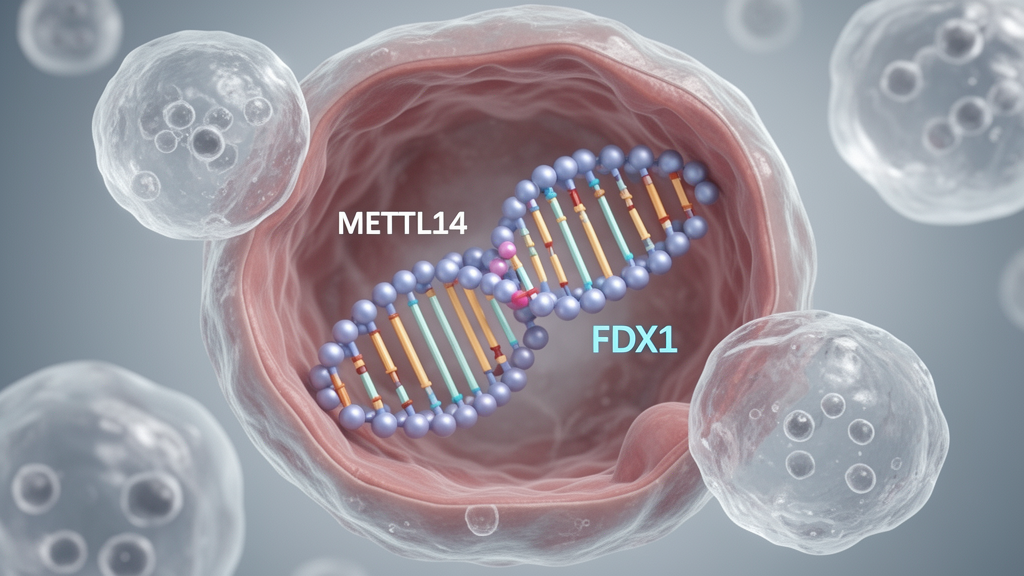
A preclinical study of clear cell renal cell carcinoma identifies a molecular switch that connects RNA methylation, copper-dependent cell death and tumor growth. Researchers found that the methyltransferase METTL14 increases the abundance of FDX1 messenger RNA by adding an N6-methyladenosine modification, or m6A, that slows the transcript’s degradation. Restoring METTL14 in ccRCC cell lines raised FDX1 levels, increased markers of cuproptosis, impaired cell survival and suppressed the growth of subcutaneous tumors in mice. The effect disappeared when FDX1 was knocked down, indicating that FDX1 is required for the tumor-suppressing effect attributed to METTL14.
The study combined analysis of public cancer datasets with clinical tissue samples, laboratory assays and mouse xenografts. Clear cell renal cell carcinoma is the most common histological form of kidney cancer, accounting for approximately 80% of renal cell carcinomas, and the paper reports that both METTL14 and FDX1 are expressed at lower levels in tumors than in matched normal tissue. In The Cancer Genome Atlas cohort, low expression of either gene was associated with shorter overall and disease-free survival. These associations were evaluated in database data rather than through a prospective clinical trial, so they establish a prognostic association but do not show that either protein can be used to predict outcomes reliably in routine practice.
FDX1 encodes a mitochondrial iron-sulfur protein involved in several biochemical processes, including electron transfer, redox catalysis, mitochondrial respiration and protein acylation. It also has a central role in cuproptosis, a copper-dependent form of regulated cell death. In the mechanism described by the investigators, FDX1 reduces divalent copper to monovalent copper, which promotes lipoacylation of proteins such as DLAT and DLST. The study’s authors describe this copper-driven protein modification as a process distinct from apoptosis and ferroptosis, the latter two of which are not inhibited by the cuproptosis pathway in the cited background research. ccRCC cells contained more intracellular divalent copper than the normal renal tubular epithelial cell line used for comparison, suggesting that reduced FDX1 expression was accompanied by impaired handling of copper in the tumor model.
To investigate why FDX1 was diminished in ccRCC, the team examined m6A regulators. m6A is a widespread post-transcriptional modification installed by “writer” proteins and removed by “eraser” proteins. METTL14 is a writer, whereas ZC3H13 is another m6A-associated factor; FTO and ALKBH5 are erasers. Tumor tissue showed reduced expression of METTL14 and ZC3H13 and increased expression of FTO and ALKBH5 in the TCGA analysis. METTL14 had the strongest positive correlation with FDX1 among the four regulators examined, with a reported correlation coefficient of 0.46. Tissue assays, immunostaining and cultured cells likewise showed lower METTL14 in ccRCC samples and cell lines than in their normal counterparts, while low METTL14 expression in the survival dataset was linked to poorer outcomes.
The molecular experiments provided evidence that METTL14 acts directly on the FDX1 transcript. A prediction tool identified potential m6A sites on FDX1 RNA, and RNA immunoprecipitation followed by quantitative PCR showed that m6A enrichment on FDX1 transcripts was lower in the 786-0 and OS-RC-2 ccRCC cell lines than in HK-2 renal tubular epithelial cells. METTL14 binding to FDX1 RNA was similarly reduced in the cancer cell lines. When METTL14 was overexpressed in 786-0 and OS-RC-2 cells, m6A modification of FDX1 mRNA increased, as did FDX1 messenger RNA and protein abundance. Actinomycin D treatment, which was used to block new RNA synthesis, showed that FDX1 RNA degraded more slowly after METTL14 overexpression, indicating that the increase in FDX1 expression was associated with greater transcript stability.
Wild-type METTL14 and a catalytically inactive D314A mutant were then compared in the same cell models. Both constructs were expressed, but only wild-type METTL14 significantly increased FDX1 messenger RNA and protein and slowed FDX1 RNA degradation. The mutant did not produce a comparable change, supporting a requirement for METTL14’s methyltransferase activity rather than a nonspecific effect of METTL14 abundance. This distinction is important because it links the phenotype to the catalytic function of the enzyme. The study did not, however, identify the specific m6A reader protein that binds the modified FDX1 transcript, leaving that part of the pathway unresolved.
Functional assays connected the METTL14-FDX1 relationship to cuproptosis and cellular metabolism. In 786-0 cells, METTL14 overexpression increased the consumption of divalent copper, while simultaneous FDX1 knockdown reduced that effect. In a 72-hour cell-viability experiment using a 300 nM elesclomol-copper complex, METTL14 overexpression was associated with the lowest survival rate, whereas FDX1 knockdown partially reversed the reduction in survival. Oxygen-consumption measurements showed that METTL14 overexpression increased basal and maximal mitochondrial respiration, with the enhancement attenuated by FDX1 depletion. METTL14 also increased lipoacylated DLAT and DLST and intracellular alpha-ketoglutarate; these changes were reversed when FDX1 was knocked down. Together, the assays support a pathway in which METTL14 raises FDX1, FDX1 promotes copper-dependent protein lipoacylation and cuproptosis, and tumor-cell survival falls.
The researchers then tested whether the cellular mechanism translated into an animal model. Groups of five six-week-old male BALB/c nude mice received subcutaneous implants of 786-0 cells carrying an empty vector, stable METTL14 overexpression, or combined METTL14 overexpression and FDX1 knockdown. Tumor volume was measured every four days for 28 days. Tumors derived from METTL14-overexpressing cells grew less and had lower mass than control tumors, while FDX1 knockdown nullified the suppression of growth. Western blotting and immunohistochemical analysis of xenograft tissue showed that METTL14 overexpression increased lipoacylated DLAT and DLST, while FDX1 knockdown abolished that increase. These rescue experiments are important because they show that FDX1 is not merely correlated with tumor behavior in the cell assays but is necessary for the observed effect of METTL14 in vivo.
Overall, the findings support a model in which loss of METTL14 contributes to reduced FDX1 expression in ccRCC by limiting m6A modification and accelerating FDX1 messenger RNA degradation. Reduced FDX1 then corresponds to weaker copper-dependent cell death and greater tumor-cell proliferation, while METTL14 overexpression produces the opposite phenotype in cell cultures and mouse xenografts. The work offers a mechanistic explanation for the previously observed association between low METTL14 or FDX1 expression and poor survival in kidney clear cell carcinoma. It also identifies FDX1-dependent cuproptosis as a measurable functional link between RNA methylation and malignant behavior. The evidence remains preclinical: the clinical sample set included 12 patients with surgically treated ccRCC, the experiments focused on two cancer cell lines and one xenograft model, and the retrospective database associations were not tested as clinical biomarkers. No therapeutic efficacy or safety was demonstrated in patients. The authors note that future work should identify the m6A reader or readers that recognize modified FDX1 RNA, which would complete the molecular description of the pathway.
Subject of Research: METTL14-dependent m6A regulation of FDX1 and cuproptosis in clear cell renal cell carcinoma
Article Title: METTL14-mediated FDX1 m6A methylation inhibited the proliferation of clear cell renal cell carcinoma
Article References: Bai, Z., Wang, C., Shen, J., Yang, Y., Liu, Q., & Shang, Z. (2026). METTL14-mediated FDX1 m6A methylation inhibited the proliferation of clear cell renal cell carcinoma. Medical Oncology, 43(11), Article 341. https://doi.org/10.1007/s12032-026-03438-9
Image Credits: AI Generated
DOI: 10.1007/s12032-026-03438-9
Keywords: clear cell renal cell carcinoma, METTL14, FDX1, m6A methylation, cuproptosis, RNA stability, mitochondrial metabolism, cancer metabolism, xenograft model, METTL14-mediated, methylation, inhibited
Cite Scienmag News
Nathaniel Bowman. (October 20, 2026). METTL14 stabilizes FDX1 RNA and restrains clear cell kidney cancer. Scienmag. https://scienmag.com/mettl14-stabilizes-fdx1-rna-and-restrains-clear-cell-kidney-cancer/
Nathaniel Bowman. "METTL14 stabilizes FDX1 RNA and restrains clear cell kidney cancer." Scienmag, 20 October 2026, https://scienmag.com/mettl14-stabilizes-fdx1-rna-and-restrains-clear-cell-kidney-cancer/. Accessed 20 October 2026.
Nathaniel Bowman. "METTL14 stabilizes FDX1 RNA and restrains clear cell kidney cancer." Scienmag. October 20, 2026. https://scienmag.com/mettl14-stabilizes-fdx1-rna-and-restrains-clear-cell-kidney-cancer/


