

Tuesday, October 27, 2026
Science
No Result
View All Result
  • Login
  • HOME
  • SCIENCE NEWS
  • CONTACT US
  • HOME
  • SCIENCE NEWS
  • CONTACT US
No Result
View All Result
Scienmag
No Result
View All Result
Home Science News Technology and Engineering

Methylene blue helps PANI/MnO2 nanocomposite electrodes keep nearly all their capacitance over thousands of cycles

October 27, 2026
in Technology and Engineering
Denise Maddox
By Denise Maddox Scienmag Editorial Profile - Mechanical Engineering
Reading Time: 3 mins read
0
Methylene blue helps PANI/MnO2 nanocomposite electrodes keep nearly all their capacitance over thousands of cycles

Methylene blue helps PANI/MnO2 nanocomposite electrodes keep nearly all their capacitance over thousands of cycles

65
SHARES
587
VIEWS
Share on FacebookShare on Twitter
ADVERTISEMENT

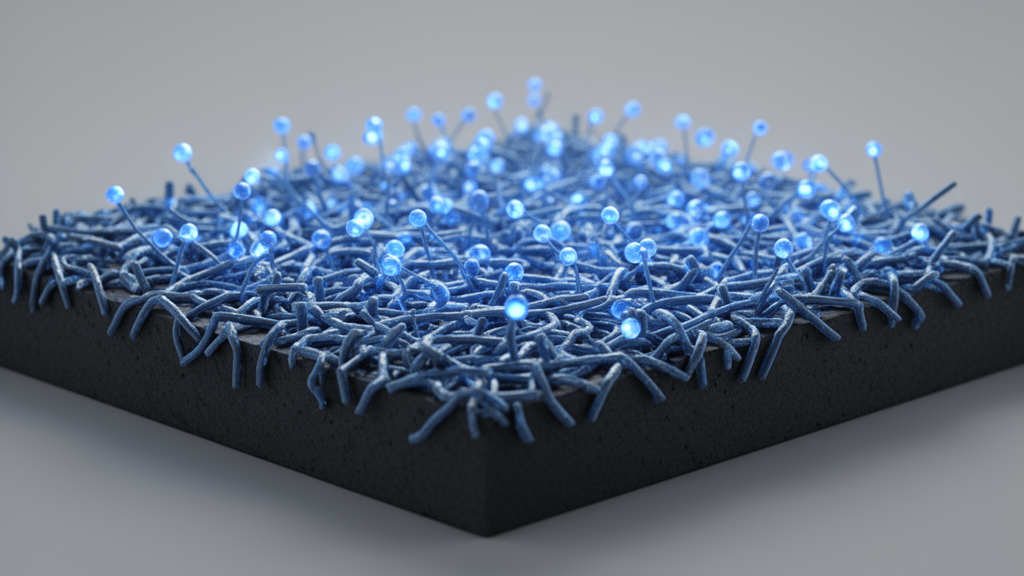
Researchers have synthesized a hierarchical PANI/MnO2 nanocomposite in which the redox-active mediator methylene blue assists stabilization of the material, and they report that electrodes made from it show both high capacitance and exceptional cycling durability. According to the study, published in the journal Ionics, the composite—labeled MB@P/M—was produced by in-situ polymerization and was designed for supercapacitor applications, where long-term electrochemical stability is a persistent challenge.

The team characterized the material with a battery of analytical techniques. UV–Vis spectroscopy indicated direct and indirect band gaps of 2.0 and 1.5 eV respectively, which the authors describe as indicative of good electronic transitions. FTIR and XRD measurements revealed characteristic chemical interactions and a semicrystalline structure, with an average crystallite size of 21.53 nm. FESEM imaging showed the surface morphology and hierarchical architecture of the composite, while XPS was used to determine the surface elemental composition and chemical states.

Porosity and transport properties also came in for detailed scrutiny. BET analysis gave a specific surface area of 17.725 m2 g−1 and an average pore size of 25 nm, features the authors say are beneficial for electrolyte-ion transport and electroactive-site accessibility. AC conductivity and electrochemical impedance spectroscopy studies confirmed, in their words, that good charge-transport properties were obtained.

The electrochemical performance of the MB@P/M electrode was the headline result. The electrode demonstrated specific capacitances of 245 F g−1 at a scan rate of 10 mV s−1 and 335 F g−1 at a current density of 1 A g−1. In terms of device-level metrics, the electrode delivered an energy density of 12 Wh kg−1 and a power density of 250 W kg−1. Most strikingly, it retained 99.3% of its capacitance after 3000 cycles at 3 A g−1, a retention figure that underscores the durability the methylene blue-assisted approach is intended to provide.

The researchers did not stop at the three-electrode level. They assembled a symmetric supercapacitor device from the composite, and that device delivered 145 F g−1 at 1 A g−1, an energy density of 5 Wh kg−1, and 97% capacitance retention after 6000 cycles, with 100% coulombic efficiency. The authors state that the results highlight the potential of MB-assisted PANI/MnO2 for long-term electrochemical power storage.

The reported work uses a redox-active mediator, methylene blue, in the PANI/MnO2 composite, and the reported performance figures—particularly the 99.3% capacitance retention after 3000 cycles at the electrode level and 97% retention after 6000 cycles at the device level—are presented as support for the durability of this approach. The characterization data, from the nanometre-scale crystallite size to the measured pore dimensions, are presented as the structural basis for the observed ion-transport and charge-transport behaviour. As with any laboratory-scale electrode study, the reported capacitances, energy and power densities, and cycling figures are measurements from the described test conditions rather than guarantees of commercial device performance, but the authors present them as support for the potential of this methylene blue-assisted composite in long-term electrochemical power storage.

Subject of Research: Redox-mediator-assisted PANI/MnO2 nanocomposite electrodes for durable symmetric supercapacitors

Article Title: Methylene blue-assisted redox stabilization of PANI/MnO2 nanocomposite electrodes for highly durable symmetric supercapacitors

Article References: S.P., P. K., Karigar, R. L., H., M., Talvar, Y. A., S.K., P., S.S., S., Bhat, S. S., S.C., G., & K.M., E. (2026). Methylene blue-assisted redox stabilization of PANI/MnO2 nanocomposite electrodes for highly durable symmetric supercapacitors. Ionics. https://doi.org/10.1007/s11581-026-07611-y

Image Credits: AI Generated

DOI: 10.1007/s11581-026-07611-y

Keywords: supercapacitors, PANI, MnO2, methylene blue, nanocomposite, energy density, capacitance retention, cyclic stability, electrode materials, energy storage, Methylene, blue-assisted

Cite Scienmag News

Denise Maddox. (October 27, 2026). Methylene blue helps PANI/MnO2 nanocomposite electrodes keep nearly all their capacitance over thousands of cycles. Scienmag. https://scienmag.com/methylene-blue-helps-pani-mno2-nanocomposite-electrodes-keep-nearly-all-their-capacitance-over-thousands-of-cycles/


Denise Maddox. "Methylene blue helps PANI/MnO2 nanocomposite electrodes keep nearly all their capacitance over thousands of cycles." Scienmag, 27 October 2026, https://scienmag.com/methylene-blue-helps-pani-mno2-nanocomposite-electrodes-keep-nearly-all-their-capacitance-over-thousands-of-cycles/. Accessed 27 October 2026.

Denise Maddox. "Methylene blue helps PANI/MnO2 nanocomposite electrodes keep nearly all their capacitance over thousands of cycles." Scienmag. October 27, 2026. https://scienmag.com/methylene-blue-helps-pani-mno2-nanocomposite-electrodes-keep-nearly-all-their-capacitance-over-thousands-of-cycles/

Tags: application of nanocomposites in durableBET porosity analysis for ion transportblue-assistedcapacitance retentionchemical interactions in PANI/MnO2 compositescyclic stabilityelectrochemical impedance spectroscopy for charge transferelectrode materialsenergy densityenergy storagehierarchical nanostructures for energy storagein-situ polymerization techniqueslong-term electrochemical cycling performanceMethylenemethylene blueMnO2nanocompositePANIPANI/MnO2 nanocomposite synthesisrole of methylene blue in electrode stabilizationSEM imaging of nanocomposite morphologySupercapacitor electrode stabilitysupercapacitorsUV-Vis spectroscopy for electronic properties
Share26Tweet16
Previous Post

New matching framework weaves polygenic risk into the search for disease causality

Next Post

Broccoli sprouts pack far more glucoraphanin and folate than mature heads, study finds

Related Posts

Solar Heating Bends Giant Wind Turbine Concrete Towers, New Model Shows
Technology and Engineering

Solar Heating Bends Giant Wind Turbine Concrete Towers, New Model Shows

October 27, 2026
Children’s education-linked genetic scores differ in ties to mental health within families
Technology and Engineering

Children’s education-linked genetic scores differ in ties to mental health within families

October 27, 2026
Citric acid treatment and iron doping tune nickel catalysts for CO2 methanation
Technology and Engineering

Citric acid treatment and iron doping tune nickel catalysts for CO2 methanation

October 27, 2026
NiCo alloy catalysts on nitrogen-doped carbon nanotubes split water efficiently
Technology and Engineering

NiCo alloy catalysts on nitrogen-doped carbon nanotubes split water efficiently

October 27, 2026
Simulation framework tailors perovskite/silicon tandem solar cells for satellite orbits
Technology and Engineering

Simulation framework tailors perovskite/silicon tandem solar cells for satellite orbits

October 27, 2026
3D-printed boron nitride composites tune heat flow through platelet alignment
Technology and Engineering

3D-printed boron nitride composites tune heat flow through platelet alignment

October 27, 2026
Next Post
Broccoli sprouts pack far more glucoraphanin and folate than mature heads, study finds

Broccoli sprouts pack far more glucoraphanin and folate than mature heads, study finds

  • Mothers who receive childcare support from maternal grandparents show more optimized

    Mothers who receive childcare support from maternal grandparents show more parental warmth, finds NTU Singapore study

    27656 shares
    Share 11059 Tweet 6912
  • University of Seville Breaks 120-Year-Old Mystery, Revises a Key Einstein Concept

    1061 shares
    Share 424 Tweet 265
  • Bee body mass, pathogens and local climate influence heat tolerance

    682 shares
    Share 273 Tweet 171
  • Researchers record first-ever images and data of a shark experiencing a boat strike

    546 shares
    Share 218 Tweet 137
  • Groundbreaking Clinical Trial Reveals Lubiprostone Enhances Kidney Function

    531 shares
    Share 212 Tweet 133
Science

Embark on a thrilling journey of discovery with Scienmag.com—your ultimate source for cutting-edge breakthroughs. Immerse yourself in a world where curiosity knows no limits and tomorrow’s possibilities become today’s reality!

RECENT NEWS

  • Swapping Peas for Mung Beans Reshapes the Microbes and Enzymes of Baijiu Starter
  • Tanzanian Teachers Show Three Distinct Patterns of Competence-Based Curriculum Implementation
  • TabNet brings interpretable attention to miRNA classification, but classical models still lead
  • Pesticides, Nitrate and Heavy Metals Found in Raw-Eaten Vegetables from Konya

Categories

  • Agriculture
  • Anthropology
  • Archaeology
  • Athmospheric
  • Biology
  • Biotechnology
  • Blog
  • Bussines
  • Cancer
  • Chemistry
  • Climate
  • Earth Science
  • Editorial Policy
  • Marine
  • Mathematics
  • Medicine
  • Pediatry
  • Policy
  • Psychology & Psychiatry
  • Science Education
  • Science News
  • Social Science
  • Space
  • Technology and Engineering

Subscribe to Blog via Email

Enter your email address to subscribe to this blog and receive notifications of new posts by email.

Join 5,151 other subscribers

© 2025 Scienmag - Science Magazine

Welcome Back!

Login to your account below

Forgotten Password?

Retrieve your password

Please enter your username or email address to reset your password.

Log In
No Result
View All Result
  • HOME
  • SCIENCE NEWS
  • CONTACT US

© 2025 Scienmag - Science Magazine

Discover more from Science

Subscribe now to keep reading and get access to the full archive.

Continue reading