
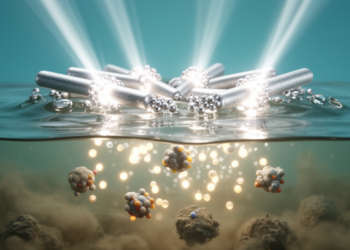
Molecular Tweaks to Lead Precursors Reshape Nanoparticles That Scrub Dye From Water
Chemists at Annamalai University showed that changing the organic group on lead(II) dithiocarbamate precursors tunes the morphology, optical properties and ...
Researchers converted coal gangue waste into a molecular sieve that boosts cobalt oxide catalysts for rapid, recyclable degradation of organic ...
Scientists coated fabric with carbon nanodots made from date palm waste and green-synthesized zinc oxide nanoparticles, creating a recoverable photocatalytic ...
Researchers in Vietnam have grown precisely controlled vertically aligned TiO2 nanorod films that simultaneously detect toxic metal ions and organic ...
A calcination-free nanohybrid of cerium oxide and carbon dots synthesized entirely from papaya leaf extract degrades 95 percent of methylene ...
Scientists in India have created a strontium-doped bioactive glass ceramic that degrades 97 percent of dye pollutants using only the ...
Researchers in Kerala have created a reusable chitosan-polyvinyl alcohol film embedded with copper nanoparticles that reduces azo dyes and 4-nitrophenol ...
A scoping review of 38 published cases documents prilocaine-associated methemoglobinemia after neonatal and infant circumcision, highlighting oxygen-refractory cyanosis, treatment patterns ...
Scientists transformed graphite recovered from spent lithium-ion battery anodes into a reusable, low-cost adsorbent that removes methylene blue dye from ...
Orthorhombic α-MoO3 nanorods outperformed monoclinic β-MoO3 nanoplates, degrading 97 percent of methylene blue dye in 150 minutes under visible light ...
© 2025 Scienmag - Science Magazine
