


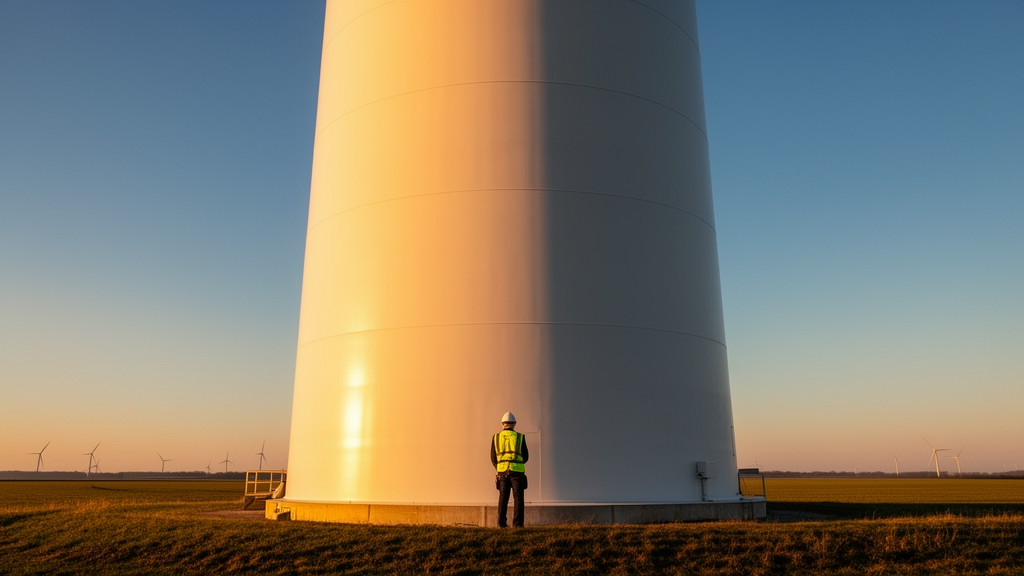
As wind turbines climb past 120, 140 and even 160 metres in hub height, their supporting towers are increasingly built as hybrid structures: a massive concrete lower section topped by a lighter steel cylinder. These towers work well because concrete supplies stiffness and steel keeps weight down, but their large, thin-walled concrete shells sit exposed to the sky all day. When solar radiation strikes one side of a circular concrete tower, that sun-facing surface heats up while the shaded side stays cool, producing a non-uniform temperature field that drives thermal stresses the current design standards barely address.
The authors, Haijun Wang, Xiaoxue Zhang and colleagues, note that existing standards for wind turbine towers, including IEC 61400-6 and the Chinese national standard GB/T 19072-2022, focus primarily on wind and seismic loads and offer limited guidance on thermal effects. Meanwhile, field measurements on other concrete shells have shown temperature differences of more than 21 degrees Celsius between sun-facing and shaded surfaces, and temperature differences exceeding 30 degrees Celsius between the top and bottom slabs of box girders. Because concrete conducts heat poorly, surface heating penetrates slowly inward, creating nonlinear temperature gradients through the wall thickness. When the resulting thermal expansion is restrained by the structure itself, stresses develop that can crack the concrete, degrade stiffness and undermine durability over a tower’s service life.
To study the problem at manageable scale, the team built a circular concrete segment with a compressive strength grade of C55, an outer diameter of 2,140 millimetres, an inner diameter of 1,770 millimetres, a wall thickness of 185 millimetres and a height of 2,600 millimetres. The diameter-to-thickness ratio of 11.57 matches that of real thin-walled hybrid tower sections, whose bottom segments typically have outer diameters of 4 to 10 metres and walls 300 to 450 millimetres thick. The researchers instrumented the segment with 24 Type T thermocouples, twelve on the outer surface and twelve on the inner surface, spaced at 30-degree intervals around the circumference, with the southernmost outer sensor aligned due south and the northernmost due north. Double-layer aluminium foil shielded the sensors from direct radiation so that only structural temperatures were recorded. The bottom of the segment was sealed with grout and the top covered with polyurethane insulation foam and reinforced bamboo plywood to mimic the enclosed cavity of a real tower.
Monitoring ran continuously for two weeks, from 18 February to 4 March 2025, with data logged every five minutes. The team selected 23 February 2025, the day with the most intense solar radiation, as the representative case. On that day the exterior sun-facing surface swung through a range of 18.38 degrees Celsius, while the exterior shaded side moved only 7.4 degrees and closely tracked the ambient air. Interior surfaces lagged behind: the sun-facing interior varied by 12.78 degrees and the shaded interior by just 5.18 degrees. Exterior temperatures peaked around 15:30 and bottomed out near 08:30, and the position of the hottest point on the circumference followed the sun, shifting from east at 08:00 to south at noon and to the southwest by 15:30. During the day the outer surface ran hotter than the inner surface, a positive temperature difference; at night the pattern reversed as the outer surface cooled faster, producing a negative difference.
With this dataset in hand, the researchers turned to a decades-old formula for circumferential temperature distribution in circular hollow piers, proposed in the mid-1970s by Liu Xingfa of China’s Ministry of Railways. That formula, built on a (1 plus cosine theta) divided by 2 angular term, captures the general trend on the sun-facing side but predicts essentially no temperature rise on the shaded side, which contradicts measurements showing a 2 to 3 degree Celsius rise there. The physical reason is that heat conducted along the surface layer from the illuminated region warms the shaded side, an effect the first-order angular term cannot represent. The team’s fix was mathematically simple: expand the angular term into a Fourier series and keep the second-order cosine term, adding a single new parameter b that quantifies circumferential heat redistribution from the lit side to the dark side.
The improvement was quantified against measurements taken at 13:35 on 23 February, when the sun sat due south. The original formula produced a mean absolute error of 1.488 degrees Celsius and a root mean square error of 1.816 degrees. With the second-order term included, using a fitted radial attenuation coefficient of 0.795 per metre and a circumferential coefficient b of 0.427, the errors fell to 1.202 and 1.459 degrees respectively, reductions of 19.2 and 19.7 percent. A third-order expansion offered less than 5 percent further improvement in mean absolute error while adding a fitting parameter prone to overfitting the twelve measurement points, so the second-order truncation was kept. The authors stress that b is not a universal constant; it depends on concrete diffusivity, diameter-to-thickness ratio, exposure duration and surface convection, and must be recalibrated for other dimensions and climates.
The optimized temperature field also changed the predicted structural response. Applying the classical vertical thermal stress calculation for a cantilevered circular thin-walled section, with a maximum radial temperature difference of 8.41 degrees Celsius, a thermal expansion coefficient of 1 times 10 to the minus 5 per degree and an elastic modulus of 3.55 times 10 to the fourth megapascals, the original formula gave a vertical stress of minus 1.59 megapascals at the sun-facing outer surface, while the revised formulation gave minus 0.71 megapascals. The refinement matters most on the shaded side, where the original expression was physically unreliable, though the authors note it has limited direct impact on peak stress values.
Independent of the analytical work, the team built a three-dimensional transient thermo-mechanical model in ABAQUS using eight-node hexahedral heat transfer elements. Rather than forcing measured temperatures onto the model boundaries, which would reduce the exercise to curve fitting, they computed surface heat fluxes from meteorological data, including solar short-wave radiation with an absorptivity of 0.65, atmospheric long-wave radiation with an emissivity of 0.90, and wind-driven convection using the Kehlbeck formulation, with natural convection inside the sealed cavity handled through an equivalent coefficient. Simulating 24 hours on the monitored day, the model reproduced the observed thermal behaviour, with the maximum inner-to-outer wall temperature difference reaching 8.41 degrees Celsius and the surface maximum arriving roughly two hours after peak solar intensity. In the thermo-mechanical coupling analysis, vertical temperature-induced stress concentrated on the sun-facing surface with a symmetric distribution on both sides, the outer wall dominated by compression and the inner wall by tension, which peaked at 0.76 megapascals at 13:35 and marked a crack-sensitive region. The simulated stress at the sun-facing orientation came out 1.07 times the theoretical value, a relative error of 6.58 percent.
Finally, the validated model was extrapolated to a completed 112-metre hybrid tower in a desert region of northwestern China at 105.1 degrees east and 38.2 degrees north, with a 400-millimetre wall thickness in the analysed segment. Because the daily thermal penetration depth in concrete, about 312 millimetres, lies between the specimen’s 185-millimetre and the tower’s 400-millimetre walls, the team did not simply scale up measured temperatures. Instead, they recalibrated the radial and circumferential parameters using the validated numerical model with local meteorological data from the China Xihe Energy Meteorological Big Data Platform for four dates in 2024: the vernal equinox, summer solstice, autumnal equinox and winter solstice, with peak radiation of 785, 920, 815 and 450 watts per square metre respectively. The simulations predicted vertical temperature-induced stress reaching a maximum of 1.77 megapascals in summer and 1.65 megapascals in winter, both exceeding the milder spring and autumn values, because larger temperature gradients in the extreme seasons drive stronger constrained expansion and periodic alternation between tensile and compressive stress.
The authors are careful about the limits of their evidence. The experimental validation rests on winter measurements only, the 2.6-metre specimen cannot capture vertical temperature stratification or internal ventilation in a 100-metre tower, and no pyranometer was deployed to correlate temperatures directly with radiation intensity. The summer results therefore stand as numerical predictions from a winter-validated model, not experimentally confirmed conclusions. Even so, the study delivers a practical package: a corrected circumferential temperature formula with quantified error, a finite element framework validated to within 6.58 percent, and a demonstration that seasonal thermal stresses in full-scale hybrid towers are large enough that design standards ignoring them may be leaving a real structural risk unexamined.
Subject of Research: Optimization and experimental validation of a solar-radiation-induced non-uniform temperature distribution formula for wind turbine hybrid concrete towers
Article Title: Non-uniform temperature effect on wind turbine concrete towers under solar radiation: Formulation optimization and experimental validation
Article References: Wang, H., Zhang, X., Li, B., Guo, Y., Yu, H., Sun, X., Liu, Y., & Yang, X. (2026). Non-uniform temperature effect on wind turbine concrete towers under solar radiation: Formulation optimization and experimental validation. Case Studies in Construction Materials, 25, Article e06641. https://doi.org/10.1016/j.cscm.2026.e06641
Image Credits: AI Generated
DOI: 10.1016/j.cscm.2026.e06641
Keywords: wind turbine towers, hybrid towers, solar radiation, non-uniform temperature field, thermal stress, concrete structures, finite element analysis, Fourier series, temperature monitoring, thin-walled cylinders, cracking, design standards
Cite Scienmag News
Faith Mcneil. (October 27, 2026). Solar Heating Bends Giant Wind Turbine Concrete Towers, New Model Shows. Scienmag. https://scienmag.com/solar-heating-bends-giant-wind-turbine-concrete-towers-new-model-shows/
Faith Mcneil. "Solar Heating Bends Giant Wind Turbine Concrete Towers, New Model Shows." Scienmag, 27 October 2026, https://scienmag.com/solar-heating-bends-giant-wind-turbine-concrete-towers-new-model-shows/. Accessed 27 October 2026.
Faith Mcneil. "Solar Heating Bends Giant Wind Turbine Concrete Towers, New Model Shows." Scienmag. October 27, 2026. https://scienmag.com/solar-heating-bends-giant-wind-turbine-concrete-towers-new-model-shows/


