

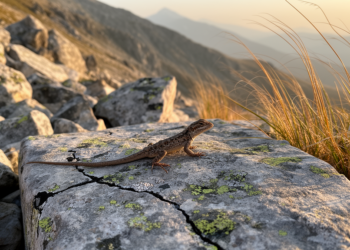
Hidden Heat Maps: Rock Lizards Outsmart the Wind on a Turkish Mountain
New field research on Mount Spil reveals that the endemic Anatolian rock lizard actively thermoregulates by exploiting solar radiation and ...
New field research on Mount Spil reveals that the endemic Anatolian rock lizard actively thermoregulates by exploiting solar radiation and ...

New simulations show that topographic shading can cut energy costs for diurnal ectotherms by over 20 percent, yet nearly half ...
A new commentary argues that vertical farming's energy inefficiency is real but that system-level factors such as urban integration, circular ...
A resilience-based study at China's Longmen Grottoes shows that lighter, more open protective structures can preserve ancient cave temples better ...
A new study maps how solar panel area, battery capacity, energy management strategy, season, and latitude jointly determine whether a ...
A Peking University team has released HCD01, a homogenized daily gridded climate dataset for China covering 1961 to 2022, after ...
A thirty-year analysis of six Brazilian cities shows that solar radiation and wind speed, not air temperature, govern reference evapotranspiration, ...
A 41-year analysis of 24 Indian weather stations shows the Ångström–Prescott model needs locally recalibrated coefficients and reveals significant long-term ...
A field study of gregarious swallowtail caterpillars shows that groups, unlike solitary larvae, become significantly cooler than the surrounding air ...
A new study validates NASA POWER satellite-derived weather data against 40 ground stations in the US and Türkiye, finding strong ...

Embark on a thrilling journey of discovery with Scienmag.com—your ultimate source for cutting-edge breakthroughs. Immerse yourself in a world where curiosity knows no limits and tomorrow’s possibilities become today’s reality!