


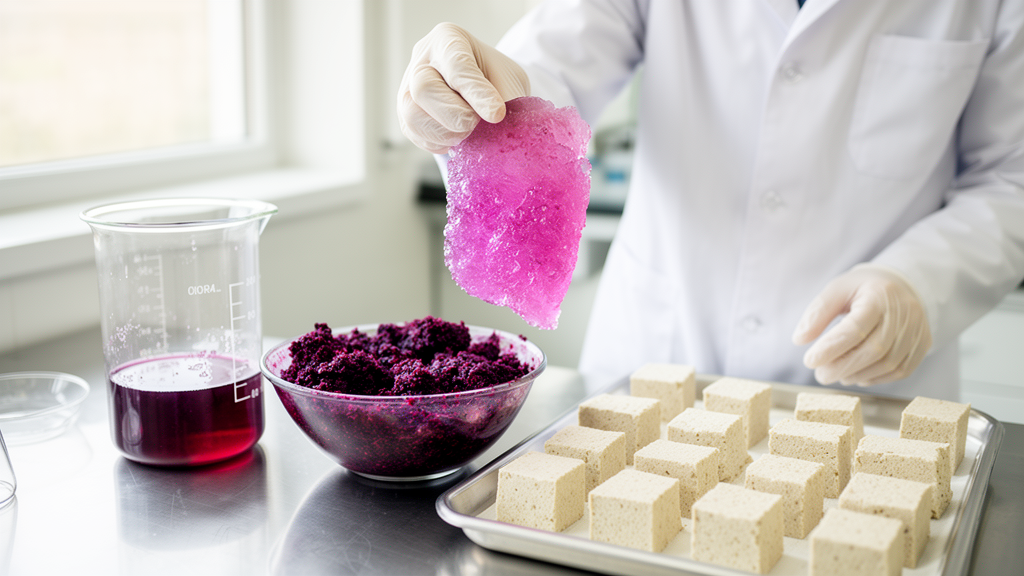
Food scientists have turned mulberry pomace, the fibrous waste left over after juice production, into a carboxymethyl cellulose ingredient that, together with calcium ions, more than doubles the strength of peanut protein isolate gels. In a study published in Food Chemistry: X, a team led by Yuanfei Ge reports that adding 1.5 percent mulberry pomace-derived carboxymethyl cellulose and 12 millimolar calcium chloride to a 15 percent peanut protein isolate gel raised gel strength to 142.89 ± 3.18 grams, compared with 52.47 ± 2.50 grams for the protein alone. The work was conducted entirely as a laboratory materials and formulation study, so the results describe model gel systems rather than finished food products.
Peanut protein isolate is an attractive raw material for plant-based gel foods because it is inexpensive, widely available, and contains a high proportion of protein, yet it suffers from well-known weaknesses. When heated to form a gel, peanut protein typically produces a loose network with insufficient strength and poor water holding capacity, which leads to texture defects, water migration, and instability during processing and storage. The research team set out to address this by combining two regulators that act in complementary ways: a polysaccharide that modifies the protein’s interaction environment and a divalent ion that promotes protein-protein cross-linking.
The polysaccharide was not bought off the shelf. The researchers extracted cellulose from mulberry pomace supplied by a food company in Henan, China, using hot water treatment, sodium chlorite delignification, and alkalization, then converted it to carboxymethyl cellulose by etherification with chloroacetic acid under alkaline conditions. The resulting material, abbreviated MPCMC, had a degree of substitution of 0.92 ± 0.07. Spectroscopic and diffraction analyses confirmed that carboxymethylation had grafted anionic carboxymethyl groups onto the cellulose backbone: new infrared absorption bands at 1600 and 1420 per centimeter corresponded to the asymmetric and symmetric stretches of the carboxymethyl anion, while X-ray diffraction peaks typical of cellulose I were weakened and broadened, indicating partial disruption of the ordered crystalline domains.
Microscopy revealed equally striking changes. Where the original mulberry pomace cellulose showed flat, smooth, rod-like fibers, the modified material displayed pronounced swelling, thickening, and a wrinkled, grooved surface with markedly increased roughness. Thermogravimetric analysis showed that the modified cellulose lost more water at low temperature, 12.33 percent versus 7.63 percent for the unmodified material between 30 and 200 degrees Celsius, consistent with a greater capacity to bind hydrophilic water. The authors concluded that the material retained sufficient thermal stability for conventional thermal processing of plant-based edible gels.
To find the optimal formulation, the team screened a grid of concentrations. Gel strength responded in a dose-dependent but non-monotonic way to each component. Calcium chloride alone raised the strength of peanut protein gels from 52.47 ± 2.50 grams to a peak of 100.17 ± 1.18 grams, but at 16 millimolar the strength fell back to 75.38 ± 1.19 grams, which the authors attributed to excessive calcium driving rapid, localized protein overaggregation and a coarse, heterogeneous network. The modified cellulose alone also improved strength up to an intermediate concentration, after which values declined from 81.50 ± 4.57 grams to 73.05 ± 3.06 grams, likely because excess polysaccharide created steric hindrance or thermodynamic incompatibility that interfered with orderly protein aggregation.
The combination outperformed either component alone. At 1.5 percent modified cellulose and 12 millimolar calcium, gel strength reached 142.89 ± 3.18 grams, the highest of all groups tested, and the resulting gel showed the best self-supporting capacity in inverted-tube tests with no liquid flow or structural collapse. Water holding capacity followed the same pattern: the plain protein gel retained 72.21 ± 1.95 percent of its water, calcium alone raised this to 80.49 ± 2.51 percent, the polysaccharide alone produced a more modest increase of 6.9 percent, and the combined system reached 85.49 ± 3.64 percent, the highest value measured. The authors noted that a previously reported cellulose nanocrystal and calcium system had not shown such a pronounced synergistic gain in water retention.
Low-field nuclear magnetic resonance provided a physical picture of where that water was held. All gels showed three relaxation populations corresponding to bound, immobilized, and free water. In the combined gel, the free-water relaxation time fell from 2125.67 ± 158.32 milliseconds in the plain protein gel to 792.21 ± 75.93 milliseconds, and the free-water fraction dropped from 2.57 ± 0.06 percent to 0.69 ± 0.09 percent, while the immobilized-water fraction, the dominant population, did not change significantly across groups. Rheology reinforced the picture: all gels behaved as elastic solids with storage modulus exceeding loss modulus, and the combined system recorded the highest power-law constants, 5210.06 ± 7.54 for the storage modulus constant and 352.11 ± 0.87 for the loss modulus constant, with all fitted models showing coefficients of determination between 0.980 and 0.998.
Structural spectroscopy traced the molecular basis of the improvement. Infrared analysis showed a progressive red shift of the carbonyl stretching band, from the plain gel to 1627 per centimeter in the single-additive gels and 1623 per centimeter in the combined gel, alongside a rise in beta-sheet content to a peak of 46.52 percent in the combined system, with alpha-helix and random coil contents declining from 20.31 and 19.95 percent to 17.75 and 17.56 percent. X-ray diffraction intensities at 9.2 and 20.1 degrees decreased with the additives, which the authors interpreted as evidence that reinforcement came from enhanced interactions within an amorphous network rather than from new crystalline phases. Intrinsic fluorescence showed the emission maximum red-shifting from 340.5 nanometers in the plain gel to 344.3 nanometers in the combined gel, indicating the most extensive unfolding of protein molecules and exposure of tryptophan residues to a more polar environment. Scanning electron microscopy showed porosity falling from 35.3 ± 2.7 percent to 21.2 ± 0.8 percent, and atomic force microscopy showed surface roughness dropping from 1.37 nanometers to 0.71 nanometers, the smoothest and most uniform surface of any sample.
Solubility experiments in selective solvents mapped the intermolecular forces behind these changes. In the plain protein gel, hydrophobic interactions and hydrogen bonds dominated stabilization. Adding calcium shifted the balance toward ionic bridging, while the polysaccharide made hydrogen bonding the primary stabilizing force. In the combined system, ionic bonds emerged as the main driver, which the authors explained by the fact that both the protein and the cellulose derivative carry negatively charged groups capable of binding calcium, multiplying the effective cross-linking junctions in the network. Pearson correlation analysis linked these molecular shifts to macroscopic performance: gel strength correlated positively with water holding capacity and the storage modulus constant, with coefficients from 0.89 to 0.99 at p ≤ 0.001, and negatively with porosity, at coefficients from −0.94 to −0.92. Ionic bond contribution correlated positively with gel strength, water holding capacity, and the storage modulus constant, at coefficients from 0.84 to 0.96, while hydrophobic interactions correlated negatively, at −0.81 to −0.69, and hydrogen bonds showed only weak, statistically insignificant associations.
Molecular docking simulations using peanut 7S globulin as the receptor predicted that the carboxymethyl cellulose repeating unit binds within a cavity of the protein through hydrogen bonds with Ser305 and Arg334, additional contacts with Asn361 and Val335, van der Waals and hydrophobic contacts with residues including Arg333 and Pro303, and coordination with adjacent calcium ions. The authors caution that solubility analysis provides only relative, not absolute, quantification of intermolecular forces, and that the docking results are computational predictions rather than direct measurements. They also note that the study evaluated model gels at fixed protein concentration and that future work should examine how the polysaccharide’s molecular characteristics govern protein-polysaccharide interactions and assess scalability in real plant-based food systems. Within those limits, the study demonstrates a route that simultaneously valorizes an underused agricultural by-product and strengthens a weak plant protein gel, with calcium acting as the primary ionic bridge and the pomace-derived cellulose stabilizing the skeleton through hydrogen bonding, hydrophobic interactions, and physical filling of network voids.
Subject of Research: Conversion of mulberry pomace into carboxymethyl cellulose to synergistically reinforce calcium-mediated peanut protein isolate gelation
Article Title: From agricultural waste to functional gels: Mulberry pomace-derived carboxymethyl cellulose synergistically enhances calcium-mediated peanut protein isolate gelation
Article References: Ge, Y., Hu, D., Sun, Y., Tong, Y., Shi, H., & Wang, C. (2026). From agricultural waste to functional gels: Mulberry pomace-derived carboxymethyl cellulose synergistically enhances calcium-mediated peanut protein isolate gelation. Food Chemistry: X, 40, Article 104676. https://doi.org/10.1016/j.fochx.2026.104676
Image Credits: AI Generated
DOI: 10.1016/j.fochx.2026.104676
Keywords: mulberry pomace, carboxymethyl cellulose, peanut protein isolate, gelation, calcium ions, water holding capacity, plant-based foods, food waste valorization, rheology, molecular docking, protein secondary structure, agricultural by-products
Cite Scienmag News
Bethany Barker. (October 27, 2026). Mulberry Pomace Waste Transformed Into Gel Booster for Plant Protein Foods. Scienmag. https://scienmag.com/mulberry-pomace-waste-transformed-into-gel-booster-for-plant-protein-foods/
Bethany Barker. "Mulberry Pomace Waste Transformed Into Gel Booster for Plant Protein Foods." Scienmag, 27 October 2026, https://scienmag.com/mulberry-pomace-waste-transformed-into-gel-booster-for-plant-protein-foods/. Accessed 27 October 2026.
Bethany Barker. "Mulberry Pomace Waste Transformed Into Gel Booster for Plant Protein Foods." Scienmag. October 27, 2026. https://scienmag.com/mulberry-pomace-waste-transformed-into-gel-booster-for-plant-protein-foods/


