


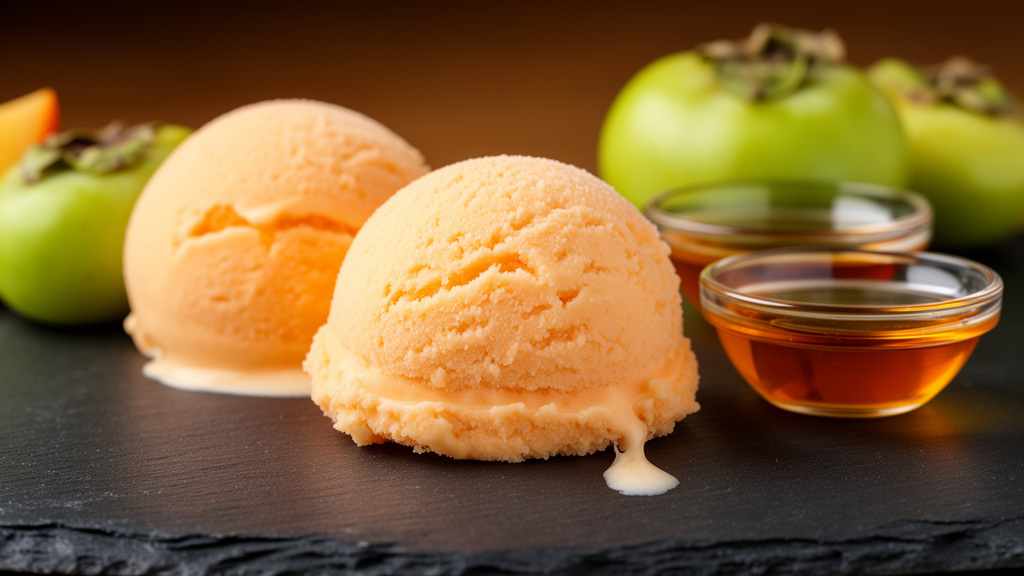
Ice cream may be about to get an unlikely new ingredient: unripe persimmons. A study published in Food Chemistry: X by researchers at Shimane University in Japan shows that an extract made from young, thinned persimmon fruit can slow melting, firm texture, deepen color, and raise antioxidant activity in ice cream, all while keeping taste scores largely intact at moderate addition levels. Because young persimmon fruits are typically discarded during fruit-thinning operations, the work also points to a way of turning an agricultural waste stream into a functional food additive.
The team began by screening plant materials for tannins, a class of polyphenols known to bind proteins. From an initial pool of roughly 300 plant species and parts collected on the Shimane University campus and at a local agricultural technology center, sixteen materials from twelve species showed the highest tannin content. These were freeze-dried, extracted with hot water, and mixed with solutions of whey protein and casein, the two major milk protein fractions. After heating and centrifugation, the researchers ran the remaining protein through SDS-PAGE gel electrophoresis to see which extracts pulled the most protein out of solution into insoluble complexes.
Three materials stood out for their ability to strip whey proteins, chiefly beta-lactoglobulin and alpha-lactalbumin, from the mixture: young grape fruits, young persimmon fruits, and Mallotus japonicus leaves. The grape extract was ruled out because its strong acidity, pH 2.9, could itself cause whey proteins to aggregate independently of any tannin binding. Young persimmon fruit contained about two-thirds of the polyphenol content of the Japanese mallotus leaves yet produced comparable protein loss on the gels, indicating a more efficient binding per unit of polyphenol. Casein bands, by contrast, changed little across all extracts, consistent with casein’s micellar structure burying much of its hydrophobic surface where tannins cannot easily reach.
With young persimmon fruit extract, or YPE, selected, the researchers prepared it by autoclaving freeze-dried, pulverized young fruits at 120 degrees Celsius for 20 minutes. This single step both extracted the water-soluble components and sterilized the preparation, an important consideration for a dairy application. The resulting extract carried a soluble tannin content of 1050 milligrams of catechin equivalents per 100 milliliters. The authors note that such severe heating can hydrolyze condensed tannins and alter their degree of polymerization, so the additive should be regarded as a heat-treated extract rather than a faithful replica of the fresh fruit’s chemistry.
Five ice cream formulations were then produced, differing only in the soluble tannin content contributed by YPE: 0, 0.1, 0.3, 0.5, and 1.0 percent. Scanning electron microscopy of freeze-dried samples revealed a progressive structural shift. The control showed the classic ice cream architecture of large, smooth, spherical voids, traces of air bubbles, separated by thin walls. As tannin levels rose, the voids became irregular, and at the two highest levels the walls thickened and the matrix grew visibly denser. Laser diffraction measurements told a matching story: the mean particle diameter fell from 4.75 micrometers in the control to between 2.25 and 3.22 micrometers at moderate tannin levels, then jumped to 21.15 micrometers at 1.0 percent, roughly 4.5 times the control value, a sign that high tannin concentrations cross-link milk proteins into large insoluble aggregates.
Those microstructural changes translated directly into bulk properties. Overrun, the air incorporated during freezing, rose briefly at 0.1 percent tannin, from 33.0 to 39.7 percent, apparently because low tannin concentrations act like a surfactant at the air-liquid interface. Beyond that point, overrun fell steadily to 22.7 percent at 1.0 percent, while density climbed from 0.78 to 0.92 grams per cubic centimeter and the viscosity of the melted product reached nearly 3.4 times that of the control. The authors caution that they did not measure surface tension or zeta potential, so the proposed dispersing-versus-bridging mechanisms remain to be confirmed.
The practical payoff appeared in melting tests at room temperature. The control sample melted completely in 42 minutes. Every YPE-containing formulation melted more slowly: formulations at 0.1 to 0.5 percent tannin took 51 to 54 minutes, and the 1.0 percent sample held out for about 75 minutes, at one point showing only 4.3 percent melted after 36 minutes. Texture analysis showed concentration-dependent increases in hardness, adhesiveness, and gumminess, with significant changes in hardness and gumminess from 0.5 percent upward. Infrared spectroscopy added a subtler finding: in partially thawed YPE ice cream, the liquid released early in melting had a solute concentration close to that of the fully thawed product, whereas the control released a concentrated first fraction, the familiar freeze-concentration pattern. The tannins appear to change how solutes distribute during melting, though the mechanism is not yet established.
Functionally, the additive delivered on antioxidants. Retained soluble tannin content, DPPH, ABTS, and H-ORAC radical-scavenging measures all rose with tannin level, with DPPH activity climbing from zero in the control to 31.20 micromoles of Trolox equivalents per gram at 1.0 percent. The recovered tannin content of the finished product closely matched what the added extract should contribute, indicating the tannins largely survived processing. YPE also tinted the ice cream a natural reddish-brown, shifting the a* color value from negative to 9.1 at the highest level, without artificial colorants, while pH and sugar content of the frozen dessert barely moved thanks to the buffering capacity of the dairy base.
A blind sensory panel of 59 university students and staff evaluated all five formulations on seven-point scales. Overall evaluation was highest at 0.1 percent tannin and remained statistically comparable to the control up to 0.5 percent, dropping significantly only at 1.0 percent, where the marked hardness and astringency likely took their toll. Appearance preference actually peaked at 0.1 percent, and smoothness intensity rose with tannin level. Astringency became significantly noticeable from 0.5 percent upward, and flavor preference declined at higher levels, though some panelists still rated the strongest formulations highly, leaving comments such as that the samples tasted sweeter or felt rich and smooth. The authors stress that the panel was young and predominantly female, 54 of 59 respondents aged 18 to 29, so preferences in other demographic groups may differ.
As an exploratory side question, the team asked whether tannin-protein binding could reduce detectable milk allergens. Sandwich ELISA measurements showed casein and beta-lactoglobulin content falling from 31.6 milligrams per gram in the control to 23.3 milligrams per gram at 1.0 percent tannin, a reduction of roughly 26 percent, significant from 0.3 percent upward. The effect was modest compared with reports in plant protein systems, likely because the near-neutral conditions favored reversible non-covalent binding and because casein micelles shield internal epitopes. Importantly, ELISA and SDS-PAGE do not measure clinical allergenicity; IgE-binding assays with patient sera would be needed to draw any conclusion, and allergen proteins remained clearly detectable at every level. Within the study’s limits, the practical window of 0.1 to 0.5 percent added tannin offers slower melting, higher antioxidant capacity, natural color, and stable consumer acceptance, all from a fruit that would otherwise be thrown away.
Subject of Research: Effects of young persimmon fruit extract on ice cream physical properties, antioxidant activity, and sensory acceptability
Article Title: Young persimmon fruit extract as a multifunctional natural additive in ice cream: Effects on physical properties, antioxidant functionality, and sensory acceptability
Article References: Kobayashi, M., Hara, T., Sunahara, A., Ishigaki, M., & Tsurunaga, Y. (2026). Young persimmon fruit extract as a multifunctional natural additive in ice cream: Effects on physical properties, antioxidant functionality, and sensory acceptability. Food Chemistry: X, 40, Article 104662. https://doi.org/10.1016/j.fochx.2026.104662
Image Credits: AI Generated
DOI: 10.1016/j.fochx.2026.104662
Keywords: ice cream, persimmon, tannins, proanthocyanidins, antioxidant activity, food science, melting resistance, milk proteins, clean label, sensory evaluation, food by-products, ELISA
Cite Scienmag News
Bethany Barker. (October 27, 2026). Tannin-Rich Young Persimmon Extract Slows Ice Cream Melting and Boosts Antioxidants. Scienmag. https://scienmag.com/tannin-rich-young-persimmon-extract-slows-ice-cream-melting-and-boosts-antioxidants/
Bethany Barker. "Tannin-Rich Young Persimmon Extract Slows Ice Cream Melting and Boosts Antioxidants." Scienmag, 27 October 2026, https://scienmag.com/tannin-rich-young-persimmon-extract-slows-ice-cream-melting-and-boosts-antioxidants/. Accessed 27 October 2026.
Bethany Barker. "Tannin-Rich Young Persimmon Extract Slows Ice Cream Melting and Boosts Antioxidants." Scienmag. October 27, 2026. https://scienmag.com/tannin-rich-young-persimmon-extract-slows-ice-cream-melting-and-boosts-antioxidants/


