

Tuesday, October 27, 2026
Science
No Result
View All Result
  • Login
  • HOME
  • SCIENCE NEWS
  • CONTACT US
  • HOME
  • SCIENCE NEWS
  • CONTACT US
No Result
View All Result
Scienmag
No Result
View All Result
Home Science News Technology and Engineering

NiCo alloy catalysts on nitrogen-doped carbon nanotubes split water efficiently

October 27, 2026
in Technology and Engineering
Neil Sanderson
By Neil Sanderson Scienmag Editorial Profile - Materials Characterization
Reading Time: 3 mins read
0
NiCo alloy catalysts on nitrogen-doped carbon nanotubes split water efficiently

NiCo alloy catalysts on nitrogen-doped carbon nanotubes split water efficiently

65
SHARES
587
VIEWS
Share on FacebookShare on Twitter
ADVERTISEMENT

Researchers have developed a nickel–cobalt alloy catalyst supported on nitrogen-doped carbon nanotubes that can drive both halves of the water-splitting reaction, offering a potential route to hydrogen production without precious metals. The study, published in Advanced Composites and Hybrid Materials, reports that the optimised material requires low overpotentials to deliver a practical current density in both the oxygen evolution reaction and the hydrogen evolution reaction.

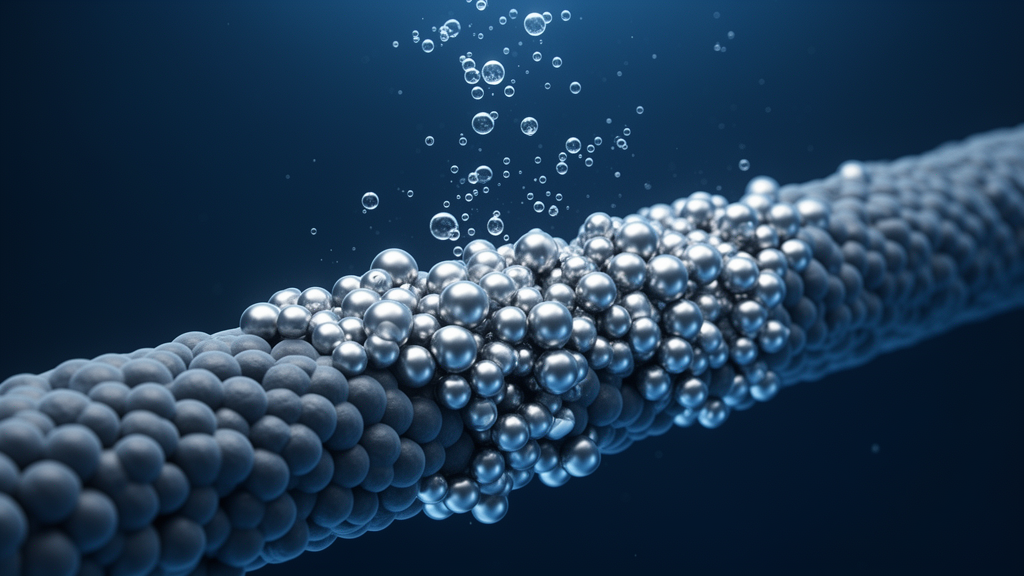
The team, led by Yufeng Hao and colleagues, first synthesised a microflower-like nickel–cobalt layered double hydroxide through a hydrothermal method. This precursor was then converted by calcination into NiCo alloy nanoparticles anchored on nitrogen-doped carbon nanotubes, a material the authors designate NiCo@NCNTs. By precisely controlling the amount of cobalt doping during synthesis, they produced a series of samples with tunable nickel-to-cobalt molar ratios, allowing them to identify the composition with the best catalytic performance.

Electrochemical testing showed that the optimal NiCo@NCNT catalyst achieved an overpotential of 295 millivolts for the oxygen evolution reaction and 255 millivolts for the hydrogen evolution reaction, each at a current density of 10 milliamperes per square centimetre. The corresponding Tafel slopes were 78 millivolts per decade for the oxygen evolution reaction and 116 millivolts per decade for the hydrogen evolution reaction, values that characterise how rapidly the reaction kinetics accelerate with applied voltage.

To test the material under realistic operating conditions, the researchers assembled the catalyst into a two-electrode water electrolyzer, using it for both the anode and cathode reactions. The device required a cell voltage of 1.70 volts to drive a current density of 10 milliamperes per square centimetre and maintained stable operation for more than 50 hours, an indication of durability under continuous electrolysis.

Theoretical calculations provided insight into why the alloy composition performs well. According to the study, incorporating cobalt into the nickel lattice modulates the electronic structure and strengthens synergistic interactions that adsorb and stabilise reaction intermediates. This, the authors report, accelerates the reaction kinetics and lowers the energy barriers for both the hydrogen and oxygen evolution reactions.

The calculations also pointed to a role for the interface between the alloy and the carbon nanotube support. Electronic reconstruction at the alloy–NCNT interface was found to modulate the nickel and cobalt electronic states, reducing the adsorption free energy of hydrogen and of oxygen-containing intermediates. In practical terms, the support is not merely a conductive scaffold but actively tunes the chemistry of the metal particles it anchors.

The motivation behind the work lies in the search for highly active, earth-abundant and stable bifunctional electrocatalysts.

As with any laboratory-scale electrochemical study, the reported overpotentials, cell voltage and 50-hour stability test describe performance under the specific conditions of the experiment, and further work would be needed to establish commercial viability. Nevertheless, the combination of tunable alloy composition, a nitrogen-doped carbon nanotube support and a detailed computational account of the electronic effects offers a coherent design strategy for non-precious-metal water-splitting catalysts.

Subject of Research: Bifunctional NiCo alloy electrocatalysts on nitrogen-doped carbon nanotubes for overall water splitting

Article Title: NiCo alloys anchored on N-doped carbon nanotubes as efficient bifunctional electrocatalysts for overall water splitting

Article References: Hao, Y., Zhou, H., Zhou, H., Zhang, Y., Qiao, Y., Meng, C., Yuan, A., Jiang, Y., & Zhang, Q. (2026). NiCo alloys anchored on N-doped carbon nanotubes as efficient bifunctional electrocatalysts for overall water splitting. Advanced Composites and Hybrid Materials. https://doi.org/10.1007/s42114-026-02130-w

Image Credits: AI Generated

DOI: 10.1007/s42114-026-02130-w

Keywords: water splitting, electrocatalysis, NiCo alloys, nitrogen-doped carbon nanotubes, hydrogen evolution reaction, oxygen evolution reaction, overpotential, Tafel slope, layered double hydroxide, electrolyzer, hydrogen production, electronic structure

Cite Scienmag News

Neil Sanderson. (October 27, 2026). NiCo alloy catalysts on nitrogen-doped carbon nanotubes split water efficiently. Scienmag. https://scienmag.com/nico-alloy-catalysts-on-nitrogen-doped-carbon-nanotubes-split-water-efficiently/


Neil Sanderson. "NiCo alloy catalysts on nitrogen-doped carbon nanotubes split water efficiently." Scienmag, 27 October 2026, https://scienmag.com/nico-alloy-catalysts-on-nitrogen-doped-carbon-nanotubes-split-water-efficiently/. Accessed 27 October 2026.

Neil Sanderson. "NiCo alloy catalysts on nitrogen-doped carbon nanotubes split water efficiently." Scienmag. October 27, 2026. https://scienmag.com/nico-alloy-catalysts-on-nitrogen-doped-carbon-nanotubes-split-water-efficiently/

Tags: advanced composite materials for energy storageElectrocatalysiselectrochemical performance of water splitting catalystselectrolyzerelectronic structurehydrogen evolution reactionHydrogen Productionhydrogen production with alloy catalystshydrothermal synthesis of alloy nanoparticleslayered double hydroxidelow overpotential water splittingnickel-cobalt layered double hydroxide synthesisNiCo alloy catalysts on nitrogen-doped carbon nanotubesNiCo alloysnitrogen-doped carbon nanotube supportnitrogen-doped carbon nanotubesnon-precious metal hydrogen evolution catalystsoverpotentialoxygen evolution reactionoxygen evolution reaction catalystsTafel slopetunable catalyst compositionwater splittingwater splitting electrocatalysts
Share26Tweet16
Previous Post

Ship Pollution Over Japan Fell Sharply After the IMO 2020 Sulfur Cap

Next Post

Psychological factors shape dementia risk, new perspective argues

Related Posts

Solar Heating Bends Giant Wind Turbine Concrete Towers, New Model Shows
Technology and Engineering

Solar Heating Bends Giant Wind Turbine Concrete Towers, New Model Shows

October 27, 2026
Children’s education-linked genetic scores differ in ties to mental health within families
Technology and Engineering

Children’s education-linked genetic scores differ in ties to mental health within families

October 27, 2026
Citric acid treatment and iron doping tune nickel catalysts for CO2 methanation
Technology and Engineering

Citric acid treatment and iron doping tune nickel catalysts for CO2 methanation

October 27, 2026
Simulation framework tailors perovskite/silicon tandem solar cells for satellite orbits
Technology and Engineering

Simulation framework tailors perovskite/silicon tandem solar cells for satellite orbits

October 27, 2026
3D-printed boron nitride composites tune heat flow through platelet alignment
Technology and Engineering

3D-printed boron nitride composites tune heat flow through platelet alignment

October 27, 2026
NTU Singapore and VFT launch S$15 million lab to advance safer flow batteries for power grids
Technology and Engineering

NTU Singapore and VFT launch S$15 million lab to advance safer flow batteries for power grids

October 27, 2026
Next Post
Psychological factors shape dementia risk, new perspective argues

Psychological factors shape dementia risk, new perspective argues

  • Mothers who receive childcare support from maternal grandparents show more optimized

    Mothers who receive childcare support from maternal grandparents show more parental warmth, finds NTU Singapore study

    27656 shares
    Share 11059 Tweet 6912
  • University of Seville Breaks 120-Year-Old Mystery, Revises a Key Einstein Concept

    1061 shares
    Share 424 Tweet 265
  • Bee body mass, pathogens and local climate influence heat tolerance

    682 shares
    Share 273 Tweet 171
  • Researchers record first-ever images and data of a shark experiencing a boat strike

    546 shares
    Share 218 Tweet 137
  • Groundbreaking Clinical Trial Reveals Lubiprostone Enhances Kidney Function

    531 shares
    Share 212 Tweet 133
Science

Embark on a thrilling journey of discovery with Scienmag.com—your ultimate source for cutting-edge breakthroughs. Immerse yourself in a world where curiosity knows no limits and tomorrow’s possibilities become today’s reality!

RECENT NEWS

  • Solar Heating Bends Giant Wind Turbine Concrete Towers, New Model Shows
  • Children’s education-linked genetic scores differ in ties to mental health within families
  • Mass spectrometry assay tracks myeloma M-protein in blood without sequencing
  • Research report: Investigation of gear design parameters for soft-gear-driven self-propelled colonoscopy robot

Categories

  • Agriculture
  • Anthropology
  • Archaeology
  • Athmospheric
  • Biology
  • Biotechnology
  • Blog
  • Bussines
  • Cancer
  • Chemistry
  • Climate
  • Earth Science
  • Editorial Policy
  • Marine
  • Mathematics
  • Medicine
  • Pediatry
  • Policy
  • Psychology & Psychiatry
  • Science Education
  • Science News
  • Social Science
  • Space
  • Technology and Engineering

Subscribe to Blog via Email

Enter your email address to subscribe to this blog and receive notifications of new posts by email.

Join 5,151 other subscribers

© 2025 Scienmag - Science Magazine

Welcome Back!

Login to your account below

Forgotten Password?

Retrieve your password

Please enter your username or email address to reset your password.

Log In
No Result
View All Result
  • HOME
  • SCIENCE NEWS
  • CONTACT US

© 2025 Scienmag - Science Magazine

Discover more from Science

Subscribe now to keep reading and get access to the full archive.

Continue reading